If there is anyone who could adapt Yotsuya Kaidan and put it into a 14th-century England setting, it’s Anna Biller. The filmmaker behind The Love Witch has always had a fascination with recreating older styles of cinema as an exact replica, her films being able to conjure up an impression that they might have been pulled from another era. The Face of Horror takes the same obsession and applies it to a medieval ghost story, based upon Tsuruya Nanboku IV’s classic Japanese tale Yotsuya Kaidan but transposed into 14th-century England. The result is a strange horror flick that manages to combine medieval romance, melodrama, camp, and supernatural revenge into a film that looks as if it were made in a different period of time. And yes, it is great.
Jonah Hauer-King plays the role of Edward Carnifex, a disgraced knight who has lost his title and is desperate to regain the wealth and social standing that he has fallen from. He is married to Eleanor, played by Kristine Froseth, a young farming girl whose father, Edward, murders so he can have her and take over the family estate. Eleanor loves her husband and sees the two of them being together, living a happy life as a married couple and sharing the estate, while Edward sees the farming as nothing but a step to get into something bigger. That dynamic becomes increasingly important to the pair of them as Edward loses his interest in the estate.
Biller makes Edward’s selfish nature central to the film, but that doesn’t make him a straight-up horror villain, and he doesn’t present himself to be so from the get-go, instead positioning him as a man who constantly rationalizes his decisions to himself. His greed, lust, and obsession with status are more important than anything else, including the woman who gave him a home and child. In fact, there is something particularly grotesque about the way Edward thinks about Eleanor’s worth as being tied to her youth, beauty, and the ability to have children. As she ages and becomes more concerned about being able to stay with her husband, Edward’s attention turns to other women and opportunities.
That comes in the form of Countess Isabel, portrayed by Bella Heathcote, whom Edward saves from a bandit. Isabel is trapped in an arranged marriage, and Edward sees the pair of them being together as a way to finally gain the wealth and status he wants, while Isabel sees Edward as a means to get out of a marriage she doesn’t want. Their mutual attraction provides the film with another angle to explore the themes of marriage and social status, as neither of them is interested in a romantic relationship with the other, as much as they want something from the other. Edward wants Isabel’s wealth and power, while Isabel wants to escape her unwanted marriage by any means necessary (even if marriage doesn’t end her misery, it would change it).
The film’s themes of patriarchy and women’s social position in society are arguably the most interesting of its traits. Eleanor is expected to live her life around her husband as she gets older, while being considered an object of value based upon her appearance, utility, her ability to get married, and social standing. Isabel is trapped in an arranged marriage by the same set of rules, while Edward has the freedom to do whatever he wants, even if he ends up destroying a number of people’s lives in the process.
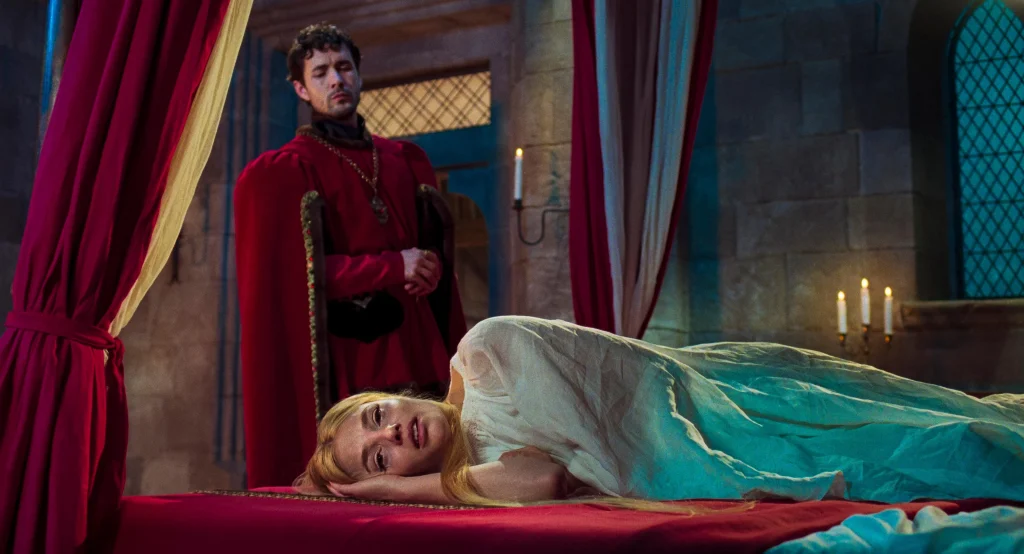
Biller understands that when it comes to this sort of subject matter, the camp of melodrama is the best way to approach it, and The Face of Horror delivers on that in spades. From the overly dramatic dialogues to the performance style, the costuming, lighting, saturation of the color palette, production design, sound design, and ADR, The Face of Horror is all camp, all the time. The sheer dedication that Biller has to the concept of The Face of Horror coming across as a film that could have been made in the 1940s or 1950s, in an era of melodrama, is the most prominent trait of the movie, and it is one of its great assets.
The film’s lush costuming is another major reason the feature feels so removed from contemporary filmmaking. The dresses, gowns, cloaks, and other period clothing are incredibly detailed, and Biller uses them as an important part of the film’s visual language. The colors practically pop off the screen. Deep reds, bright blues, and other saturated shades stand out against the darker medieval interiors, giving the movie the appearance of a Technicolor production from the Golden Age of Hollywood. Even when characters are simply standing in a room talking, the combination of the costumes, lighting, sets, and carefully arranged compositions makes the frame feel deliberately constructed.
That visual style goes far beyond simply making the movie look pretty. Biller clearly wants The Face of Horror to feel like a film that somehow survived from another era. The three-point lighting, exaggerated colors, theatrical sets, ADR, costumes, and formal performances all contribute to that illusion. There is something almost tactile about the way the colors are photographed, particularly when a brightly colored dress is placed against a more muted background. The costumes have a richness that makes the characters look like they belong to an old studio melodrama, while the medieval setting gives the imagery an unusual quality that separates it from the films Biller is emulating.
This is also where Biller’s attention to period filmmaking becomes most impressive. She isn’t simply putting actors in medieval clothing and calling it a day. Nearly every visual element has been considered, from the way the characters are lit to the colors surrounding them. The result is a movie that can look striking even during scenes where the story itself slows down. That slow pacing can become a problem, but the visual craftsmanship gives you something to appreciate during those quieter stretches.
While the film’s approach to using an older aesthetic for its source material makes it stand out, it also makes the film a bit of a chore to sit through. The story can be excruciatingly slow at times, particularly when it comes to setting up Edward’s motivations and Eleanor’s feelings towards him. There are moments when it feels as if the film is lingering on a scene too long or that it could have used more dramatic weight. The film has a fair share of emotional weight to it, but it can be buried under the heavy approach of its presentation.
Kristine Froseth, however, manages to keep the film grounded in the present, as she gradually transforms Eleanor from a naive young woman who loves her husband to someone consumed by grief and anger at his betrayal. The supernatural transformation is a good one, because the film has been building up to the point where she is transformed into a monster, and her prosthetics and performance are the culmination of everything that has happened to her up to that point. The grotesque nature of the experience feels like a part of the transformation, because she is becoming something else, and that has been hinted at throughout the entire film.
The final act of the film is where it is most reminiscent of Yotsuya Kaidan, as Eleanor’s transformation results in her becoming a supernatural entity that exacts revenge on Edward, turning the entire film into a traditional creature feature. The transformation and its resulting ugliness are a part of the transformation, in the sense that she has gone from a beautiful young woman to a monster, and Edward could no longer ignore or dismiss her. This is also the point where the film finds its strongest horror theme, as Edward spends a lot of the film trying to avoid the consequences of his actions, whether through marriage, wealth, social standing, and religion, but none of it saves him.
There is a lot to unpack in The Face of Horror, with themes of grief, loss of youth and beauty, religion, class, marriage, misogyny, and social mobility, among other things. Some of those get more attention than others, and the screenplay is occasionally inconsistent in trying to balance its melodrama with its more serious themes, but Biller’s direction is so unique that it is hard to fault the film for that. It’s a film that is very difficult to categorize, and while that doesn’t always work, it is also an aspect that makes the film memorable.
The Face of Horror won’t be for everyone, as its slow pacing can be a turnoff, and some viewers might find the over-the-top performances and dialogue distracting from the film’s message. Personally, however, I find that the film’s commitment to its concepts makes it stand out as a film that is hard to mistake for anything else. Anna Biller manages to make a film that takes its inspiration from a number of different areas, but always stays true to its own style, making it quite difficult to dismiss.
The Face of Horror had its U.S. Premiere at Fantastic Fest 2026.
Director: Anna Biller
Writer: Anna Biller
Rated: NR
Runtime: 120m
Before we let you go, we have officially launched our merch store! Check out all of our amazing apparel when you click here and type in GVN15 at checkout for a 15% discount!
For major deals and money off on Amazon, make sure to use our affiliate link! If you are purchasing any of the latest and best in physical media at MovieZyng, you can support us using our affiliate link.
The Face of Horror won’t be for everyone, as its slow pacing can be a turnoff, and some viewers might find the over-the-top performances and dialogue distracting from the film’s message.
-
GVN Rating 8.5
-
User Ratings (0 Votes)
0

Roberto Tyler Ortiz is a movie and TV enthusiast with a love for literally any film. He is a writer for LoudAndClearReviews, and when he isn’t writing for them, he’s sharing his personal reviews and thoughts on Twitter, Instagram, and Letterboxd. As a member of the Austin Film Critics Association, Roberto is always ready to chat about the latest releases, dive deep into film discussions, or discover something new.