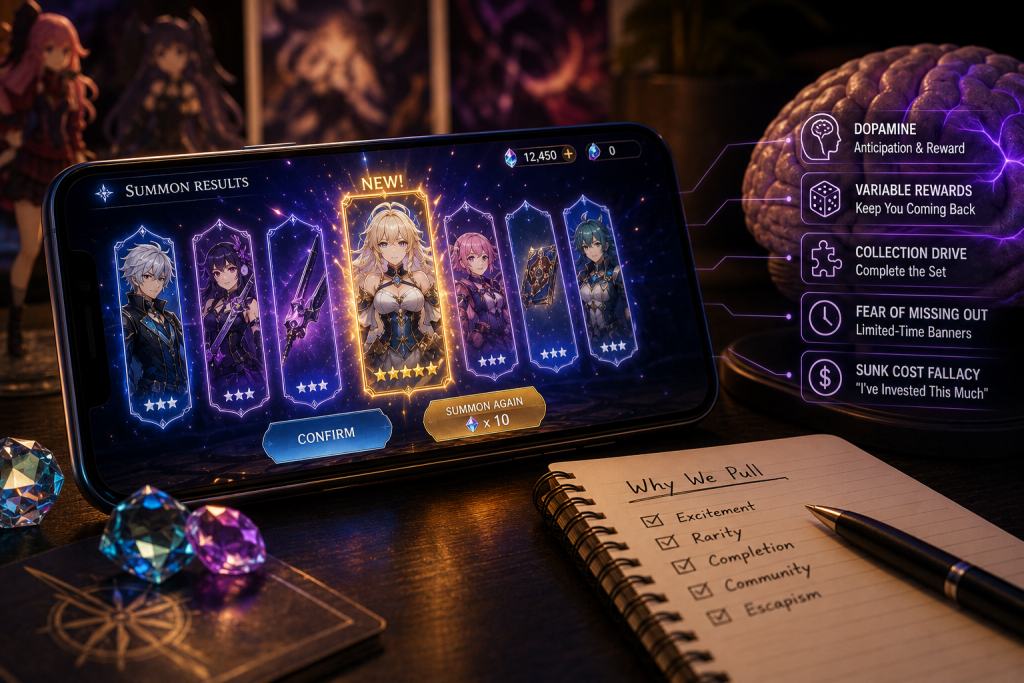
Gacha games have quietly become one of the most studied categories in behavioral economics, and Genshin Impact sits near the top of that list. Its wish system looks simple on the surface — spend a currency, pull a character — but the mechanics underneath are engineered around well-documented psychological triggers that keep players spending long after the initial excitement of a new banner fades.
The Sunk Cost Trap Built Into Every Banner
The core loop of Genshin’s gacha system runs on the sunk cost fallacy almost by design. Once a player has committed 50 or 60 pulls toward a limited banner without securing the featured character, walking away feels like forfeiting everything already spent, even though those pulls have already happened and can’t be recovered either way. This is precisely the psychological pressure point that keeps players pushing “just one more pull” past the point where it makes financial sense.
Limited-time banners amplify the effect. Because featured characters typically don’t return for months, the perceived cost of stopping isn’t just the currency already spent — it’s the fear of missing a character that may not be obtainable again soon.
How the Pity System Actually Works
Genshin’s soft pity and hard pity mechanics are often misunderstood by newer players, which makes budgeting around them harder than it should be. Soft pity begins nudging pull rates upward around pull 74 on the 5-star banner, while hard pity guarantees a 5-star by pull 90. Layered on top is the 50/50 system, where a 5-star pull has even odds of being the featured character or a standard-banner character, with a guarantee on the next 5-star if you lose that coin flip.
Calculating the real expected cost of a character means accounting for all of this — not just the sticker price of a single pull, but the statistical likelihood of needing a second 90-pull cycle if the 50/50 doesn’t land in your favor. Players who do this math upfront tend to budget far more accurately than those who simply top up as they go and hope for the best.
Budgeting Rationally Around Irrational Design
None of this means gacha spending is inherently a bad decision — it means it should be a deliberate one. Players who treat their Genshin budget the way they’d treat any entertainment expense, by setting a hard ceiling before a banner drops rather than reacting mid-pull, consistently report less buyer’s remorse regardless of pull outcome.
Part of that rational approach involves being deliberate about where the currency itself comes from. Primogems purchased directly through the in-game store carry a fixed exchange rate that doesn’t move regardless of region or timing, which makes it harder to control the real cost per pull. Players trying to stretch a fixed banner budget further often look for the cheapest genshin top up available through verified third-party channels, since even a modest discount compounds meaningfully across a 90-pull pity cycle.
A Practical Pre-Banner Checklist
For players who want to keep gacha spending inside a rational framework rather than an emotional one:
- Decide your ceiling before the banner drops — not after seeing the character splash art.
- Calculate worst-case pity cost, not best-case luck, when budgeting.
- Separate “want” from “need” — ask whether the character fills a real team gap or just looks appealing.
- Compare top-up sources before committing currency, since the cheapest genshin top up option can meaningfully lower your effective cost per pull.
- Walk away from a losing 50/50 if it pushes you past your predetermined ceiling, regardless of how close you feel to guaranteed pity.
Gacha mechanics are built to feel urgent. Budgeting against that feeling — rather than reacting to it — is what separates a hobby-level spend from one that quietly grows out of control.

Robert Griffith is a content and essay writer. He is collaborating with local magazines and newspapers. Robert is interested in topics such as marketing and history.