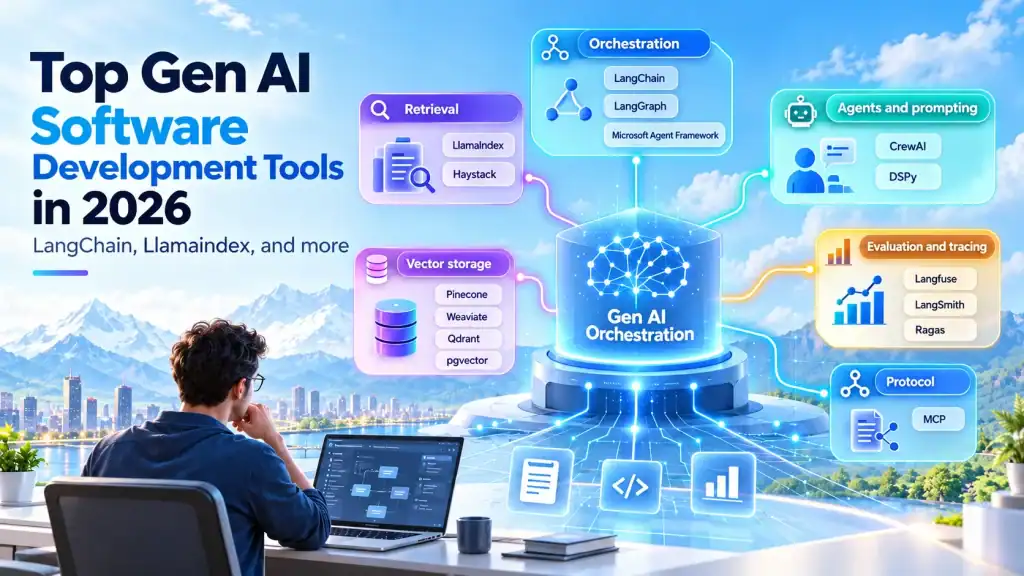
A year ago, a list like this would have put AutoGen near the top. Today its repository carries a maintenance-mode notice, and Microsoft’s advice to anyone still on it is to migrate to the new Agent Framework. That’s the trouble with choosing tools by popularity. The ground keeps moving.
LangChain and LangGraph both hit 1.0 in October 2025, with a promise of no breaking changes until 2.0. The Model Context Protocol went to the Linux Foundation two months later. If you started building in early 2025, odds are something you picked has changed shape since.
So we’ll skip the ranking. For each tool below, we’ll look at what it’s good at, where it gets annoying, and how hard it is to walk away from. That last question gets ignored far too often when teams shop for generative AI software development tooling, and it’s worth asking any vendor selling generative AI development services as well.
LangChain and LangGraph
LangChain is where most people begin, and honestly, that’s fine. It gives you the plumbing to connect a model to tools and to your own data, and the 1.0 release cleared out a lot of clutter that had built up over the years.
LangGraph is the half we’d look at twice. It runs an agent as a graph with saved state. So a job can pause while a human clicks approval, then pick up the next morning, or recover from a crash instead of starting over. Think of a refund agent that drafts a payout and waits for a manager.
Where it gets irritating is the layers. Open a LangChain app that’s misbehaving and you can lose an hour just working out what text reached the model, because a few helper classes touched it on the way. Tracing tools help (more on those below). And a graph built in LangGraph stays LangGraph-shaped. Moving it elsewhere means a rewrite.
LlamaIndex
If your project is mostly “answer questions from our documents,” start with LlamaIndex. Its whole job is ingestion: load the files, split them into chunks, build an index, query it. There’s a paid parsing service, LlamaParse, for complicated documents.
Here’s what surprises people. The query is almost never the hard part. The chunks are. Split a contract in the wrong place and no framework on earth will rescue the answer. We’d spend the first week on document quality and the second on everything else.
It does agents now too, though that’s not why we’d pick it. If you ever leave, the indexes come with you. The query code doesn’t.
Haystack
Haystack, from deepset, takes the opposite approach to LangChain. You assemble components into a pipeline and every stage stays visible. Regulated teams like that, because when an auditor asks why the system said something, you can point at the step that did it. The license is Apache 2.0.
The cost is time. New engineers take longer to get productive, and when something breaks you’ll find fewer forum threads than LangChain would give you.
Microsoft Agent Framework
Run mostly on .NET and Azure? Then this one deserves a look. It’s what you get when Semantic Kernel and AutoGen merge, it’s MIT-licensed, and it reached release candidate in February 2026.
Already built on AutoGen? Don’t wait. Microsoft has migration guides, and each month you sit still is another month of code written against a project that won’t get new features. One more thing: the framework leans on Azure. Fine if that’s home for you. Awkward if it isn’t.
CrewAI and DSPy
CrewAI is the fun one. Each agent gets a role, say a researcher and a reviewer, and the work passes between them. It demos beautifully. In production, every extra agent is another model call on your bill and another place for something to go wrong, so we’d start with one agent and add roles only when it clearly helps.
DSPy is a different animal. You write down the task and a way to score it, and DSPy tries prompt variations until the score climbs. That’s great if you’ve got a pile of prompts and a decent test set. If you’ve got neither, skip it for now.
Vector Databases
Embeddings need a home. Pinecone is hosted, so there are no servers to run. Weaviate and Qdrant are open source and self-hostable. And pgvector is an extension that turns PostgreSQL into a vector store.
Already running Postgres? Try pgvector first. It won’t win any awards for excitement. Dedicated vector stores earn their keep later, once you’ve got real volume and real latency complaints from real users.
Evaluation and Tracing
This is where most projects quietly go wrong, because nobody checks the answers. Generative systems don’t crash when they’re wrong. They answer confidently.
Langfuse and LangSmith record every step of a request, so you can see whether retrieval or generation caused the bad answer. Ragas scores things like faithfulness and context precision. Langfuse can run on your own servers. LangSmith is the quickest way in if you’re on LangChain already. One comparison we read ranks it as the highest lock-in risk of the tools it covered, which is worth knowing before you build a dozen dashboards around it.
Then do the dull thing that matters most: keep a test list. Twenty or so real questions, each with an answer you’d accept, rerun after every change. Tracing that speaks OpenTelemetry makes swapping vendors painless.
Model Context Protocol
MCP is a standard way for agents to call tools and read data. Anthropic donated it to the Linux Foundation’s Agentic AI Foundation in December 2025, with Block and OpenAI as co-founders, and reported more than 10,000 public MCP servers at the time.
Wrap an internal system as an MCP server once, and the agents you build next year can use it too. How well each framework supports MCP varies, so try yours on something small first.
Where Teams Trip Up
Most generative AI software development mistakes happen before anyone writes real code. Four stand out.
Reaching for a framework too early. If the feature summarizes a support ticket, that’s one prompt and one model call, maybe twenty lines of plain code. A framework there is something extra to maintain, with nothing gained.
Mistaking the demo for the project. A prototype that handles five hand-picked questions says nothing about question six. Question six hundred is where real users live.
Obsessing over the vector database. A week goes into comparing storage options, and nobody has read a single chunk of the company’s actual documents yet. Read the documents first.
Skipping the test set. Everyone plans to write one “after launch.” Then a wrong answer reaches a customer, and suddenly an afternoon of writing twenty questions looks cheap.
How Hard Is It to Leave?
|
Layer |
Examples |
Leaving later |
|---|---|---|
|
Orchestration |
LangChain, LangGraph, Microsoft Agent Framework |
Hard |
|
Retrieval framework |
LlamaIndex, Haystack |
Medium |
|
Agents and prompts |
CrewAI, DSPy |
Fairly easy |
|
Vector storage |
Pinecone, Weaviate, Qdrant, pgvector |
Medium |
|
Evaluation |
Langfuse, LangSmith, Ragas |
Easy with open standards |
|
Protocol |
MCP |
Easy |
Matching Tools to the Job
Take two real-world jobs. The first is an internal assistant that answers HR questions from policy PDFs. It’s mostly retrieval, so LlamaIndex or Haystack fits, with pgvector living inside the Postgres database you already have, Langfuse watching the traces, and a spreadsheet of test questions that somebody reruns every Friday.
The second is an agent that books travel and has to wait for a manager’s sign-off. That one belongs in LangGraph. The agent has to pause for an approval that might not arrive until tomorrow, then pick up exactly where it left off.
In both cases we’d do the same small thing in the code. One function, something like ask_assistant(question), that the rest of the app calls. The framework hides behind it. Swap the framework later and you edit that function and little else.
Where Generative AI Development Services Fit
Tools are the easy bit. What actually eats the calendar is everything around them: messy source data and awkward connections into the systems you already run, plus the testing nobody budgeted for. That’s where generative AI development services earn their money.
BiztechCS, which delivers GenAI Solutions and AI/ML Development for mid-market businesses, tends to begin with the workflow and the data and leave the framework for last. Frameworks change on their own schedule. Your workflow doesn’t.
So before any generative AI software development project gets going, name one workflow and one number you’ll track. Then, as each tool goes in, scribble a line on how you’d remove it.