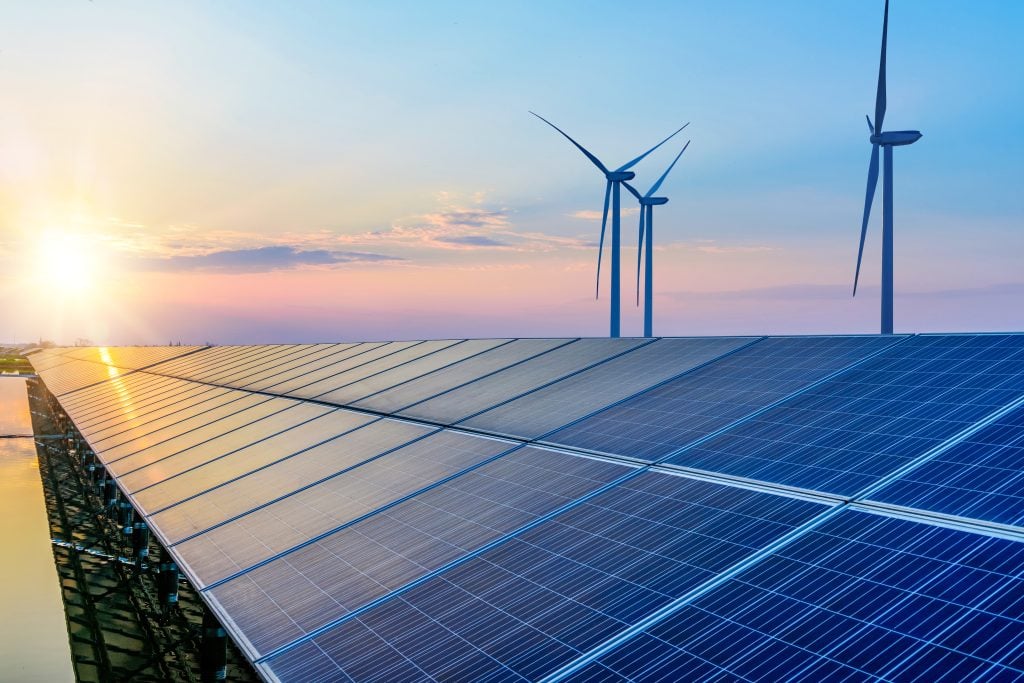
The U.S. utility-scale PV market is shifting from intermittent generation to dispatchable power. Standalone solar or storage no longer meets modern grid demands, making integrated “inverter + storage + system” solutions the prevailing industry trend.
These systems improve energy flexibility, stabilize grid interaction, and simplify large-scale project execution while supporting evolving market requirements for reliability and ancillary grid services.
This article first examines critical U.S. market requirements, then analyzes leading integrated solution providers operating in this regulatory environment.
U.S. Market Compliance & Project Requirements
1. IRA Incentives and Domestic Content Considerations
The Inflation Reduction Act (IRA)[1] continues to influence utility-scale renewable investment strategies in the U.S. Projects meeting domestic content requirements may qualify for additional ITC incentives, increasing pressure on developers to evaluate battery sourcing, inverter manufacturing, and supply-chain compliance during procurement and EPC planning. Integrated system providers can simplify documentation, traceability, and long-term procurement coordination.
2. UL 9540 and UL 9540A[2][3]
UL 9540 is the primary system-level safety certification for battery energy storage systems(BESS) in North America, while UL 9540A is the fire propagation test method used to evaluate thermal runaway behavior. These standards are increasingly required for permitting, AHJ approval, and insurance acceptance. Integrated liquid-cooled ESS platforms can also improve thermal consistency and reduce commissioning uncertainty.
3. Grid Interconnection Challenges and Integrated Solutions[4][5]
Grid interconnection queues remain a major challenge across U.S. ISO and RTO markets as renewable deployment accelerates. Utilities increasingly require advanced inverter functions such as fault ride-through, voltage regulation, and grid-forming support before project approval. Integrated solar-storage systems with unified controls can simplify commissioning, improve compatibility, and help developers meet evolving grid requirements more efficiently.
Why Integrated “Solar + Storage” Systems Are Becoming Essential
-
Lower LCOS and Simplified Project Delivery
Integrated solar-plus-storage systems provide operational and financial advantages compared with independently engineered PV and storage assets.
From a cost perspective, tighter integration can reduce wiring complexity, decrease auxiliary power consumption, optimize footprint utilization, and improve round-trip efficiency. These factors drive a lower LCOS and more predictable long-term operational expenditure.
For EPC contractors, standardized integrated platforms may also reduce field labor requirements, commissioning time, and cross-vendor troubleshooting. This becomes particularly important in large urban charging and microgrid projects where deployment schedules are tightly constrained.
-
Core Technologies
- DC Coupling vs. AC Coupling
DC-coupled architectures typically deliver higher conversion efficiency because solar generation can charge batteries directly before DC-to-AC inversion. These systems are often preferred in new-build utility-scale projects seeking maximum energy yield and reduced conversion losses.
AC-coupled systems, however, provide greater retrofit flexibility and simplify integration with existing PV infrastructure. They are commonly selected when developers expand operational solar plants with additional storage capacity.
The optimal choice depends on project scale, existing infrastructure, operational strategy, and interconnection constraints.
- Liquid Cooling and Thermal Stability
Thermal management has become a defining factor in modern high-density battery energy storage systems.
Air-cooled designs may experience reduced efficiency and accelerated component degradation under high ambient temperatures.
Liquid-cooled systems improve temperature uniformity across battery cells and PCS components, helping stabilize performance during sustained cycling operations.
Advanced thermal management systems can also reduce auxiliary energy consumption, improving overall system efficiency and lifecycle economics.
- Grid-Forming Inverters and Grid Stability
Grid-forming technology is increasingly viewed as a critical capability for future renewable-dominant power systems. Unlike conventional grid-following inverters, grid-forming inverters actively establish voltage and frequency references, enabling renewable assets to support weak grids and operate during instability events.
This technology is particularly important in utility-scale storage projects participating in ancillary service markets and grid reliability programs.
Leading U.S. Solution Providers
Sungrow
(1) Product Excellence
Sungrow’s PowerTitan 3.0 series is designed for utility-scale energy storage applications, integrating battery storage, PCS, and thermal management into a factory-integrated solution optimized for large-scale deployment.
The series incorporates silicon carbide (SiC)-based PCS technology with up to 99.3% peak efficiency, and achieves a system round-trip efficiency (RTE) of up to 93.6% for a 4-hour duration.
(2) Fire Safety
Sungrow integrates multi-layer safety protection across its utility-scale energy storage products, including cell-level thermal runaway isolation, intelligent monitoring, and active fire suppression mechanisms.
Its energy storage systems are designed to comply with UL 9540A testing requirements, supporting U.S. permitting, fire safety compliance, and large-scale project deployment.
The company’s liquid-cooled system architecture also helps improve thermal stability and reduce operational risks under high-load operating conditions.
(3) Cybersecurity
Sungrow reports that its Information Security Management System (ISMS) is certified under ISO/IEC 27001 and aligned with IEC 62443-4-1 secure development lifecycle requirements.
The company also deploys an end-to-end “device-network-platform” cybersecurity architecture.
Additional measures include a dedicated Product Security Incident Response Team (PSIRT), a Bug Bounty Program, and localized data deployment options intended to support regional regulatory compliance requirements.
(4) Bankability
According to BloombergNEF’s 2024 Energy Storage System Cost Survey, Sungrow ranked the No.1 most bankable company for both Energy Storage Systems and PCS globally.
The company was also ranked the No.1 most bankable inverter brand globally for the fifth time in BloombergNEF’s 2024 PV Module & Inverter Bankability Survey.
Tesla Energy
Tesla maintains strong market visibility through its Megapack platform and Autobidder software ecosystem.
Its vertically integrated architecture provides tight hardware-software coordination and strong operational consistency. However, the closed ecosystem structure may offer less flexibility for long-term third-party hardware upgrades, interoperability, or independent maintenance strategies.
Fluence Energy and GE Vernova
Fluence and GE Vernova both maintain extensive global utility-scale deployment experience and flexible project configurations.
As third-party system integrators, their solutions typically combine components from multiple manufacturers. While this allows customization flexibility, final performance often depends on successful cross-vendor coordination and commissioning. Advanced functions such as grid-forming may require extensive interoperability validation across multiple hardware and software platforms.
SMA America and Ingeteam
SMA America and Ingeteam have long-established positions within the U.S. inverter market.
Their systems commonly rely on split-system architectures where PCS and battery equipment are supplied separately. Although technically mature, this approach may increase onsite wiring complexity, cross-platform debugging requirements, and EPC coordination costs, particularly for projects implementing advanced grid-forming capabilities.
Conclusion
The U.S. utility-scale renewable market is increasingly shifting toward integrated solar-storage infrastructure capable of delivering dispatchable, grid-supportive power.
For developers seeking lower LCOS, streamlined EPC execution, and stronger long-term bankability, integrated solutions from Sungrow represent a practical pathway for future utility-scale energy deployment.
Reference
- Available at: https://www.congress.gov/crs-product/R48358
- Available at: https://www.ul.com/services/ul-9540a-test-method
- Available at: https://www.mayfield.energy/technical-articles/ul-9540-and-9540a-explained/
- Available at: https://emp.lbl.gov/publications/queued-2024-edition-characteristics
- Available at:
https://www.cfr.org/articles/us-interconnection-challenge-why-renewables-are-stuck-line

Caroline is doing her graduation in IT from the University of South California but keens to work as a freelance blogger. She loves to write on the latest information about IoT, technology, and business. She has innovative ideas and shares her experience with her readers.
![‘Diamond’ Review – A Cinematic Love Letter To Authentic Detective Storytelling [Cannes 2026]](https://cdn.geekvibesnation.com/wp-media-folder-geek-vibes-nation/wp-content/uploads/2026/05/Diamond-450x253.jpg "‘Diamond’ Review – A Cinematic Love Letter To Authentic Detective Storytelling [Cannes 2026]")