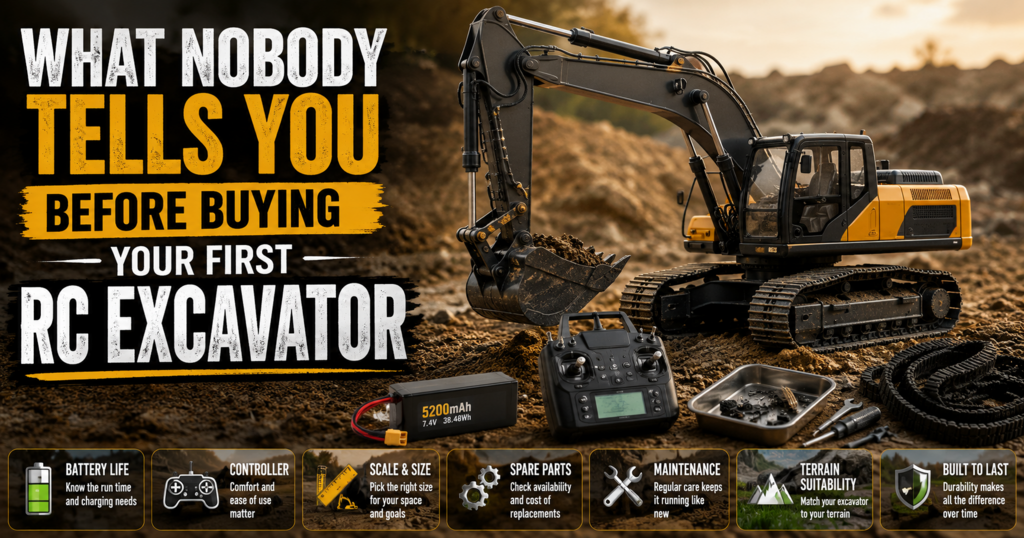
There’s a reason excavators are the gateway drug of the RC construction hobby. Not trucks, not bulldozers, not cranes , excavators. Something about the articulated boom, the rotating cab, and the satisfying curl of a bucket scooping real dirt hits differently than any other RC vehicle category. It combines the precision of a skilled operator with the tactile satisfaction of actually moving earth, and once you’ve experienced it, driving an RC car in circles feels a little flat by comparison.
But here’s the problem. The market for RC excavators has exploded in the last few years, and the range of quality, price, and capability is enormous. A first-time buyer faces a bewildering spread , from $30 plastic toys to $2,000 full-metal hydraulic machines , with very little honest guidance on what actually matters and what’s just spec sheet noise.
So before you spend a dollar, here’s what I wish someone had told me when I started.
Why Excavators? Why Now?
The RC world is massive. Cars, trucks, planes, drones, boats — the options are endless. So why are so many people gravitating toward construction equipment?
Part of it is the skill element. Driving an RC car fast is fun, but the learning curve flattens quickly. Operating an excavator demands coordination across six or more channels simultaneously. It’s a challenge that keeps rewarding practice for months and years.
Part of it is the creative dimension. You’re not just driving a vehicle around a track. You’re building job sites, moving material, and solving miniature engineering problems with your hands and a transmitter.
And part of it is simply the satisfaction of mechanical authenticity. A well-built RC excavator works like the real thing, and that resonates with adults who appreciate engineering.
The Gap Between Toy-Grade and Hobby-Grade Is Wider Than You Think
This is the single most important distinction, and it trips up nearly every newcomer.
A toy-grade RC excavator is designed to be unboxed, switched on, and driven around a living room floor. It uses small electric motors or basic actuators to move the boom and bucket, typically runs on AA batteries or a small rechargeable pack, and operates on a simple infrared or low-frequency radio signal. The tracks usually spin but don’t grip much. The bucket opens and closes but can’t dig anything firmer than dry sand. For a kid under ten, it’s perfect. For anyone expecting mechanical substance, the novelty wears off in about forty-five minutes.
Hobby-grade machines occupy entirely different territory. You’re looking at proportional control across every function , boom, arm, bucket, swing, and independent track drives , meaning the speed and range of each movement responds to how far you push the stick. The construction shifts from plastic shells to metal frames, metal booms, and in many cases full-metal tracks with individual links. Radio systems operate on 2.4GHz with reliable range and zero interference. Motors deliver real torque. The machines have weight to them, and that weight translates directly into digging capability.
The price jump between these categories feels steep until you understand what you’re getting. A good hobby-grade remote control excavator isn’t just a better toy. It’s a different product category entirely , closer to a functional scale machine than anything you’d find in a toy aisle.
What to Look For: The Specs That Actually Matter
Marketing copy for RC excavators loves to throw around numbers that sound impressive but tell you very little about real-world performance. Here’s what to focus on instead.
Build Material
This is your first filter. Plastic booms and arms flex under load, which means the machine struggles to dig anything compacted and feels flimsy during operation. Metal booms , typically aluminum alloy or steel , handle load without deflection. They also add mass low in the machine, which improves stability during digging and swing operations. If the boom, arm, and bucket aren’t metal, you’re going to hit a performance ceiling very quickly.
The cab and upper frame matter less structurally, but a metal upper adds realistic heft and keeps the center of gravity where it belongs. Full-metal machines feel completely different in your hands. You pick one up and immediately understand where the money went.
Drive System
Track drive is where cheap models cut the most corners. Low-end machines use a single motor driving both tracks through a simple gearbox, which means you can go forward, backward, and sort of turn. Hobby-grade excavators run independent motors for left and right tracks, giving you true skid-steer capability , spin on the spot, make gradual arcs, counter-rotate for tight maneuvering. On a job site course with obstacles, ramps, and narrow paths, independent track drive changes everything.
Hydraulic vs. Electric Actuators
This is the fork in the road that defines your experience.
Electric actuator models use small motors or servos to move the boom, arm, and bucket. They’re simpler, require less maintenance, and cost less. For a first machine, they’re perfectly capable and far less intimidating to set up and run. Most hobbyists start here, and plenty never feel the need to move beyond it.
Hydraulic models run miniature hydraulic systems , pump, valves, cylinders, oil reservoir , that operate on the same principles as full-size construction equipment. The movement is smoother, more proportional, and carries a mechanical authenticity that electric systems can’t replicate. But they’re more expensive, heavier, and require maintenance: fluid changes, bleeding air from lines, inspecting seals. They’re a commitment, and they reward that commitment generously.
If you’re unsure, start electric. You can always move to hydraulic later once you know this hobby has its hooks in you. And it probably will.
Radio System and Channel Count
Channel count tells you how many independent functions you can control simultaneously. A basic excavator needs a minimum of six channels: left track, right track, boom, arm, bucket, and cab swing. More advanced models add proportional throttle, auxiliary hydraulics for attachments like thumbs or breakers, light controls, and sound system triggers.
More channels means more simultaneous control, which matters when you’re trying to swing and curl the bucket while repositioning the boom , the kind of coordinated movement that separates a smooth operator from someone who looks like they’re fighting the machine. Look for at least a six-channel system with proportional sticks on the transmitter, not digital switches.
The Learning Curve Is Real (And That’s the Point)
Nobody picks up an RC excavator and operates it smoothly on day one. The coordination required to manage boom, arm, bucket, swing, and tracks simultaneously is genuinely challenging, and that challenge is a massive part of what makes the hobby sticky.
Real excavator operators spend hundreds of hours developing muscle memory for coordinated boom-and-stick movements. The RC version compresses that learning curve, but it doesn’t eliminate it. Your first sessions will involve a lot of awkward stabbing at controls, buckets swinging wildly past their target, and tracks spinning when you meant to swing the cab. Everyone goes through it.
The breakthrough comes gradually. After a few weekends of practice, movements start chaining together. You’ll swing to a dig point, drop the boom, curl the bucket, and load in one fluid sequence without consciously thinking about each input. That feeling , smooth, coordinated operation that mirrors what a real operator does on a full-size machine , is addictive in a way that’s hard to explain until you experience it.
This is also why the hobby retains people. There’s no skill ceiling. You can always get smoother, faster, more precise. Hobbyists who’ve been running excavators for years still find room to refine their technique, and watching a skilled operator work a high-quality rc excavator through a complex dig sequence is genuinely impressive , the machine becomes an extension of their hands.
Building a Dig Site: Where the Hobby Gets Creative
Operating the machine is only half the equation for most enthusiasts. The other half is building the environment.
Dedicated hobbyists construct elaborate miniature job sites in their yards, garages, or dedicated outdoor spaces. Graded haul roads, retention walls built from miniature concrete blocks, trenching runs, loading zones with dump trucks waiting for material , the creativity involved rivals model railroading in its scope and attention to detail.
Materials are usually simple. Decomposed granite or fine crushed rock makes excellent scale-appropriate fill material. Sand works for loose-soil scenarios. Small landscaping stones become boulders. PVC pipe sections become culverts. The job site evolves over time as you add features, and every new element creates a new operating challenge.
Some hobbyists run timed challenges , load a dump truck in under sixty seconds, trench a two-meter line to a specific depth, grade a road section flat within tolerance. Others focus on scale realism, operating at a pace that looks correct for the scale, as if the model were being filmed for a documentary. Both approaches are valid, and most people eventually dabble in each.
Common First-Timer Mistakes Worth Avoiding
A few pitfalls come up repeatedly in the community, and dodging them early saves frustration.
Buying the cheapest option to “test the waters” usually backfires. The experience on a $30 toy is so far removed from the real hobby that it gives you no useful information about whether you’d enjoy a proper machine. You’re better off saving for a mid-range hobby-grade model that actually represents what the hobby offers.
Ignoring battery quality is another common mistake. The stock battery in many models is adequate but unremarkable. Upgrading to a higher-capacity pack extends your runtime significantly and often improves motor performance. It’s one of the best dollar-for-dollar upgrades you can make early on.
Skipping maintenance catches up with everyone eventually. Even electric-actuator models need periodic attention , gear lubrication, track tension adjustment, electrical connector inspection, motor brush replacement on brushed systems. Hydraulic models demand more, but every machine runs better and lasts longer with basic upkeep. Build it into your routine from the start.
Is It Worth Getting Into?
Unambiguously, yes , but with the right expectations.
This isn’t a hobby you passively consume. It demands hands-on engagement, patience during the learning curve, and a willingness to maintain your equipment. The machines aren’t cheap, and the good ones aren’t simple. You’ll spend time building, adjusting, troubleshooting, and practicing before everything clicks.
But when it does click , when you’re running a well-tuned excavator through a dig sequence you built yourself, moving earth with precision and smoothness, hearing the tracks grind and the motor load up under a full bucket , the satisfaction runs deep. It’s mechanical, it’s tactile, it’s skill-based, and it connects you to a community of people who find the same unlikely joy in making miniature machines do real work.
Start with a solid hobby-grade machine, give yourself time to learn, and don’t be afraid to ask questions in the community forums. Every experienced operator you see online started exactly where you are now, fumbling with the sticks and wondering why the bucket keeps missing the pile.
It gets better. It gets a lot better.

Matthew is a Sr. Content Writer working as a freelancer in Outreachmonks for the past 5 years. He has completed his education in Bachelor’s in Business Administration. With his articles he loves to impart information about the latest business trends and models.