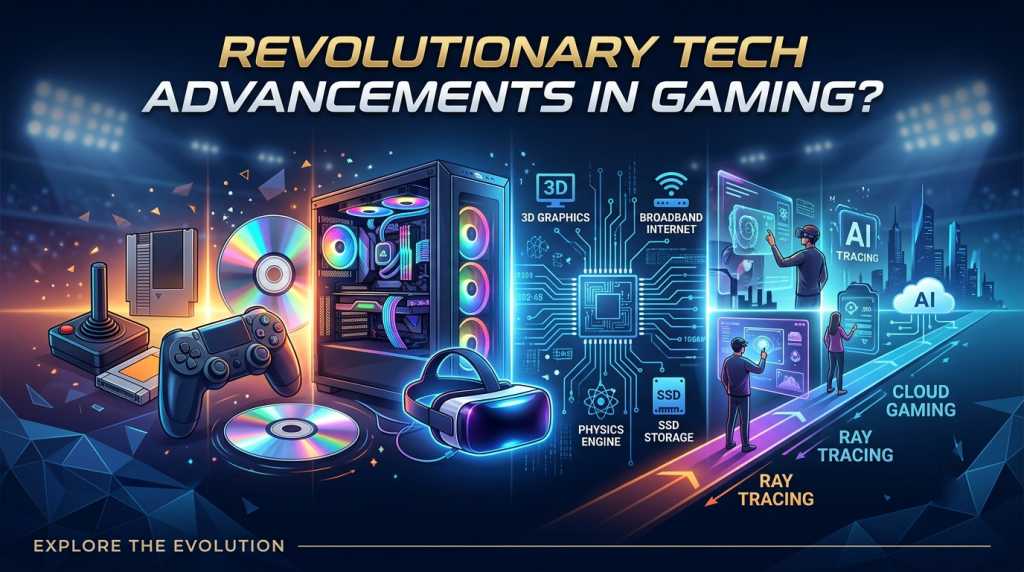
Gaming technology has moved far beyond better graphics and faster processors. Every major breakthrough has changed the way games are created, played, and delivered across different devices. Some advances raised visual quality, while others removed hardware limits or made online play far more reliable. New technology has even opened opportunities outside traditional video games, with real-time streaming and cloud infrastructure now supporting several forms of digital entertainment.
The market reflects that steady progress. As developers continue to adopt new tools and platforms, investment across the industry keeps growing.
Cloud Gaming and Game Streaming
Cloud gaming removed one of the biggest barriers in modern gaming. Instead of relying on powerful local hardware, the game runs on remote servers while the video streams directly to the player’s device. That means players can access demanding titles on smartphones, tablets, smart TVs, and entry-level laptops without investing in expensive components. Services such as Xbox Cloud Gaming and PlayStation Plus helped move this technology into the mainstream, while faster internet speeds and lower latency made game streaming a realistic option for everyday use.
The same streaming technology soon found a place outside traditional video games. As cloud infrastructure and real-time video became more reliable, the iGaming sector began to adopt similar systems for live content. Studio productions replaced standard digital interfaces with real dealers, multiple camera angles, professional broadcasts, and direct interaction through live video feeds. This change supported a wider range of formats, from live roulette and blackjack to baccarat and interactive game shows that run in real time.
Today, casino game shows in the UK sit alongside live roulette and other live casino formats that rely on the same streaming technology to deliver high-quality real-time broadcasts across connected devices.
High-Fidelity Graphics
Visual quality has reached a level that once seemed impossible. Modern graphics technology gives developers the freedom to build highly detailed worlds with realistic lighting, lifelike character models, and environments that respond naturally to changing conditions.
Higher polygon counts, advanced rendering techniques, and improved texture quality all work together to create scenes that feel consistent from beginning to end. Every new hardware generation gives studios more room to push visual standards even further without sacrificing overall performance.
Few games show this progress better than Cyberpunk 2077 and The Last of Us Part II. Both titles use detailed facial animation, cinematic lighting, realistic environments, and smooth character movement to create worlds that feel believable. Small visual details, from changing weather to natural reflections and detailed interiors, add another level of realism without distracting from gameplay.
Virtual Reality
Virtual reality changed the way people interact with games by placing them inside the action instead of in front of a screen. Headsets now track movement with far greater accuracy than early systems, while motion controllers create direct interaction with objects and environments. Better display quality and lower latency have made gameplay much smoother, which has helped VR become more practical across a wider range of titles.
Half-Life: Alyx showed what modern virtual reality could achieve when hardware and software worked together. Players could move through detailed environments, interact with objects naturally, and solve challenges through physical actions rather than traditional controls.
The game set a new benchmark for VR design and proved that virtual reality could support full-scale productions instead of short technical demonstrations. Since then, developers have continued to improve comfort, tracking, and visual quality, which has strengthened VR’s place within the gaming industry.
Advanced Game Engines
Every modern game begins with an engine, and those engines have become far more capable than they were only a few years ago. Developers now have access to complete production tools that manage graphics, animation, lighting, physics, sound, and networking inside a single platform. This saves valuable development time and allows studios to release games across several systems with far fewer technical obstacles.
Unreal Engine 5 raised expectations with features such as Nanite and Lumen, both of which changed how developers build detailed environments and realistic lighting. Games such as Fortnite and Senua’s Saga: Hellblade II show those improvements in action. Rich environments, natural shadows, and detailed assets no longer require the same amount of manual work as before.
Smaller studios benefit just as much because many of these professional tools are now widely available. As game engines continue to improve, developers can spend less time solving technical problems and more time refining gameplay, world design, and storytelling.
Gaming Innovation by the Numbers
The gaming industry continues to grow at a remarkable pace, and the numbers show just how much the market has expanded over the last few years. Global revenue was expected to rise from $262 billion to $312 billion, which reflected strong demand for new games, digital services, and online platforms. Developers have continued to invest in larger productions as audiences spend more time across console, PC, and mobile ecosystems.
Earlier industry reports estimated that game applications generated more than $180.3 billion, with revenue rising by 4.4% despite a slower release schedule during the pandemic. Once development returned to normal, forecasts pointed toward industry revenue climbing beyond $198 billion by 2027.
Mobile gaming is expected to remain the largest contributor with more than $95 billion, followed by $61 billion from console gaming and roughly $39 billion from PC gaming. Those figures show that new technology does more than improve games. It continues to shape where the industry invests, how studios develop future titles, and what players expect from every new release.