Introduction
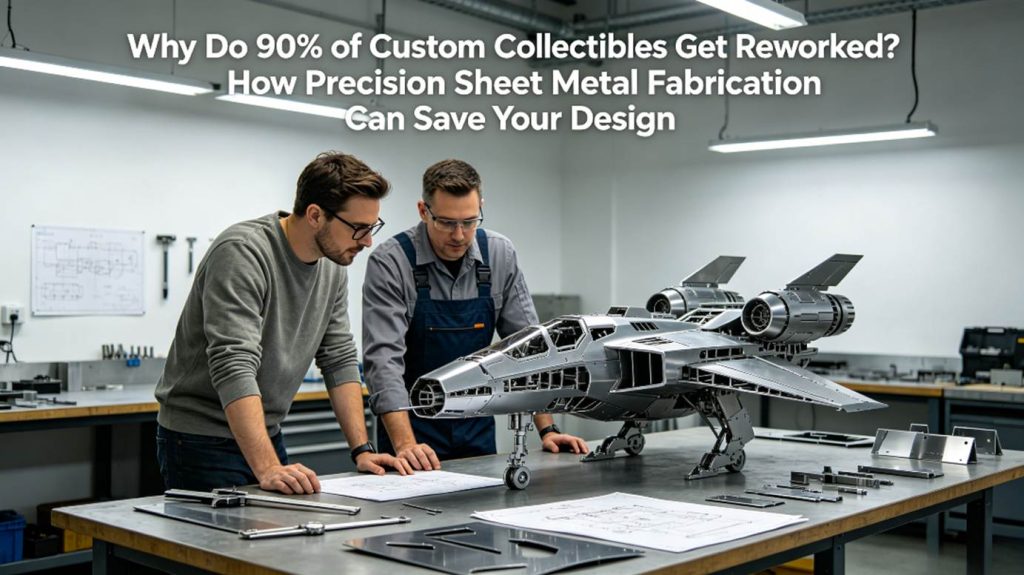
For designers and enthusiasts pursuing ultimate details in custom collectibles, transforming bold concepts into physical models often involves high trial-and-error costs and long waiting periods. Whether it’s a complex mecha shell, a sci-fi vehicle frame, or an elaborate scene diorama, the final product frequently suffers from welding distortion, dimensional deviations, or surface imperfections, leading to extensive rework or project abandonment.
The root cause is that traditional general-purpose manufacturing services lack a deep understanding of the high aesthetic and precision requirements of collectibles. Designers focus on creative vision but often overlook critical engineering factors such as material properties, process limitations, and assembly logic. This gap between design and manufacturing plants the seeds of failure early in the prototyping stage. This article explores a precision manufacturing philosophy originating from aerospace and medical devices — precision sheet metal fabrication — and reveals how it systematically solves quality and cost challenges in custom collectible development through engineered design, rigorous process control, and proactive manufacturability analysis.
Why Is Material Selection the First Step in Determining the Quality and Longevity of Custom Collectibles?
Material selection has a decisive impact on the final appearance and durability of collectibles. Common misconceptions — choosing materials based solely on appearance or price while ignoring formability, corrosion resistance, and finishing compatibility — lead to costly rework and compromised quality.
1. The Common Pitfall of Aesthetic-Only Material Selection
Many designers select materials based on visual appeal or cost, without considering how the material behaves during forming or how it interacts with surface finishes. For example, a material with poor bend ductility may crack when folded into a sharp angle, ruining an otherwise perfect part. A material incompatible with the desired powder coating may result in poor adhesion and premature peeling. This oversight is a primary reason why custom collectibles require rework. Professional custom sheet metal fabrication services begin with a thorough material analysis, matching the alloy to both the design intent and the manufacturing process.
2. Comparative Material Properties for Collectible Applications
Each metal offers distinct advantages. Stainless steel (304 or 316L) provides excellent corrosion resistance and a premium metallic luster, ideal for high-end statue armatures or weapon accessories. Aluminum (5052 or 6061) is lightweight and easily formed, making it suitable for large spaceship model frames or articulated joints. Cold-rolled steel offers high strength at lower cost, perfect for load-bearing bases or internal structures. A sheet metal fabrication services provider with material science expertise guides designers toward the optimal choice, balancing aesthetics, performance, and budget.
3. DFM Feedback as a Material Optimization Tool
During the Design for Manufacturing (DFM) review, engineers assess the chosen material against the part geometry. They may recommend adjusting the bend radius to prevent cracking in aluminum, or selecting a different temper of stainless steel to improve formability. This early intervention ensures that the material not only looks right but also survives the fabrication process intact. This collaborative approach is the essence of custom metal fabrication services that deliver cost-effective, high-quality results.
How Can Precision Manufacturing Techniques Ensure Millimeter-Perfect Fit for Collectible Components?
Assembly fit is the most visible quality metric for collectibles. Gaps, misaligned holes, and uneven seams destroy the illusion of a cohesive, high-end product. Precision manufacturing techniques eliminate these defects through systematic process control.
- The Pain Point of Traditional Tolerance Management: A meticulously designed mecha model arrives at assembly only to find that the arm joint holes do not align, or the backpack thruster leaves a visible gap. This is the classic symptom of uncontrolled tolerance accumulation. Traditional fabrication relies on nominal material thickness and assumes perfect bends, ignoring real-world variations. The result is parts that theoretically fit in CAD but fail in practice. Achieving precision sheet metal fabrication requires abandoning these assumptions.
- Dynamic Compensation for Real-World Material Variation: LS treats material thickness as a variable, not a constant. Actual gauge data from each material batch is logged into the Manufacturing Execution System (MES). The CNC press brake programming uses this measured thickness — rather than a theoretical value — to compute the exact bend deduction. This dynamic compensation ensures that every bend lands at the correct position, regardless of normal material variation. This is the foundation of reliable Custom Enclosures and structural components.
- Closed-Loop Correction with Laser Scanning and SPC: After bending, a laser scanner measures the achieved angle. If springback has caused deviation, the system automatically calculates the required crowning correction for the next part. This closed-loop feedback eliminates drift. For production runs, Statistical Process Control (SPC) monitors critical dimensions on control charts, enabling proactive adjustments before any part goes out of spec. This ensures that the hundredth custom sheet metal parts is identical to the first. This level of control is what defines true high-precision sheet metal parts and guarantees flawless assembly.
How Can You Control Total Cost of Ownership While Pursuing Ultimate Quality?
The belief that high quality inevitably means high cost is a fallacy. When evaluated through the lens of Total Cost of Ownership (TCO), precision manufacturing often proves more economical by eliminating the hidden costs of rework, scrap, and delays.
1. The Hidden Cost of Rework and Scrap
Many collectible projects fail not because the initial quote was too high, but because endless rounds of modification, scrapped parts, and schedule extensions inflate the final bill. A part that costs 50tomakebuthasa4083 per good part when factoring in waste. This is the reality of uncontrolled processes. cost effective sheet metal fabrication is not about the lowest unit price — it is about the highest first-pass yield.
2. Proactive DFM as a Cost-Control Lever
The most powerful cost-control tool is applied before any metal is cut. A thorough DFM review identifies features that are unnecessarily expensive to produce. For example, a complex multi-bend part might be simplified into two simpler parts joined by a weld, reducing scrap risk and tooling cost. Although this adds an assembly step, the overall cost is lower because the yield is near 100%. This engineering-first approach is the hallmark of quality sheet metal fabrication.
3. Integrated Supply Chain Eliminates Coordination Waste
A single-source sheet metal fabrication company manages design review, prototyping, production, finishing, and inspection under one roof. This eliminates the communication gaps, responsibility disputes, and schedule dependencies of fragmented supply chains. A case study illustrates the point: a complex base requiring custom steel sheet metal fabrication was projected to have a 40% scrap rate. Through DFM optimization and closed-loop process control, the actual scrap rate was 0%, and the total project cost was reduced by 22%. This demonstrates that true cost-effective fabrication comes from systemic efficiency, not corner-cutting.
Why Is Professional Surface Finishing the Key to Transforming Parts into Art?
Raw metal parts, fresh from fabrication, carry burrs, oils, and machining marks that are far from display-ready. Surface finishing is the alchemy that transforms functional components into visually stunning artifacts worthy of a collector’s shelf.
1. The Gap Between Fabricated and Finished
A laser-cut and bent aluminum panel has sharp edges, a dull surface, and residual lubricant. It looks industrial, not artistic. The finishing process removes these imperfections and imparts the desired visual and tactile qualities. Choosing the right finish is as important as choosing the right material. custom metal fabrication services that include finishing expertise can guide designers through the options.
2. Finishing Options for Collectible Applications
Powder coating offers unlimited color options with durable, chip-resistant surfaces, available in gloss, matte, or textured finishes — ideal for mecha armor or diorama bases. Anodizing creates a hard, wear-resistant oxide layer on aluminum, available in vibrant colors, perfect for sci-fi control panels or decorative trim. Brushing and polishing produce distinctive metallic lusters, from satin to mirror, suitable for premium audio equipment knobs or vehicle chrome accents. Each process imparts a different character to the custom collectibles.
3. Engineering Guidance for Optimal Finish Selection
A knowledgeable partner does not just apply finishes; they advise on which finish best achieves the design intent within budget. For a movie-prop replica requiring weathered authenticity, a multi-layer paint system with deliberate distressing might be recommended. For a minimalist modern sculpture, a brushed and clear-coated aluminum surface might be ideal. The combination of precision sheet metal fabrication and artistic finishing transforms cold metal into a warm, expressive medium.
How to Evaluate Whether a Sheet Metal Fabrication Partner Is Worthy of Your Collectible Project?
Selecting the right partner requires more than comparing prices and checking certification boxes. The true test is the supplier’s systemic ability to solve problems, communicate transparently, and deliver consistent quality.
1. Go Beyond the Certificate: Examine the Quality System in Action
Request copies of ISO 9001 certification, but also ask for Closed-Loop Corrective Action (CLCA) reports from past non-conformances. This reveals whether the quality system is a living process or a paperwork exercise. A supplier that can show how they investigated a welding defect, identified the root cause, and implemented a permanent fix demonstrates genuine process discipline.
2. Observe Operational Excellence on the Shop Floor
If possible, conduct a video tour of the production floor. Look for 5S organization, clearly labeled tooling, and visible process documentation. Observe a tool changeover on a press brake to gauge their SMED (Single-Minute Exchange of Die) proficiency. A well-organized, efficient shop floor is a leading indicator of cost-effective and reliable production.
3. Demand Process Data and Test DFM Capability
Request SPC charts or CMM inspection reports from a past project. A confident sheet metal fabrication company will share this data willingly. Then, send a challenging part design and ask for a formal DFM review before quoting. A solution-oriented partner will provide specific, actionable feedback — such as recommending a different aluminum grade to achieve a sharp radius, or suggesting a welding sequence to prevent distortion. This test reveals their true engineering depth. A partner like LS, with ISO 9001, IATF 16949, and AS9100D certifications and a closed-loop quality system, represents the gold standard for delivering quality sheet metal fabrication and custom sheet metal parts.
Conclusion
From initial material selection to final surface finishing, precision sheet metal fabrication provides a complete, predictable engineering solution for the custom collectible industry. It resolves the common issues of poor accuracy, high rework rates, and cost overruns, while empowering designers with greater creative freedom. By embracing systematic design and process control, visionary concepts can be transformed into tangible masterpieces with exceptional quality and reasonable cost.
FAQs
Q1: What is precision sheet metal fabrication, and how is it different from ordinary sheet metal work?
A: Precision sheet metal fabrication is a systematic engineering approach using dynamic compensation and SPC to control dimensional tolerances within ±0.1mm. Compared to ordinary processing, it ensures high consistency across batches, drastically reducing assembly issues and rework, especially for precision-demanding custom collectibles.
Q2: My collectible design is very complex. Can you handle it?
A: Absolutely. Professional sheet metal services offer a free Design for Manufacturing (DFM) review. Engineers evaluate your design and suggest optimizations, such as adjusting bend sequences or splitting complex structures, to ensure efficient, cost-effective fabrication without sacrificing aesthetics.
Q3: How do I get an accurate quote? What do I need to prepare?
A: Simply provide your 3D CAD file (STEP or STL format). Engineers calculate costs based on material, process, quantity, and tolerance requirements, typically providing a detailed quote with cost breakdown within 24 hours.
Q4: Can the quality of samples match mass production parts?
A: Yes. Through Statistical Process Control (SPC) , critical dimensions are continuously monitored during production, ensuring the process remains in control. As long as the first article passes inspection, all subsequent parts replicate the same high precision.
Q5: What surface finishing options do you offer to enhance collectible visuals?
A: Services include powder coating (multiple colors and textures), anodizing (vibrant and wear-resistant), brushing, polishing, and plating. Engineers recommend the best plan based on your design intent and budget.
Author Bio
The author is a senior engineer with over a decade of experience in precision manufacturing, specializing in complex sheet metal solutions for high-tech, medical, and consumer electronics industries. He is passionate about applying advanced industrial manufacturing principles to the emerging custom collectibles market, helping creative talents overcome fabrication bottlenecks and bring their products to life. LS Manufacturing provides comprehensive precision sheet metal fabrication services backed by ISO 9001, IATF 16949, and AS9100D certifications, serving as a trusted partner for designers and engineers requiring uncompromising quality.

Sandra Larson is a writer with the personal blog at ElizabethanAuthor and an academic coach for students. Her main sphere of professional interest is the connection between AI and modern study techniques. Sandra believes that digital tools are a way to a better future in the education system.