Digital storefronts have transformed the way players buy and experience games, offering convenience that physical retailers cannot always match. Yet for many gamers, GameStop has always represented something beyond a transaction. It has been a place where gaming culture exists in the real world—a space filled with new releases, collector editions, accessories, discussions, and the excitement that comes with discovering something unexpected.
The importance of GameStop has never been limited to selling video games. Its lasting appeal comes from the experiences built around them: browsing shelves, discussing upcoming releases, collecting physical editions, trading older titles, and sharing excitement with other players.
The store’s feeling still matters more than people admit
Online shopping is efficient, but it changes the way people interact with games. A digital storefront can recommend titles based on algorithms, but it cannot recreate the feeling of walking through a store and discovering something you were not looking for.
Physical game stores encourage curiosity. A player might enter searching for a new release and leave with a classic they had forgotten about. A parent looking for a gift might receive advice from someone who understands the difference between editions, platforms, and accessories. A casual shopper might discover a franchise simply because a familiar character catches their attention on a shelf.
That kind of accidental discovery has always been part of gaming culture.
GameStop also provided a shared environment for conversations. Employees and customers often exchanged recommendations, debated whether a remake improved upon the original, or discussed which upcoming releases were worth anticipating. These small interactions helped make gaming feel like a community rather than just a hobby practiced alone.
Collector editions hit harder when you see the actual thing
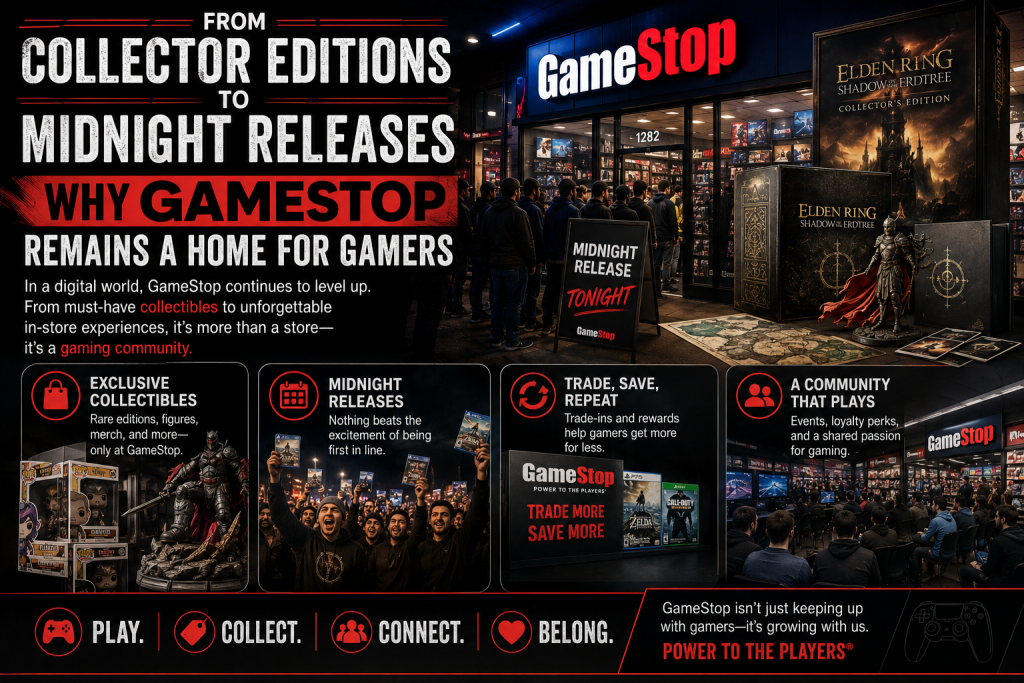
The physical side of gaming has a strange pull. You can say you are practical, and maybe you are, but then a limited box shows up with a map, pins, art cards, and a statue that is just big enough to be inconvenient.
One of the strongest connections between GameStop and gaming culture has been the popularity of collector editions.
For many fans, a special edition of a game is not simply a more expensive version of the same product. It is a physical representation of a franchise they care about. Art books, statues, maps, steelbook cases, and other collectibles transform a digital experience into something tangible.
The pre-owned section became its own kind of treasure hunt. Players could find older PlayStation, Xbox, or Nintendo titles sitting beside recent releases, often giving forgotten games another chance to find an audience.
Midnight releases had their own little weather system
Before digital launches became the standard, midnight releases were some of gaming’s most memorable events.
Players would gather outside stores late at night, often after work or school, waiting together for a game they had been anticipating for months. The experience was rarely about convenience. In many cases, downloading the game at home would have been easier.
But midnight launches created something digital platforms cannot easily replace: shared excitement.
Fans who had never met before suddenly had something in common. They discussed theories, compared expectations, and celebrated the arrival of a new chapter in a beloved franchise. The game became an event before anyone even played it.
Those moments contributed to the identity of gaming communities. They reminded players that games were not only products—they were experiences shared with others.
For many gamers, GameStop was often the first stop when a major release was announced. Pre-ordering a highly anticipated title was not just about securing a copy—it was part of the excitement leading up to launch day.
Why do gamers still like having a place to go
You might enter thinking about a new release and walk out with a pre-owned classic. Or you ask about one controller and end up testing the weight of another. Online shopping makes changing your mind feel like research.
In a store, it feels like wandering.
Parents get help without needing gamer language
A parent buying a gift does not always know platform names, editions, ratings, or why one headset costs more than another. A quick conversation can save them from picking the wrong version. To be fair, that kind of help still matters more than people admit.
And not everyone wants to decode product pages for twenty minutes.
The place keeps gaming visible
You see what people are excited about. It is about the conversations before release day. The excitement of opening a collector edition. The discovery of an unexpected title. The memories created while sharing a hobby with other people. That does not make the store magical. It just gives gaming a public room, and for whatever reason, that still feels useful.
The home part is a little messy, and that is fine
Maybe “home for gamers” sounds too grand if you say it too seriously. A store is still a store. You buy things there. You compare prices. You sometimes leave empty-handed because the thing you wanted was out.
Digital gaming may continue to grow, but the desire for real-world gaming spaces remains.
For many players, GameStop represents a familiar part of that experience—a place where games were not just purchased, but discovered, discussed, and celebrated.

Heather Neves is working as a freelance content writer. She likes blogging on topics related to parenting, golf, and fitness, gaming . She graduated with honors from Columbia University with a dual degree in Accountancy and Creative Writing.