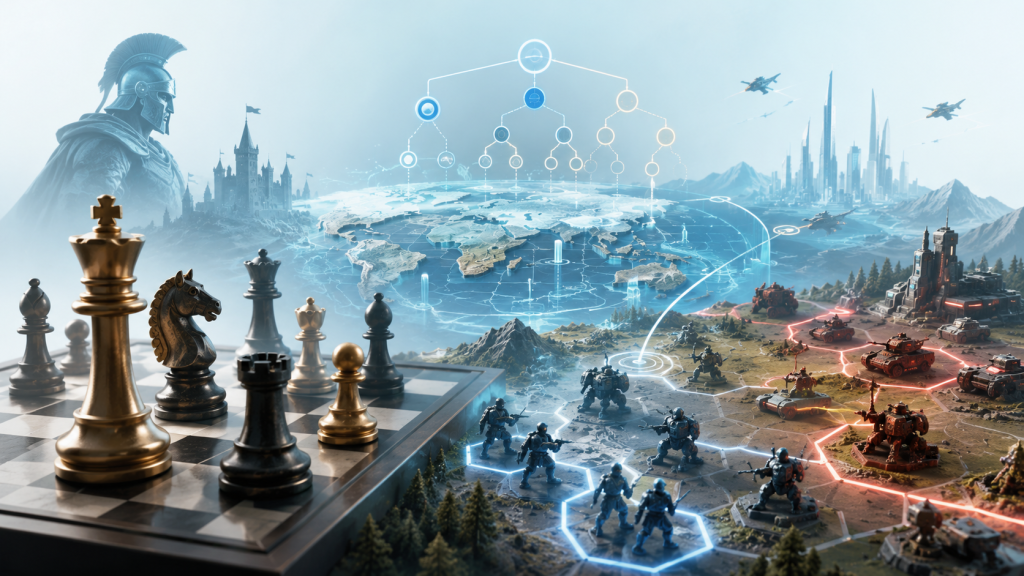
Strategy games hold a firm place in geek culture because they turn thought into action. They do not reward fast hands alone. They reward plans, risk, patience, and sharp choices under pressure.
A good strategy game feels like a locked room with many keys. The player studies the board, tests a path, and pays for each mistake. Chess, tabletop war games, trading card games, grand strategy titles, and tactical RPGs all share this pull. They ask the player to build a plan, defend it, and change it when the ground shifts.
That is why geeks keep returning to them. Strategy games make the mind visible. Every move leaves a mark.
Strategy Games Turn Rules Into Drama
Every strong strategy game starts with clear rules. The board has edges. The deck has limits. The map has choke points. The player cannot do everything. That pressure creates drama.
In a shooter, a fast hand can save a bad plan. In a strategy game, the plan stands in the open. A weak move sits on the table like a cracked shield. The next turn tests it.
This is why games like chess, Civilization, XCOM, Magic: The Gathering, and poker keep a loyal geek audience. They give players a machine they can study. Each rule becomes a lever. Each choice pulls that lever in a new way.
Online card platforms also fit this pattern when they focus on skill, timing, and risk. A player who reads a table, counts odds, and folds at the right moment uses the same mental tools as a player guarding a base or planning a raid. Sites such as poker-bc.com show how classic table strategy can live inside modern digital play, where each hand still turns on patience, position, and nerve.
That mix feels built for geek culture. It rewards study. It respects practice. It lets players lose, learn, and return with a sharper plan.
Strategy Games Reward Careful Thinking
Strategy games give players room to think before they act. They slow the hand and sharpen the eye. A player must ask simple questions: What do I have? What can I lose? What will my rival do next?
This rhythm suits geek culture because it treats play like a puzzle box. The fun does not come from noise. It comes from pressure, pattern, and choice. A good turn feels like placing the last gear in a clock.
Most strategy games reward the same core habits:
-
Planning Ahead: Players look past the next move and build toward a stronger position.
-
Reading The Board: They study space, resources, weak points, and hidden threats.
-
Managing Risk: They choose when to attack, defend, wait, or fold.
-
Learning From Loss: They treat defeat as data, not as dead weight.
-
Adapting Fast: They change the plan when the map, deck, or table shifts.
These habits make each match feel personal. Two players can use the same rules and still create a different story. One wins through patience. Another wins through pressure. A third wins by setting a trap and watching it close.
That variety keeps strategy games alive. They do not run on surprise alone. They run in depth. The more a player looks, the more the game gives back.
Digital Play Made Strategy Easier To Reach
Strategy games once needed a table, a shelf, and a free evening. Players had to sort pieces, read thick rulebooks, and find people in the same room. Digital play changed that. Now the board fits in a pocket.
This shift helped strategy games grow. A player can start a turn-based match on a train. They can test a deck before lunch. They can join a ranked lobby after work. The screen removes the heavy box, but it keeps the hard choices.
Mobile play also suits games built on timing and judgment. Card games show this well. A clean app can turn a short break into a tense match, where each move still matters. Guides for tools like the BC Poker APK show how classic table play now sits beside other mobile strategy formats, from deck builders to tactical RPGs.
The best digital strategy games do not make play shallow. They make access simple. The deep part stays in the player’s hands.
Strategy Games Build Strong Fan Communities
Strategy games do not end when the match ends. Players talk. They compare moves. They share builds, maps, decks, openings, and mistakes. A single loss can turn into a long thread, a guide, or a late-night debate.
This makes strategy games natural fuel for geek communities. Fans like systems they can open, inspect, and rebuild. A strategy game gives them that system. It works like a watch with a glass back. You can see the gears move.
“A great strategy game gives players more than a win screen. It gives them a problem worth discussing.”
That discussion keeps the culture alive. Chess players study old games. Tabletop players paint armies and test lists. Card players tune decks card by card. PC players write mods, guides, and patch notes of their own.
The game becomes a shared language. One player says “tempo,” another says “control,” and both see the same shape in the match. That shared shape builds trust. It turns strangers into rivals, rivals into teammates, and teams into fandoms.
Strategy Games Keep Geek Culture Sharp
Strategy games still dominate geek culture because they give players more than action. They give them structure, choice, and consequence. Each match becomes a small test of nerve and thought.
Their appeal does not depend on one format. A strategy game can live on a chessboard, a war map, a card table, a console, or a phone. The shape changes. The core stays firm. Players study a system, make a plan, and face the result.
That is why these games last. They reward focus. They invite debate. They turn failure into a lesson and victory into proof of work.
Geek culture values worlds with rules, depth, and secrets. Strategy games offer all three. They give the mind a place to play, and they keep asking for one better move.

Heather Neves is working as a freelance content writer. She likes blogging on topics related to parenting, golf, and fitness, gaming . She graduated with honors from Columbia University with a dual degree in Accountancy and Creative Writing.