

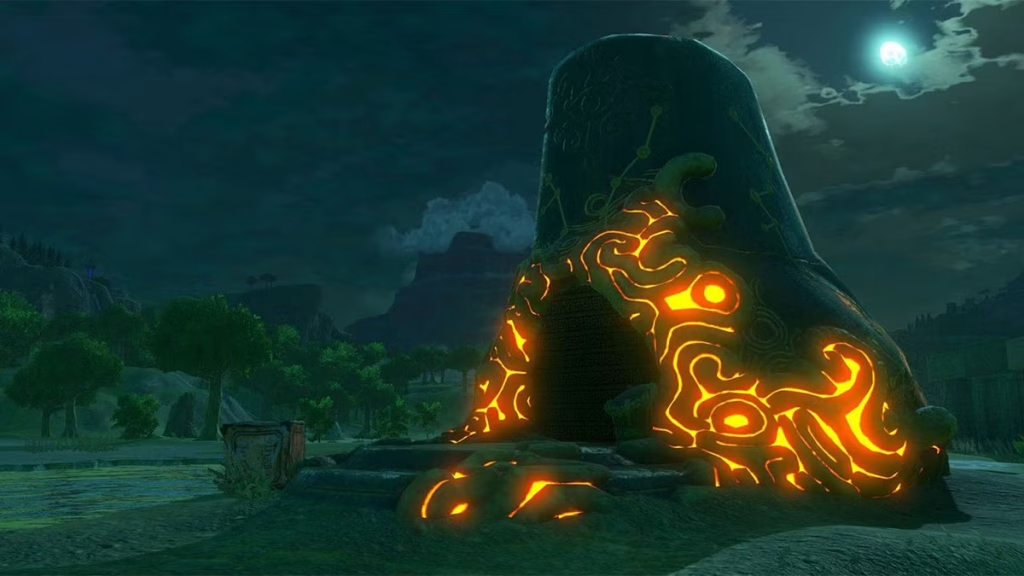
Most open-world games reward exploration with new weapons, collectibles, or another objective to clear from the map. The Legend of Zelda: Breath of the Wild and Tears of the Kingdom take a different approach. Some of their most memorable discoveries are small puzzle chambers that challenge players to think about the game’s mechanics in entirely new ways.
Shrines have become one of the defining features of modern Zelda. They’re scattered across Hyrule, sometimes hidden behind environmental puzzles, buried inside caves, or located in places players might never visit during the main storyline.
What makes them interesting isn’t simply the number of challenges available. It’s how Nintendo uses them to teach players new ideas without making those lessons feel like traditional tutorials.
Small Puzzles in an Enormous World
Breath of the Wild introduced 120 base-game shrines, each offering a self-contained challenge or reward. Tears of the Kingdom expanded that concept with 152 shrines spread across Hyrule’s surface and the sky islands.
On paper, that sounds like an enormous amount of optional content.
In practice, their design gives players a reason to investigate places they might otherwise ignore.
A strange rock formation, an unusual landscape feature, or a distant structure can become the beginning of a new puzzle.
The reward isn’t always the most interesting part. Discovering how to reach the shrine can be just as satisfying as completing the challenge inside.
This is one reason Zelda’s approach differs from open-world games that rely heavily on map markers and repetitive objectives. Exploration frequently leads to a new problem rather than simply another item to collect.
Tears of the Kingdom Made Shrines More Creative
The biggest change between the two games comes from Link’s abilities.
Breath of the Wild introduced mechanics such as Magnesis, Stasis, Cryonis, and Remote Bombs. These tools encouraged players to experiment with objects and their surroundings.
Tears of the Kingdom replaced those abilities with systems that offer considerably more freedom.
Ultrahand allows objects to be moved, rotated, and attached to one another. Recall reverses an object’s movement, while Ascend lets Link travel upward through suitable surfaces.
Fuse adds another layer of experimentation by allowing weapons, shields, and arrows to interact with different materials.
As Geek Vibes Nation observed in its Tears of the Kingdom review, the sequel gives players remarkable freedom to experiment with these abilities throughout Hyrule.
That flexibility becomes particularly noticeable inside shrines.
A challenge might appear to have one obvious solution, but players can often approach it using unexpected combinations of tools and objects.
Sometimes the intended method isn’t even the most entertaining one.
The Best Shrines Teach Without Explaining Everything
Good puzzle design gives players enough information to understand the problem while leaving room to discover the answer.
Zelda’s shrines frequently achieve this through their environments.
A room might contain a movable platform, a switch, and a series of obstacles. Rather than providing lengthy instructions, the game encourages players to examine how those elements interact.
Tears of the Kingdom’s Joku-usin Shrine, for example, centres on an electrical combat challenge where Link must rely on the equipment provided rather than his usual inventory.
The Hila Rao Shrine in Breath of the Wild takes a different approach, combining environmental navigation with the game’s familiar movement and puzzle mechanics.
These are among the shrine challenges documented in walkthroughs published by Ragequit gg, illustrating how Nintendo can use the same underlying gameplay systems to create very different experiences.
Some challenges reward careful observation. Others require precise timing, creative thinking, or a better understanding of the tools available.
The variety helps prevent shrines from becoming entirely predictable, even after players have completed dozens of them.
Failure Is Part of the Experience
One of the strengths of Zelda’s puzzle design is that experimentation rarely feels like wasted effort.
A player might attempt to build a complicated machine, discover that it doesn’t work, and try something completely different.
The game generally allows that process to happen without forcing the player back through a lengthy sequence.
This encourages curiosity rather than punishing it.
It’s also why watching someone else solve a shrine can be so entertaining. Two players might encounter the same obstacle and approach it in completely different ways.
One builds a functioning mechanism using several objects. Another finds a simple solution involving a single ability.
Both can be valid.
This freedom creates memorable moments that extend beyond the actual puzzle.
The result is a game where solving a problem often feels personal, even when thousands of other players have already completed the same challenge.
Shrines Make Exploration Feel Worthwhile
Large open worlds face a familiar problem: how do developers make exploration rewarding without filling every corner with repetitive activities?
Nintendo’s solution is to make discoveries meaningful in several ways.
Finding a shrine provides a new fast-travel destination, a contained gameplay challenge, and an opportunity to earn a Light of Blessing in Tears of the Kingdom or a Spirit Orb in Breath of the Wild.
These rewards contribute to Link’s progression, allowing players to improve their health or stamina.
That creates a natural connection between exploration and character development.
Instead of completing optional activities solely to increase a percentage on a completion screen, players have a practical reason to investigate their surroundings.
The shrines also help establish a rhythm.
After a lengthy journey through Hyrule, a short puzzle offers a change of pace before the next adventure.
The Connection to Classic Zelda Design
Although Breath of the Wild and Tears of the Kingdom represent major changes for the franchise, their shrines retain something fundamental about older Zelda games.
Classic entries frequently centred on dungeons where players acquired new items and learned how to use them to overcome increasingly complicated obstacles.
Shrines condense part of that experience into smaller challenges.
They’re not replacements for traditional dungeons, but they preserve the satisfaction of learning a mechanic and applying it creatively.
Geek Vibes Nation’s look at what newcomers should know about Ocarina of Time explores the more structured progression found in earlier Zelda adventures.
The contrast is interesting.
Older games often restricted progress until players obtained a particular item. Modern Zelda typically provides a broad collection of abilities early and challenges players to discover how to use them.
Both approaches reward understanding, but they encourage different types of problem-solving.
Can There Be Too Many Shrines?
For all their strengths, shrines aren’t universally loved.
Some players find the sheer number overwhelming, particularly when attempting to complete every challenge.
Others miss the longer, interconnected dungeons that defined earlier Zelda games.
A shrine lasting only a few minutes cannot always replicate the satisfaction of navigating a complicated temple filled with interconnected rooms, enemies, and puzzles.
There is also a question of repetition.
After completing dozens of shrines, familiar visual elements and recurring mechanics can begin to feel less surprising.
Tears of the Kingdom addresses some of these concerns through different challenge types, including combat-focused shrines, environmental puzzles, and Rauru’s Blessing shrines that reward players for overcoming the challenge of reaching them.
Even so, the debate over shrines and traditional dungeons remains understandable.
They serve different purposes, and enjoying one doesn’t mean players have to reject the other.
A Design Idea Worth Keeping
Nearly a decade after Breath of the Wild introduced its shrine system in 2017, the idea remains one of Nintendo’s most effective solutions to a difficult open-world design problem.
Shrines encourage exploration, reward experimentation, and give players opportunities to understand mechanics that might otherwise go unnoticed.
Tears of the Kingdom demonstrated how much further the concept could evolve when paired with more flexible abilities.
Future Zelda games may approach exploration differently, and Nintendo could eventually move away from the shrine formula altogether.
But the underlying lesson is worth preserving: an open world becomes more interesting when discovering a new location means discovering something new to learn.
Sometimes the best reward for exploring isn’t a legendary weapon or a rare collectible.
It’s a puzzle you didn’t expect to find.