

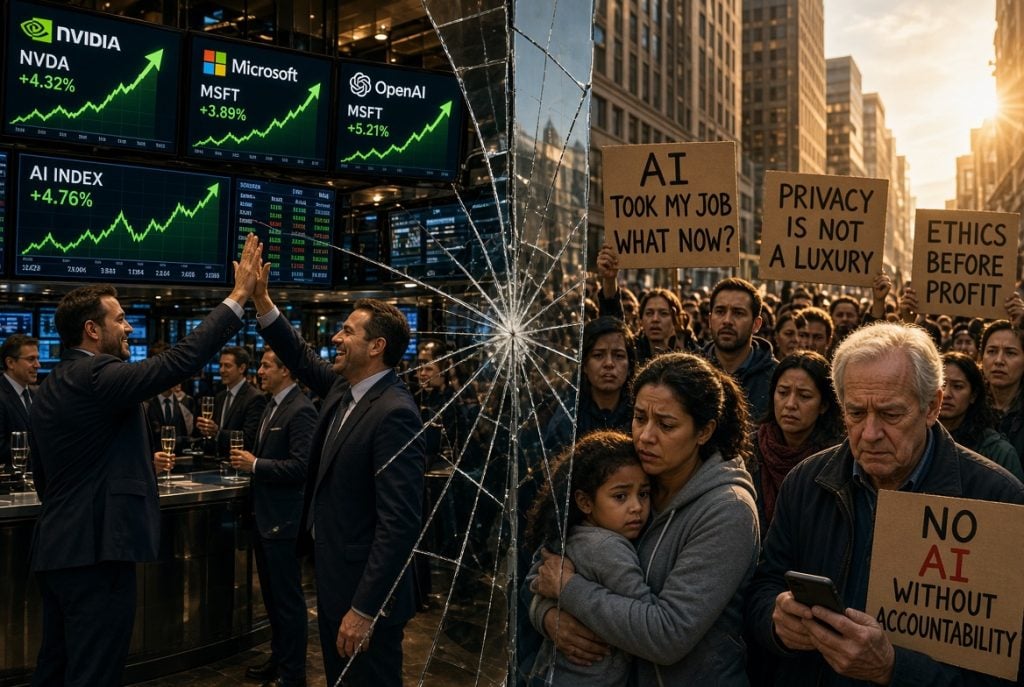
Over the past few years, artificial intelligence has been perceived by the market primarily as a source of new revenue, productivity growth, and multi‑trillion‑dollar valuations for technology companies. However, the flip side of this boom is now becoming increasingly noticeable. Public dissatisfaction with AI, data center construction, and job automation is gradually transforming from a reputational issue into a full‑fledged financial risk.
This trend is particularly evident in the United States. Against the backdrop of persistently high inflation and weak consumer confidence, the contrast between public sentiment and the ongoing growth of major technology companies is becoming increasingly stark. More than half of Americans already say that the growing presence of AI in everyday life causes them more concern than excitement, while trust in the leaders of the largest AI companies remains low.
For OpenAI and Anthropic, such sentiment is especially important ahead of future IPOs with trillion‑dollar valuations. Anthropic is already explicitly pointing to public resistance to AI as a risk factor for its business, and its CEO, Dario Amodei, has acknowledged the existence of a full‑blown crisis of trust. Investors have good reason to pay attention: negative public sentiment can directly affect the pace of infrastructure construction, regulation, and, ultimately, the cost of expanding the business. If these risks materialize, future Anthropic stock could ultimately fall short of market expectations.
The situation with data centers has become the most telling example. In the first quarter of 2026 alone, resistance from local residents led to US data center projects worth about $130 billion being suspended or blocked. For comparison, the same figure for the entire year of 2025 amounted to $156 billion.
Opponents of new facility construction point to the high consumption of electricity and water, rising utility bills, noise pollution, and the use of agricultural land. As a result, the infrastructure boom is gradually becoming a political issue for representatives of both major US parties. For hyperscalers, this means quite specific consequences: longer approval processes, additional investments in energy, and higher costs for new projects.
At the same time, public resistance is not limited to infrastructure. Meta has already agreed to pay up to $17 billion to settle claims related to the potential negative impact of social media. Another example is the startup Flock Safety, whose AI-based systems for monitoring license plates have come under criticism due to instances of unlawful surveillance and erroneous accusations. More than 90 American cities have already suspended or terminated contracts with the company this year, or refused to enter into them.
But the most serious source of tension over the long term may be the labor market. China is already demonstrating how quickly AI can transform entire industries once the economic benefits of automation become sufficiently clear.
Following the spread of new generative video models, the production of short‑form content in the country is rapidly shifting toward AI. In the first quarter of 2026, China released about 128,000 short‑form series, more than three times as many as in the entire previous year, and about 95 % of them were created using AI.
Back in 2024, a team of five people needed about three months to create a few minutes of content; now, a single employee can complete the same work in one or two days. The cost of producing a minute of video has dropped by about 90% to $90–120.
A similar situation is emerging in e‑commerce. Digital hosts can work around the clock and cost about 10% of what a human employee does. For businesses, the appeal of such automation is obvious: fewer employees, lower costs, and the ability to scale production with virtually no limits. But it is precisely this economic efficiency that is fueling public concerns about AI.
As a result, technology companies are facing a new paradox. The more AI boosts productivity and reduces costs, the greater the likelihood of political and public resistance to its further adoption.
For investors, this means that evaluating AI companies solely on revenue growth rates and the size of their computing infrastructure is no longer sufficient. Regulation, protests against the construction of data centers, the potential displacement of millions of workers, and declining public trust are gradually becoming factors that can affect business value just as much as capital expenditures or competition.
And if the early years of the AI boom were marked by the question of how quickly technology could transform the economy, the market is now increasingly facing a different question: how quickly society will allow it to do so.

Caroline is doing her graduation in IT from the University of South California but keens to work as a freelance blogger. She loves to write on the latest information about IoT, technology, and business. She has innovative ideas and shares her experience with her readers.