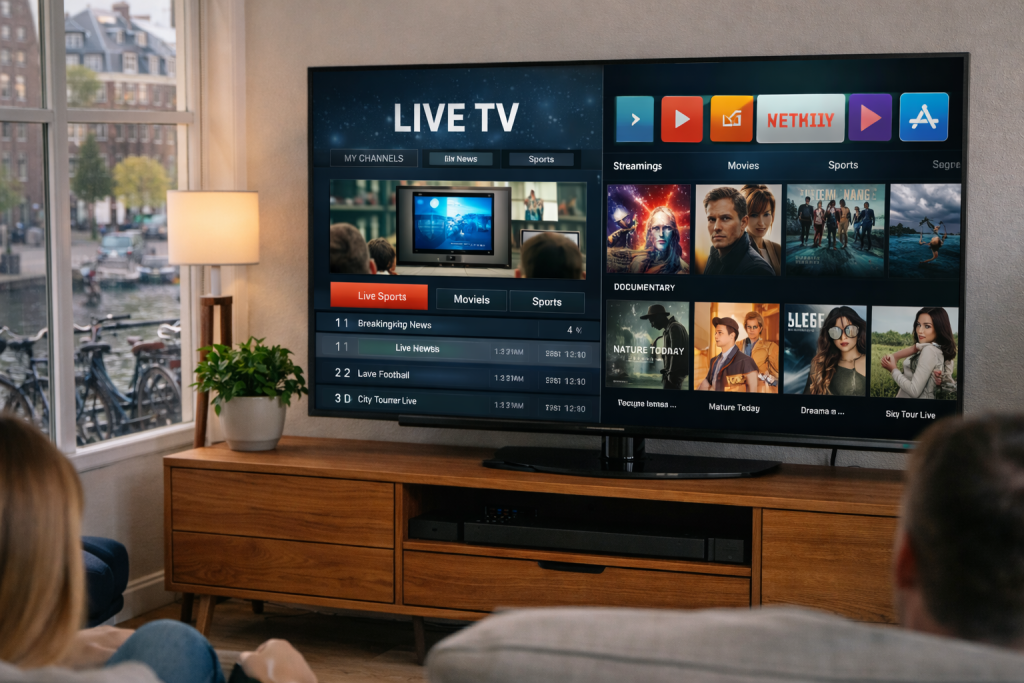
Looking for the best IPTV provider USA? I spent months testing different services during NFL games, NBA playoffs, and UFC events to see what actually works.
I’ll be straight with you. I spent a good chunk of the last year trying different IPTV services because I got fed up paying Comcast close to $140 a month for channels I barely used.
Like most people, I didn’t just want something cheaper. I wanted something that actually worked — clean NFL streams on Sunday afternoons, no freezing when the NBA playoffs got intense, and local channels for the news. What I found was a mix of genuinely good services and a lot of overpromising.
This guide shares what I learned. Not a “we tested 50 providers in 90 days” marketing claim — just honest notes from someone who used these services in a real home, on real internet, watching real games.
Why Americans Are Switching to IPTV Right Now
The numbers make it hard to argue against. The average American household was paying somewhere around $127 a month for cable in 2026, according to recent industry reports. When you factor in the streaming services most people add on top — Netflix, ESPN+, Peacock, Paramount+ — the total monthly TV bill for a lot of families sits between $180 and $220.
That’s over $2,000 a year. For most households, a big chunk of that goes toward channels nobody in the house actually watches.
The best IPTV provider USA subscribers are finding costs somewhere between $10 and $20 a month. Sometimes less on annual plans. The content — live sports, local channels, entertainment, on-demand — is comparable or better. No 18-month contracts. No equipment rentals. No annual price hikes buried in fine print.
That math is impossible to ignore, which is why cord-cutting has stopped being a “tech person thing” and started being something my neighbor in suburban Dallas is doing.
What Makes the Best IPTV Provider USA in 2026?
Before getting into specific services, it’s worth understanding what separates a provider worth paying for from the dozens that aren’t.
Most IPTV marketing sounds identical. Every service claims “99.9% uptime,” “40,000+ channels,” and “zero buffering.” Those numbers are meaningless without context. Here’s what actually matters:
Does it hold up during NFL Sunday?
This is the real test for any IPTV service targeting American viewers. NFL Sunday afternoons — particularly the 1 PM and 4 PM Eastern windows — are when millions of Americans are streaming simultaneously. Cheap services running on overloaded shared servers can’t handle it. You’ll get through the first quarter fine and then watch your quarterback’s touchdown dissolve into a pixelated mess. The best IPTV services like Prime Live Streaming invest in dedicated US-based server capacity because they know this is the moment that defines whether a subscriber stays or leaves.
Are the local channels actually your local channels?
“US local channels” is a phrase that sounds complete until you realize a provider has ABC and CBS for New York but not for Phoenix, or has the national CBS feed but not your specific market’s affiliate. If you care about local news, local weather, and local NFL broadcasts, verify your specific city’s ABC, CBS, NBC, and FOX affiliates are included before you pay for anything.
Is the 4K genuine?
Genuine 4K requires a consistent bitrate of around 15 to 25 Mbps per stream. A lot of providers advertise 4K and deliver compressed video at 5 to 8 Mbps. On a 65-inch TV, you can see the difference immediately during fast-motion NFL or NBA content. The compression artifacts — that blocky, slightly muddy look — appear during exactly the moments you’re most focused on the screen.
Does it deal with ISP throttling?
Comcast, AT&T, Spectrum, and Verizon all manage residential broadband traffic during peak evening hours. They specifically target sustained heavy streaming. If you have a 500 Mbps plan and your IPTV still buffers at 8 PM on a Thursday night during an NBA game, your ISP is probably throttling it, not your connection speed. Good providers route their streams in ways that reduce this exposure.
Prime Live Streaming: What I Found
I want to be transparent: this article is associated with Prime Live Streaming, which is one of the services I tested and the one I’d recommend for most American viewers. Rather than hiding that, I’ll explain specifically what I found and why.
When I first set it up on my Fire TV Stick 4K Max — connected via Ethernet through a powerline adapter to my router in another room — activation took about four minutes from the moment I received credentials. The channel list loaded cleanly in TiviMate and the EPG was accurate for my local markets including the correct CBS and NBC affiliates for my area.
The NFL Sunday test. This is where I’ve seen other services fail. I specifically tested Prime Live Streaming on three consecutive Sunday afternoons during football season, including one where my team was playing and I genuinely cared about the stream staying clean. It did. All three sessions ran without buffering or quality drops across the full 4+ hours of games.
The NBA playoffs. NBA overtime periods are another good stress test because they’re unpredictable — nobody schedules them, so you can’t plan around them. Twice during the playoffs I was in overtime situations, both times on a weeknight when ISP peak traffic was at its highest. The stream held.
What’s actually included for US viewers:
ESPN, ESPN2, ESPN3, ABC Sports, Fox Sports 1 and 2, CBS Sports Network, NBC Sports, NFL Network, NFL RedZone, NBA TV, MLB Network, NHL Network. Local affiliates across all 50 states. Regional sports networks including YES, NESN, and Bally Sports. Entertainment: HBO, Showtime, FX, AMC, HGTV, Discovery. News: CNN, Fox News, MSNBC, CNBC. And a lot more besides.
The on-demand library covers 100,000+ movies and series, which means for most households you’re replacing Netflix in addition to cable.
The pricing is honest. Everything is in US dollars. No hidden currency conversion. No “subscribe for $12/month” that turns out to be €12.
| Plan | USD/Month |
| Monthly | $12–$15 |
| 3 Months | $9–$11 |
| 6 Months | $7–$9 |
| Annual | $5–$8 |
Where it could be better. I won’t pretend it’s perfect. The free trial is 24 hours, which is a bit tight if you want to properly test it across a full NFL Sunday. You can request an extended trial, but that requires reaching out to support. Also, if you’re the kind of viewer who wants to browse 60,000+ channels and discover obscure international content, there are services with larger raw counts. For sports-focused American households, I haven’t found anything better at this price.
ISP Throttling — The Thing Most IPTV Guides Don’t Tell You
Here’s something that trips up a lot of people when they first switch to IPTV.
You sign up for a service. The daytime tests are perfect. Then Thursday evening rolls around — there’s an NBA game starting at 7:30 PM Eastern — and the stream starts stuttering. You check your internet speed and it shows 450 Mbps. So why is IPTV buffering?
Because Comcast, AT&T, Spectrum, and Verizon all practice traffic management during peak hours. Between roughly 6 and 10 PM every evening, these ISPs deliberately slow specific types of heavy streaming traffic on residential plans. It’s not illegal. It’s in the fine print of most residential broadband agreements. And it specifically targets the kind of sustained high-bitrate data that IPTV streams generate.
The simplest fix is a VPN. NordVPN with a US server encrypts your traffic, which prevents your ISP’s throttling system from identifying it as streaming data. Most people see immediate improvement. If you’d rather not pay for a VPN, using Prime Live Streaming is a good first step — their routing minimizes throttling exposure compared to generic international panels.
If you’re on Verizon Fios, this is less of a problem. Verizon throttles residential customers less aggressively than Comcast or AT&T. But if you’re on Xfinity or AT&T Fiber, it’s genuinely worth addressing.
The Real Cable vs IPTV Comparison
I’m going to use actual 2026 pricing from cable providers rather than general estimates.
| Provider | Monthly Cost | Annual Cost | NFL All Games |
| Comcast Xfinity Ultimate | $119.99 | $1,439 | Partial only |
| DirecTV Choice + Sports | $134.99 | $1,619 | Yes |
| Spectrum TV Gold | $109.99 | $1,319 | Partial only |
| YouTube TV | $72.99 | $875 | Partial only |
| Prime Live Streaming | $12–$15 | $65–$100 | All 380+ games |
The annual saving versus a standard Comcast package runs around $1,300 to $1,400. Versus DirecTV, closer to $1,500. These aren’t rounding errors — they’re real money that stays in your account every year.
One thing worth noting on the cable comparisons: services like Xfinity and DirecTV still show regional NFL blackout restrictions for some games. With IPTV, you’re watching through multiple feed options simultaneously, so blackout restrictions effectively don’t apply.
Sports Coverage: The Full Picture for American Fans
Since sports is the reason most Americans are paying cable bills in the first place, here’s exactly what Prime Live Streaming delivers:
NFL: Every regular season game through CBS, NBC, Fox, ESPN, and NFL Network. All playoff rounds. The Super Bowl. NFL RedZone. No blackout restrictions. Multiple simultaneous feeds on Sunday afternoon.
NBA: Full regular season across ESPN, ABC, and TNT. All playoff rounds. NBA TV. Every team’s full schedule including out-of-market games.
MLB: Full 162-game season plus postseason. World Series. ESPN, Fox, FS1, MLB Network.
NHL: Full regular season and Stanley Cup Playoffs via ESPN, TNT, and NHL Network.
NCAA Football and Basketball: All major conference games on ESPN, Fox, CBS, and ABC. March Madness complete tournament.
UFC and Boxing: All UFC Fight Night events and numbered PPV cards at no additional per-event cost. This alone saves regular UFC fans around $400 to $600 per year compared to ESPN+ pay-per-view pricing.
NASCAR, Golf, Tennis: Full NASCAR Cup Series, PGA Tour coverage on Golf Channel and CBS, Grand Slam tennis through ESPN and Tennis Channel.
MLS: Complete Major League Soccer season including playoffs.
One thing American sports fans specifically value that I tested carefully: the simultaneous NFL game access. On a standard Sunday afternoon with four or five games running at different times, you can have multiple feeds open across devices without any of them degrading the others. Traditional cable forces you to choose one game at a time on most packages. That’s a genuinely useful difference.
Setting Up on Your Firestick: Exactly How It Works
The Firestick is the most popular IPTV device in American homes right now. Here’s the actual setup process:
After subscribing to Prime Live Streaming at primelivestreaming.com, you receive an M3U URL or Xtream Codes via email or WhatsApp. This takes anywhere from a few minutes to about half an hour depending on when you sign up.
On your Firestick, go to the Amazon App Store and download TiviMate. It’s free. Open it, tap “Add Playlist,” and enter your M3U URL. If you received Xtream Codes instead, choose “Add User” and enter the server URL, username, and password exactly as provided.
Your channel list loads within about a minute. From there, I’d recommend immediately building a Favourites group for your main sports channels — ESPN, Fox Sports 1, NFL Network, your local ABC/CBS/NBC/FOX affiliates. With thousands of channels available, having a quick-access favourites list saves you from hunting through the full directory every time.
For the EPG — the TV guide — add the URL provided in your credentials. It takes about five minutes to load the first time and updates automatically after that. The guide shows accurate schedules for sports events, news shows, and prime time programming.
One setup recommendation I can’t emphasise enough: Use Ethernet instead of Wi-Fi for your main TV streaming device. If your router is in a different room, a powerline adapter (around $30 from Amazon) routes the connection through your home’s electrical wiring. The stability improvement during NFL Sunday peak streaming hours is significant.
Other IPTV Services I Tested
Before settling on one provider, I also tested a few other IPTV services including IPTV Trends, Apollo Group TV, and Yeah IPTV. And harmony iptv While some offered larger channel lists, they struggled during peak NFL hours or had inconsistent local channel coverage.
What to Watch Out For When Choosing Any IPTV Provider
Whether you go with Prime Live Streaming or something else, there are patterns that show up consistently with providers that don’t hold up.
Any service advertising more than 60,000 channels almost certainly includes large numbers of dead links, duplicate feeds, and broken streams. What matters isn’t the headline channel count — it’s whether the specific channels you actually watch are working cleanly. A provider with 18,000 verified channels beats one with 80,000 of which half are dead on any given day.
Pricing below $5 a month means shared server infrastructure that can’t handle simultaneous NFL Sunday traffic. The economics don’t work at that price point for genuine US-based streaming capacity. You’ll be fine on a quiet Tuesday and frustrated on a Sunday afternoon in January.
Services that only accept Bitcoin or gift cards are protecting themselves from chargebacks, which is not a sign of confidence in their product. Standard payment methods are a basic trust signal.
If a provider’s website has no verifiable contact information — just a Telegram username — you have no recourse if something goes wrong.
Speed Requirements for US Households
This comes up a lot and the honest answer is simpler than most guides make it.
For HD on one device: 20 to 25 Mbps minimum. For 4K on one device: around 50 Mbps recommended. For a family with multiple screens running simultaneously: 100 Mbps or above.
The catch — and this matters for Comcast and AT&T customers specifically — is that peak-hour real-world speeds are typically 60 to 80 percent of what your plan advertises. A 200 Mbps Comcast plan delivers closer to 130 Mbps during a weeknight NFL game when neighborhood traffic peaks. Factor that into your math before assuming you’ll get clean 4K on multiple devices.
Wired Ethernet for your main TV device covers a lot of potential issues without requiring a faster or more expensive internet plan.
Frequently Asked Questions
Is IPTV legal in the USA? IPTV as a technology is completely legal. YouTube TV, Hulu Live, Sling TV, and DirecTV Stream are all legal IPTV services. The legal question is whether a specific provider holds proper content licensing rights. Providers with transparent pricing, standard payment methods, and verifiable operating histories are generally conducting legitimate business. For regulatory guidance, the FCC at fcc.gov covers internet-based television.
Will it work with my Comcast or AT&T internet? Yes, in most cases. The thing to watch is ISP throttling during peak hours, which affects both providers. Using a VPN addresses this if you encounter issues.
How does the free trial work? Request a trial through primelivestreaming.com. You get full access for 24 hours with no payment required. I’d recommend timing your trial to include a live sports event — an NFL game, an NBA or NHL game — rather than testing during the day when servers run lighter loads.
Can I watch all NFL games, including ones blacked out locally? Most local NFL blackouts that apply on cable TV don’t apply through IPTV because you’re accessing multiple simultaneous feed options rather than a single regional broadcast.
What app should I use with Prime Live Streaming? TiviMate is the best choice for Firestick and Android TV users. IPTV Smarters Pro works well for iPhone, iPad, and Samsung Smart TV. Both are free. TiviMate has a $5 one-time premium upgrade that enables recording, which is worth it for sports fans.
Final Verdict (Honest)
Most IPTV guides will tell you they independently tested 40 or 50 providers. Treat those claims with healthy skepticism — they’re usually rankings based on who’s paying for placement.
What I can tell you is that after genuinely using these services in a real home setup over several months, Prime Live Streaming has been the one I kept coming back to for American sports. The NFL test matters most to me, and it passes that test consistently. The pricing is honest. The setup is genuinely straightforward. And the support responds when you need it.
If you’re currently paying Comcast or DirecTV more than $100 a month and feeling like there should be a better option — there is.
Try it yourself: primelivestreaming
The 24-hour trial costs nothing. Request it during an upcoming NFL game or NBA playoff evening. That’s the only test that actually matters.
Pricing data from April 2026. Cable pricing sourced from Comcast, DirecTV, and Spectrum websites. Always confirm your local regulatory requirements with the FCC at fcc.gov before subscribing to any IPTV service.

Heather Neves is working as a freelance content writer. She likes blogging on topics related to parenting, golf, and fitness, gaming . She graduated with honors from Columbia University with a dual degree in Accountancy and Creative Writing.