What does it mean to be lonely?
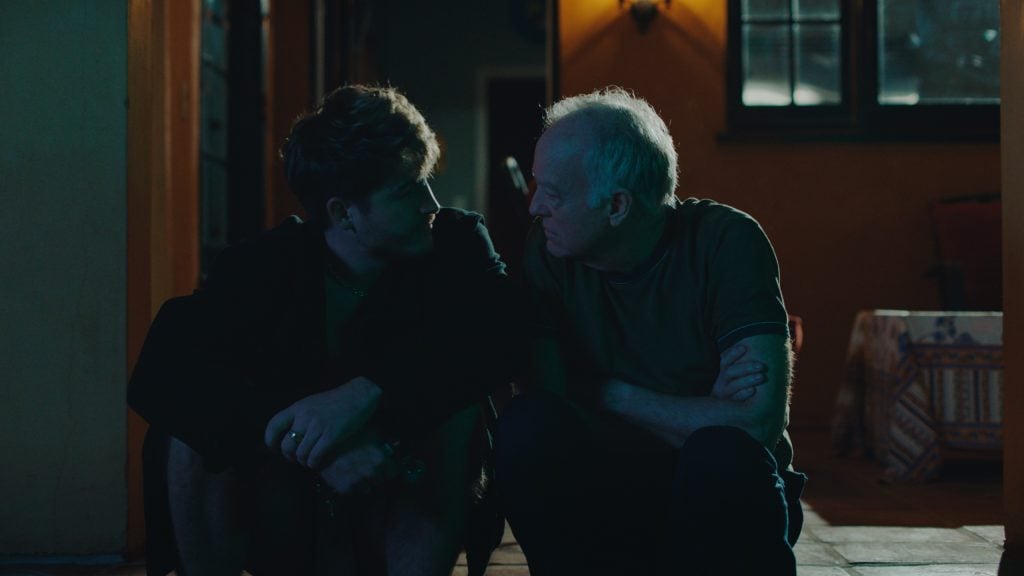
Blue Film isn’t the first film to seek an answer to that question. However, its path to that answer is among the most provocative we’ve ever seen. The provocation comes from the circumstances that Alex (Kieron Moore) and Hank (Reed Birney) find themselves in one late night in Los Angeles. Hank hires Alex, a findom camboy who goes by the stage name Aaron Eagle, for what Alex assumes is a night of aggressive sex. Alex’s expectations are torn asunder by the revelation that Hank is his former middle school teacher, who was jailed for attempting to sexually assault another student. Hank flew to Los Angeles for the express purpose of meeting Alex and determining if he was still in love with his pedophilic obsession.
As you might imagine, a film exploring and contextualizing pedophilia is a tall order for audiences living in an Epstein world. Blue Film attempted the festival circuit and was rejected by several, including Sundance and SXSW. It eventually found a home at last year’s Edinburgh International Film Festival and was acquired by Obscured Pictures for U.S. distribution.
“I definitely think that, at least with the American festival landscape right now, if you’re making anything interesting, it’s going to be an uphill battle,” director Elliott Tuttle said about his film’s distribution struggles. “There’s plenty of interesting stuff that comes out of festivals, but it’s never because it’s pushing a boundary. I think it’s pretty sad right now, but I have optimism that audiences are showing that they are eager for a different kind of film.”
Funnily enough, part of what makes Blue Film as compelling as it is uncomfortable is its grounding of both the taboo and the indefensible in an identifiable and relatable experience. Besides relatively brief sexual interludes, Alex and Hank spend their time together discussing their sexual proclivities and their consequences. Although their sexual desires and circumstances are markedly different, Hank and Alex find commonalities in their loneliness and isolation from society.
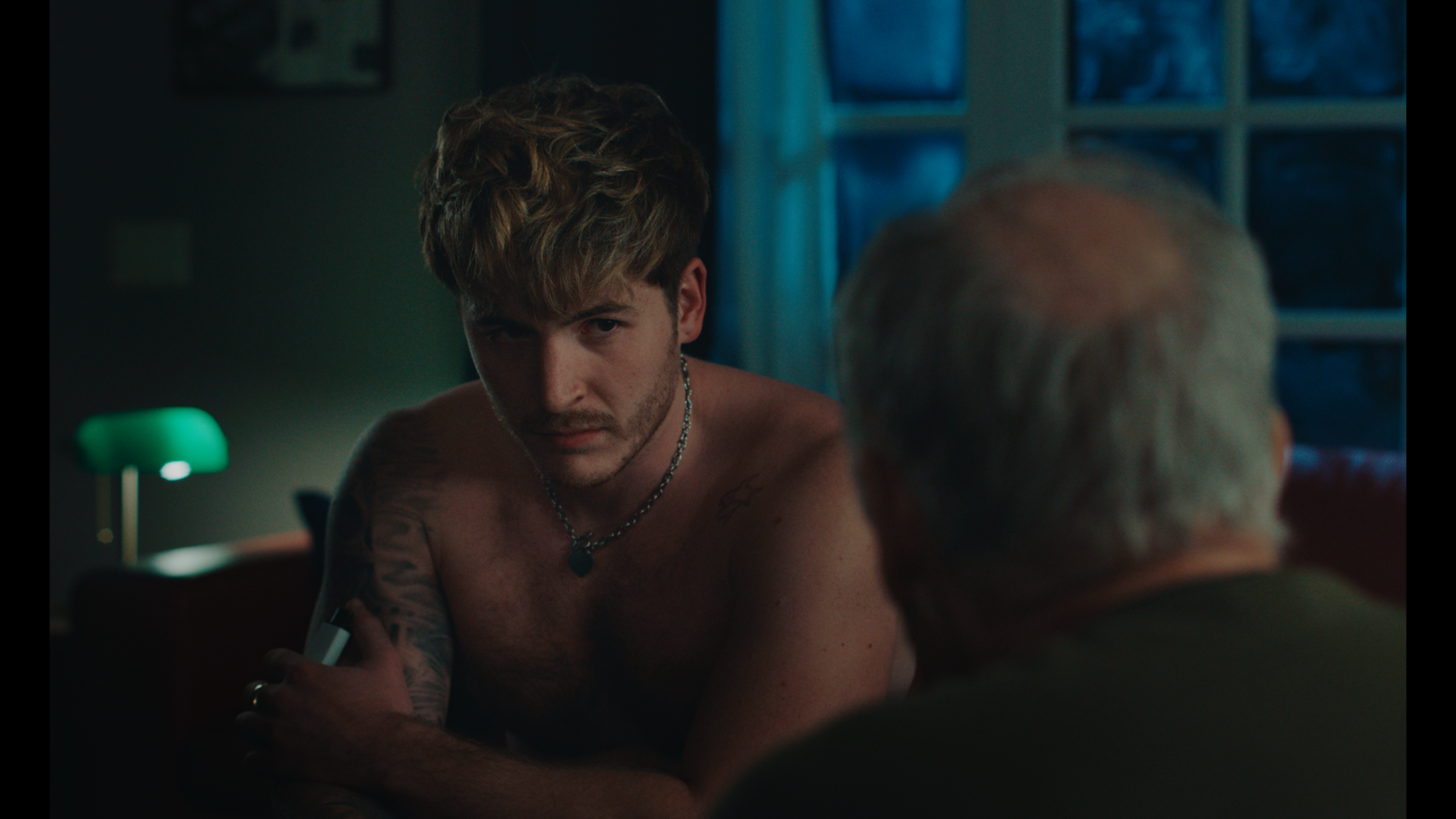
For Alex, his isolation is self-imposed, with him using his sex work and Aaron Eagle persona as both performance and protection.
“A lot of us grow into the adult that the child in us needed, and that can be the best or the worst version,” Kieron Moore explained. “It can come from compassion, completely 180-ing their adult life in such a beautiful, blessed way because they’ve had such horrific childhoods and don’t want anyone else to experience that. Some of us don’t do that. Some of us become this beast to protect this vulnerability in us.”
Moore continued, “A lot of the Aaron Eagle version of Alex is a performance. For me, it was always armor to shield this vulnerability, his ability to love and be loved. So, the way to repel against that is to dominate. I don’t think Aaron realized how much of Alex is left in him, and I think that’s the beauty of this movie. As he cracks down, there’s part of this thing that he thought he’d lost that’s still there. I think [Aaron and Alexis] exist simultaneously, but Alex has taken the forefront in this ‘I have no weakness’ martyrdom. But it’s actually the opposite. I think he’s truly very sensitive underneath.”
After leading roles in the streaming series Vampire Academy and Boots, Blue Film is Moore’s feature film debut, and a remarkably daring one at that. Moore didn’t shy from the challenge, viewing it as an opportunity to push himself and prove what he was capable of.
“I thought the script was incredible,” Moore said about taking the role of Alex. “And at that time in my career, I was just so hungry to show myself, audiences, and the higher powers what I could do. I’ve been very lucky and been part of some great projects, but I knew I had more to give. I wanted to see if I could do that, so when the script came through, it was a bit of a no-brainer.”
Moore admits that there was some fear about Blue Film’s subject matter, but he largely saw it as an opportunity to explore the burdens and questions that we rarely grant space for. One of Alex’s burdens, as Moore alluded to, is the chasm between Aaron Eagle and the inner child that Aaron is meant to protect. That protection is threatened by one of the film’s most disturbing scenes, where Hank and Alex attempt to engage in an age-play sex scene. Alex ultimately cuts the scene short because of his discomfort, revealing cracks in the Camboy armor.
“Aaron constantly feels like he’s in control,” Moore said. “He’s so physically capable that he feels like a dangerous force compared to this older man, and you relinquish this fear that he’s going to be contained. It’s not until he surrenders to that youthfulness in him that it starts to slip out, and then he’s transmitted into it…He’s transported back to a time where he feels powerless.”
Another of Alex’s burdens is revealed when Hank openly challenges the value of sex in their lives. Alex refutes Hank’s position, insisting that his sex means something to him. But what?
Despite Alex’s insistence, Moore’s answer is more complicated. “With Aaron, there has to be some element of enjoyment in being desired. And that’s why sex can be so corrupting, can’t it? In this hunt for love, we fill our void with lust and desire, and sex can come with so much shame. Sometimes, sex makes us feel really good in the moment, and after, we feel terrible about ourselves; we’ve succumbed to our animalistic nature. It’s such a volatile space, and a massive part of it dictates how we feel about ourselves.”
Lasering in on Alex, Moore said, “When he says that line about [his] sex meaning something to [him], I felt that was where Aaron and Alex crumble into one. They come from this same sort of pain and sadness, a real want to connect, and just loneliness. Alex, as a young gay man, is lonely, and Aaron is this dominant online performer who is inherently lonely because he’s cut everyone off.”
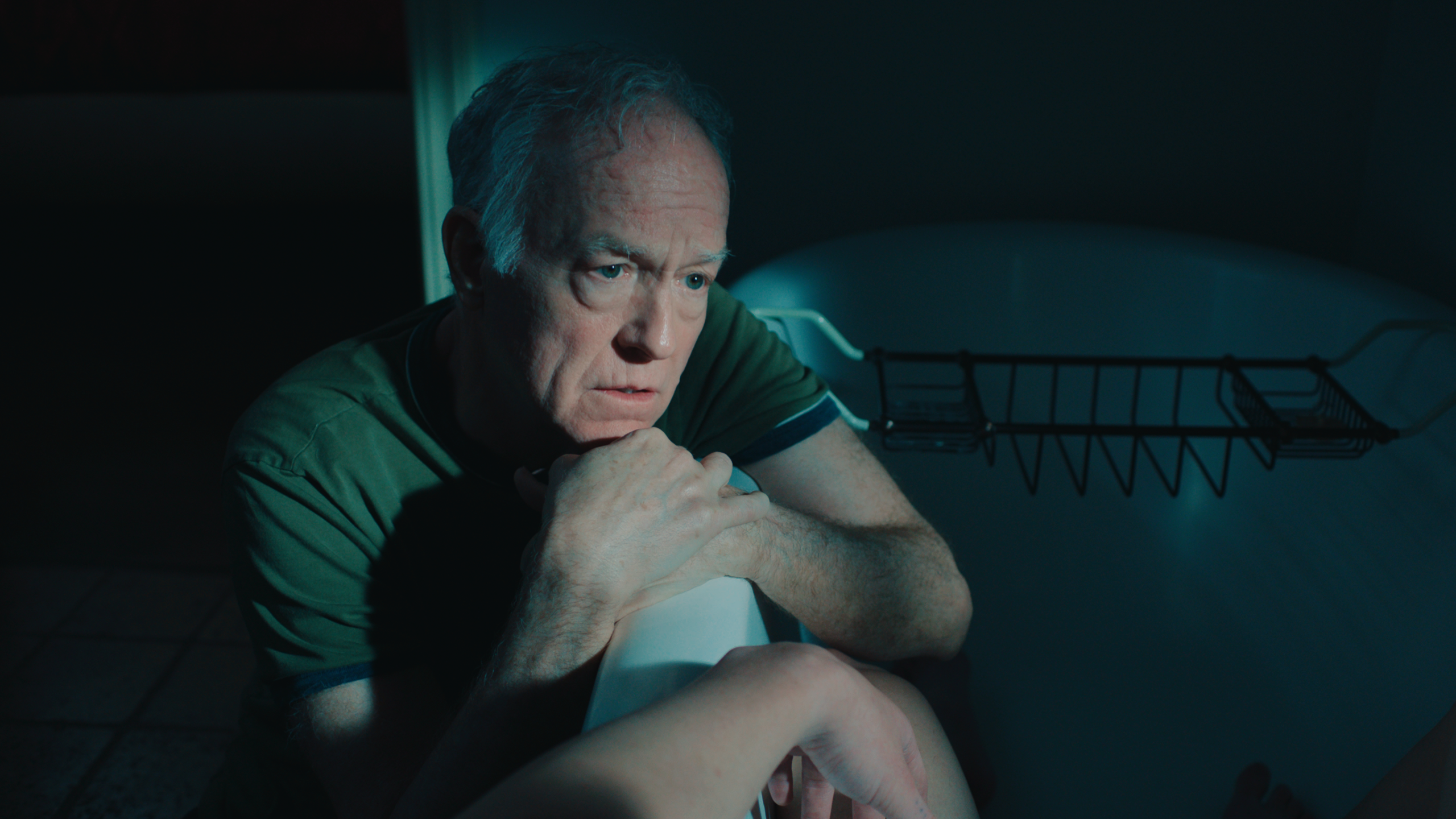
Hank, who sparks Alex’s reckoning with his sexual identity, comes from a horrifying, fraught position. His pederasty and pedophilia have isolated him from the world, leaving him alone to grapple with a type of loneliness that is unfathomable for most, likely including audiences of Blue Film. Tony Award-winning actor Reed Birney approached the film as an opportunity to explore “two very broken, lonely people,” whom he views as a story that’s “always worth telling.”
Hank’s loneliness specifically stems from sex as an inherently dangerous act. “Hank has some very strong feelings about how sex is an Achilles heel and dangerous, because it is for him,” Birney explained. “It’s not unusual for people, when they’re feeling lonely or empty, to do all kinds of stuff to deal with the unfillable hole, and I think a lot of people, straight and gay, use sex to comfort themselves. I think he’s had impulses, and he knows it’s dangerous, and he’s been able to control himself, which I think probably made him feel even lonelier.”
Birney recalled a line in the original script that had Hank reveal that he’d only had sex once in his life when he was in college. “I thought it was such a beautiful line, and telling about how Hank has lived his life. Despite being a sexual person, I think he has led a non-sexual life because his sexuality is dangerous.”
Hank’s fear and isolation related to his sexuality ultimately lead him to hire Alex for the night. While Hank says that he wanted to see if he still had romantic or sexual feelings towards Alex, Birney revealed a new motivation: a sexual intervention.
“I actually believe that Hank has gone to Los Angeles to see Alex as part of his atonement for James,” Birney explained, referring to Hank’s attempted abuse of a middle school student. “To see if he could rescue Alex from what he perceives as Alex going astray. He says several times, ‘You were a good kid,’ and there’s a real attempt to remind Alex of who he was and where he came from, and that he’s gone wrong.”
Hank’s intentions are muddled in that age-play sex scene. “I think it was a mistake,” Birney said of Hank’s attempt at having sex with Alex. “I think he’s drunk, and Aaron says, ‘I want to fuck,’ and despite his better angels, he’s like, ‘Okay, if we’re going to do this, then this is what I want to do.’ That’s the regret I think he probably has. The first thing he says when he sits down the next morning is, ‘Was this a bad idea?’ So, it didn’t go as planned.”
Despite Hank’s indulgence in his worst and most feared behaviors, Birney has a somewhat somber faith in his tortured character. “I think he will ultimately be proud of what he went to do. I think there will be some therapy, and there’ll be some discussions with the priest about what went on, but he will appreciate that his impulse was pure.”
Birney continued, “I think the reality is he’s going to be at this Shop & Save, bagging and seeing James once a week in the store, knowing that everybody’s whispering about him. I don’t think he has any kind of social life. It’s a very solitary, monastic life, full of repentance.”
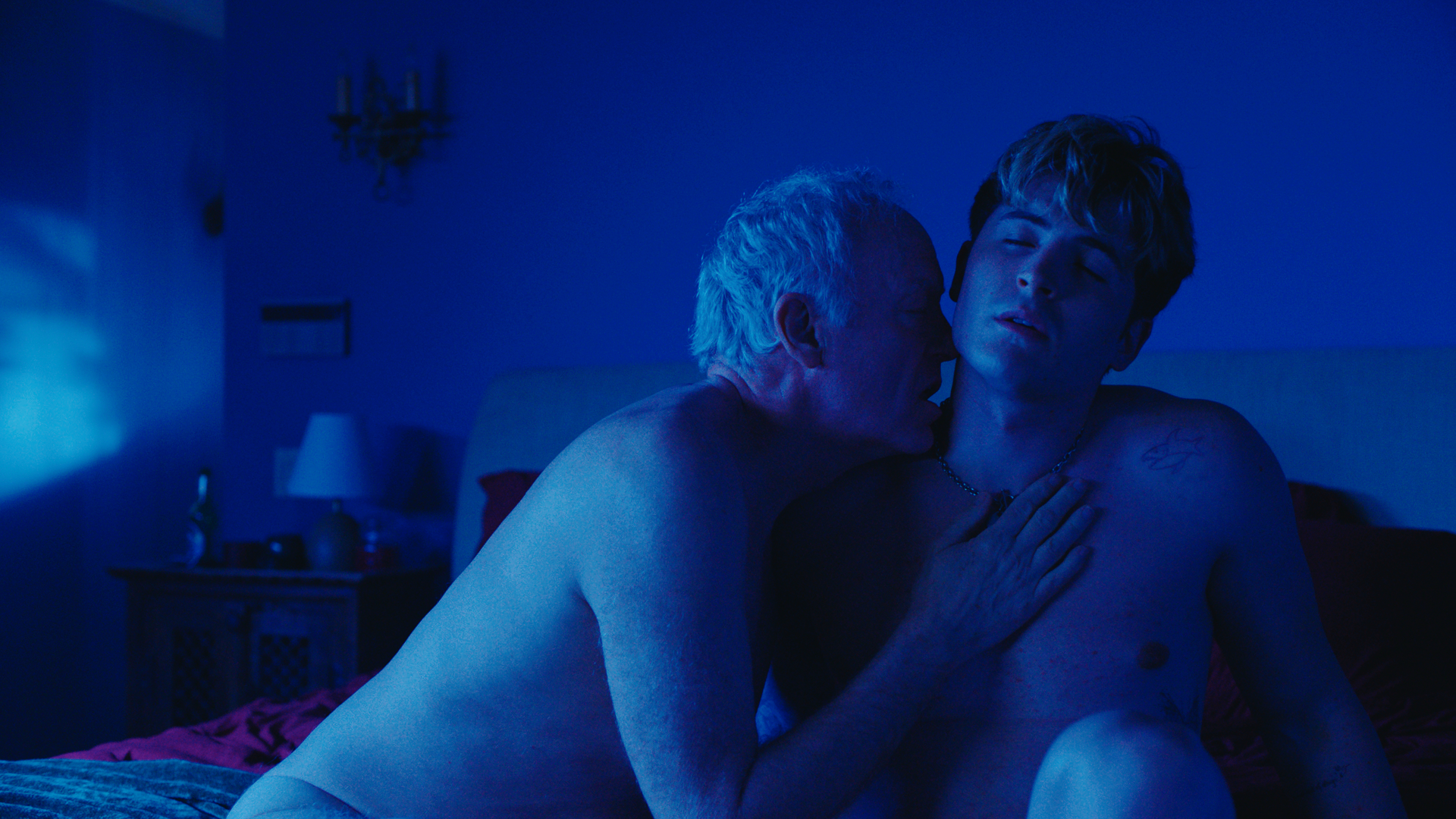
As for Tuttle, he believes the film explores how sex and isolation are complex and sometimes contradictory functions of each other. One such way is the loneliness that comes from having one’s illusions about oneself or others shattered by the truth. “The loneliness [in the film] is predicated on the lies we tell ourselves or the fantasies we build,” Tuttle explained. “Hank is there because he has been dreaming of Aaron/Alex for a long time and has built up this image of him in his head. The entire arc of Aaron’s character is that he has bought into his own fantasy of his cam-boy persona, and that deconstructs throughout the film. The film’s engine is sustained by their fantasies dissolving.”
The other way, which will likely challenge audiences the most, is the inherent loneliness caused by sexual taboos and abuses. “So much of how we interact with the world comes back to eroticism and sex,” Tuttle shared. “It touches so many of the ways we interact with the world at large and, to me, that breeds loneliness because it dictates so much of the things we do and don’t do. Hank is so lonely because of his lust, and Alex’s love has made him lonely. They come from different places, but they share this dark night of the soul, negotiating their loneliness with each other.”
For a film so deeply engaged with loneliness in one of its most extreme forms, and loneliness being one of the most accessible human emotions, it is worth asking what the creatives behind Blue Film hope audiences take away from the film.
“I would really encourage people to sit with their own discomfort,” said Moore. “Not every movie is meant to agree with us or confirm our own opinions. Sometimes, it exists to let us feel our way through, and I think this movie can do that if you’re open enough to it.”
Birney hopes that audiences feel seen by the film, something he has already witnessed by reading Letterboxd entries about Blue Film. “I think the movie’s greatest strength is how unflinching it is in that conversation, and the fact that we have that really dangerous, scary conversation is a little mind-blowing.”
As for Tutle, he amalgamates the perspectives of his two leading men. “I really hope audiences are moved, or they see something of themselves on the screen. I hope people show this film to others because they want their friends to see it. Ultimately, I want this film to spark at least one conversation and a feeling in people when they watch it.”
Blue Film is now available on VOD courtesy of Obscured Releasing.
Before we let you go, we have officially launched our merch store! Check out all of our amazing apparel when you click here and type in GVN15 at checkout for a 15% discount!
For major deals and money off on Amazon, make sure to use our affiliate link! If you are purchasing any of the latest and best in physical media at MovieZyng, you can support us using our affiliate link.

A late-stage millennial lover of most things related to pop culture. Becomes irrationally irritated by Oscar predictions that don’t come true.