Game development has always been a story of trade-offs. You trade time for polish, money for talent, and creative vision for practical execution. For indie developers, the most painful trade-off has historically been character art. You either spend weeks learning pixel art, empty your budget hiring a professional, or settle for asset packs that make your game look like every other indie title on Steam. None of these options are good. But over the past few weeks, I have been testing a different approach—one that does not ask you to choose between quality and affordability. The results suggest that the economic calculus of indie game development is due for a reckoning.

The Real Price of a Sprite: More Than Just Money
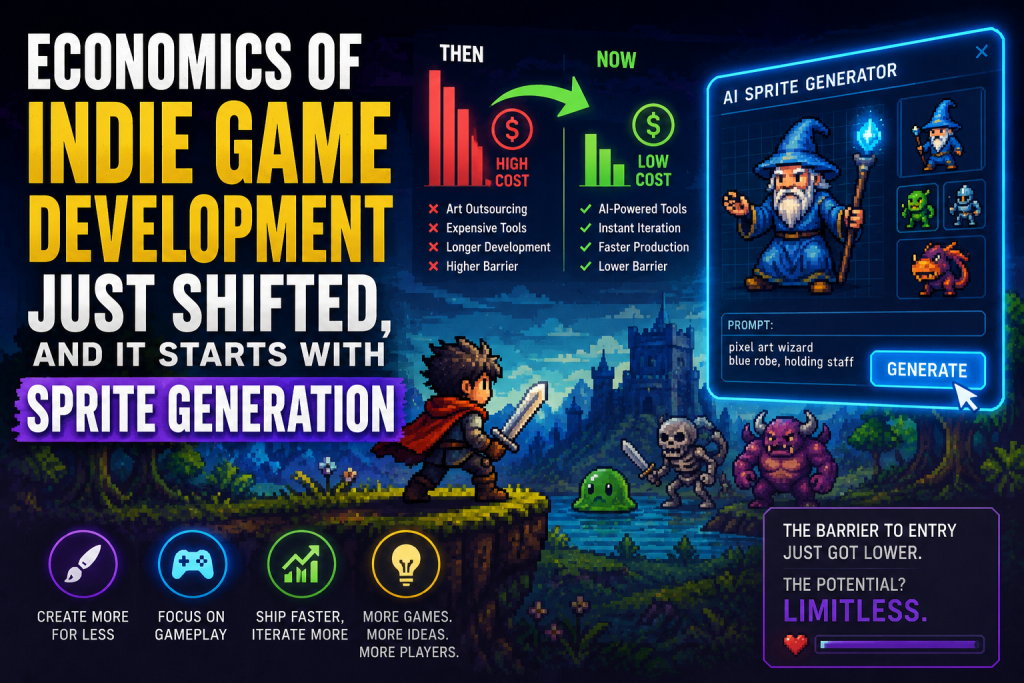
When developers talk about the cost of character art, they usually focus on the obvious number: the invoice from a freelance artist. Professional sprite artists typically charge $200 to $350 for a static character, $500 to $1,500 for an animated character with a walking cycle, and $800 to $5,000 for a complete sprite sheet. Those numbers are intimidating, but they are only part of the story. The hidden cost is time. A single animation frame in Aseprite or Photoshop takes thirty to one hundred twenty minutes to complete. A walking cycle of eight frames consumes four hours. A complete character with idle, walk, run, jump, and attack animations adds up to over twenty hours of work. At an hourly rate of $30 to $50, that is another $600 to $1,000 in opportunity cost. By the time you factor in revisions, style drift, and the sheer mental exhaustion of drawing frame after frame, the true cost of a single character can easily exceed $5,000.
This is where the conversation around AI Sprite Generator starts to get interesting. The platform does not claim to replace professional artists. It claims to change the math. Instead of twenty hours per character, the workflow promises twenty minutes for a complete character with all essential animations. Instead of $500 to $5,000 per character, the pricing starts free and scales to under $5 per character for ongoing use. Those are not incremental improvements. They are orders of magnitude.
Breaking Down the Cost Structure: What You Actually Pay For
To understand whether this math holds up in practice, it helps to break down what you are actually paying for when you generate sprites the traditional way versus using an AI-powered approach. The comparison is not just about dollars—it is about what each method delivers and where the value actually accumulates.
The Traditional Pipeline: Labor-Intensive and Inflexible
Manual sprite creation is expensive because it is labor-intensive. Every frame requires individual attention. Every character variation requires redrawing every frame from scratch. Every new animation type adds another cycle of work. The cost is linear: more characters, more frames, more animations all scale directly with time and money. This creates a perverse incentive structure. Developers who cannot afford to hire artists either limit the scope of their game or rely on asset packs that compromise their creative vision. Asset packs cost $20 to $200 and offer instant gratification, but they come with a hidden tax: every other developer using the same pack produces games that look visually identical. Your game loses its visual identity before it even launches.
The AI Pipeline: Fixed Cost, Variable Output
The AI-powered approach flips this model. The cost is not tied to the number of frames or characters. Once you train a style using three to five reference images, the system locks your color palette, line thickness, detail level, and proportions. Every subsequent generation uses those locked parameters, meaning the cost of generating your tenth character is identical to the cost of generating your first. This changes the economics of game development in a fundamental way. Instead of deciding whether you can afford to include a character, you decide whether the character adds value to your game. The financial constraint shifts from “can we draw this?” to “should we include this?” That is a much healthier creative question.
Testing the Economics: A Weekend Experiment
To test whether the platform actually delivers on its economic promises, I ran a weekend experiment. The goal was to generate a complete cast of characters for a small RPG—not a hero character that would receive bespoke attention, but the supporting cast: the town NPCs, the shopkeepers, the enemy variants, the background characters that populate a game world but rarely justify the cost of professional art.

The Setup: Forty Characters in Two Days
I started with a single character base: a fantasy adventurer in a semi-realistic 2D cartoon style. I uploaded five reference images—concept sketches I had commissioned for a previous project—and let the style lock train. The training took about three minutes. From there, I generated the base character with a full animation set: idle, walk, run, jump, attack, hit reaction, and death. The complete set generated in roughly seven minutes for the first run.
Then came the variations. I changed the color palette to create different armor tiers: leather, iron, steel, and mythril. I changed equipment configurations: sword and shield, two-handed axe, bow, and staff. I changed outfits for NPC variations: merchant clothes, guard uniforms, peasant garb, and noble attire. Each variation took about ninety seconds to regenerate. By the end of the weekend, I had generated forty unique characters, each with a full animation set, all sharing the same locked style. The total time investment was under four hours of active work. The total cost was negligible.
The Quality Assessment: Consistent but Not Perfect
The results were visually coherent. Every character shared the same line weight, the same color saturation, the same proportional rules. The walking cycles were smooth, the attack animations had readable arcs, and the idle loops felt natural. The style consistency across forty characters was genuinely impressive—frame one and frame one hundred looked like they came from the same artist.
The limitations were also apparent. The animations had a slightly procedural quality. They were correct but not inspired. The weight shifts in the walking cycles were functional but lacked the subtle personality that a skilled animator might inject. The attack animations were readable but did not convey the specific fighting style of each character. For NPCs and enemy variants, this was entirely acceptable. For a hero character intended to carry the emotional weight of the game, I would still want to bring the frames into Aseprite for polish. The platform itself acknowledges this workflow, suggesting that developers use it for the bulk of their sprites and reserve manual tools for hero characters.
Where the Economics Work Best: A Practical Framework
The platform is not a universal solution. It is a targeted tool that excels in specific scenarios. Understanding where it fits in your development pipeline is essential to evaluating its economic value.
Rapid Prototyping and Game Jams
For developers who need to test gameplay mechanics before committing to a visual style, the platform is transformative. The ability to generate a complete character with all essential animations in under thirty minutes means you can prototype ideas that would otherwise require weeks of art preparation. Game jam participants, in particular, benefit from this speed—one user reported submitting a game jam project with custom sprites instead of free asset packs and winning second place.
Bulk Character Generation
For RPGs, strategy games, and idle games that require dozens or hundreds of unique characters, the platform delivers economies of scale that are impossible to achieve manually. One developer generated forty-seven unique character sprites in a single weekend. Another generated over two hundred enemy sprites in a retro sixteen-bit style. These are not edge cases—they are the natural use case for a tool that separates style training from character generation.
Character Variations and Customization
For games that offer player customization, equipment tiers, or unlockable cosmetics, the platform is nearly ideal. Traditional approaches require redrawing every animation frame for every variation—a process that can exceed twenty hours per variation. The platform regenerates variations in about three minutes by changing only the color palette or equipment settings. One mobile game developer created thirty character variations in two hours, a task that would have cost approximately $15,000 from a professional artist.
The Limitations You Need to Know
A responsible economic analysis must acknowledge what the platform does not do well. First, the quality of the output is directly tied to the quality of the reference images. Uploading rough sketches produces rough results. The platform is not a magic wand—it is a tool that amplifies the quality of your inputs. Second, the animations, while consistent, lack the expressive nuance of hand-crafted work. For hero characters, narrative moments, or emotionally charged scenes, the results may feel mechanical. Third, complex character designs with asymmetrical details, flowing capes, or non-human proportions may require multiple generation attempts. The result may vary, and in some cases, manual adjustment in Aseprite is still necessary.

The Verdict: A New Economic Reality for Indie Developers
The platform does not eliminate the need for artists. It eliminates the need for artists to do repetitive, high-volume work. This distinction is crucial. The most productive workflow I found was a hybrid approach: generate all base animations in the platform, then selectively polish key frames in Aseprite. This delivers production-ready assets in a fraction of the time while preserving the option for artisanal refinement where it matters most.
For solo indie developers, the economic impact is significant. A professional sprite artist charges an average of $1,500 per character. The platform generates fifty or more characters for a fraction of that cost. For a three-person indie studio, the ability to prototype game ideas ten times faster means more iterations, better gameplay, and faster time to market. For game design students and hobbyists, it means the difference between submitting a game with custom sprites and submitting one with generic asset packs.
The math is not complicated. Twenty hours versus twenty minutes. Five thousand dollars versus five dollars. One character versus fifty characters. When the trade-offs shift this dramatically, the creative possibilities expand in ways that are difficult to overstate. AI Sprite Generator does not promise to make you a better artist. It promises to make you a more productive game developer. In my testing, that promise holds up.

Ashley Rosa is a freelance writer and blogger. As writing is her passion that why she loves to write articles related to the latest trends in technology and sometimes on health-tech as well. She is crazy about chocolates. You can find her at twitter: @ashrosa2.