The Old Workflow Was Quietly Killing Independent Creators
For years, solo creators faced an impossible choice: spend endless hours mastering complex software like Photoshop, After Effects, and DaVinci Resolve, or accept that their visual output would always lag behind well-funded studios. A single polished product shot used to take three to four hours, factoring in lighting setup, retouching, background work, and color grading. A 15-second cinematic intro? Easily a full workday, sometimes two.
This bottleneck didn’t just slow creators down — it shaped what they were willing to attempt. Ambitious ideas got shelved. Concepts that needed twenty variations got reduced to two. The friction between imagination and execution became the silent ceiling on creative careers.
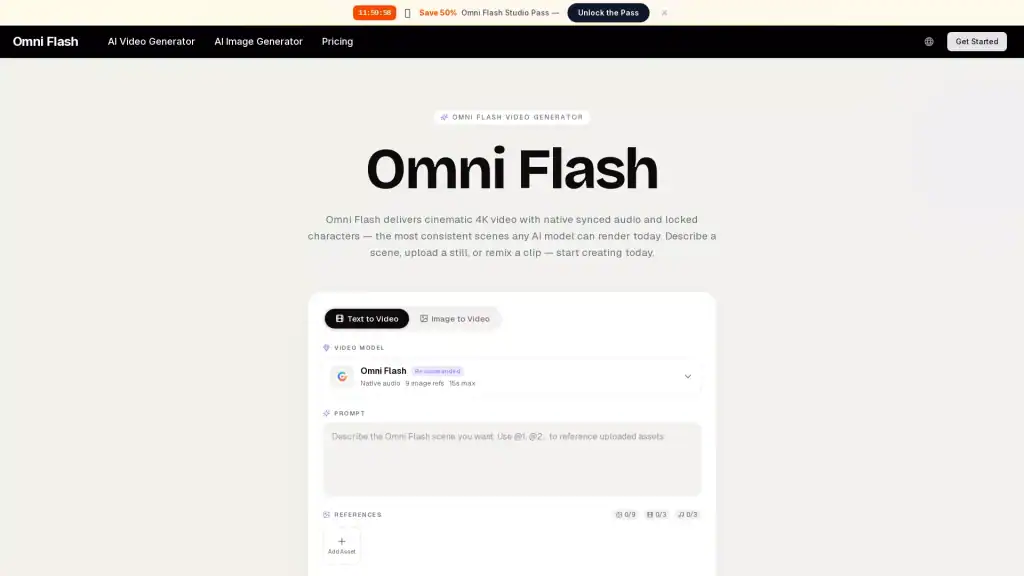
Omni Flash is dismantling that ceiling, and the numbers are genuinely difficult to believe until you watch it happen.
What Actually Changed
The shift isn’t about AI being “faster than before.” It’s about a structural collapse in the time required to move from idea to finished asset. Tasks that once required eight hours of specialist labor now finish in roughly eighty seconds. That’s not a marginal improvement — it’s a 360x compression of the creative pipeline.
A few concrete examples of what solo creators are now producing in under two minutes:
- Cinematic product reveals with dynamic lighting, depth-of-field shifts, and brand-consistent color palettes
- Multi-shot promotional sequences featuring continuous character identity across scenes
- Editorial-grade lifestyle imagery with controlled composition, mood, and photographic realism
- Concept boards and pitch visuals that previously required hiring a freelance illustrator
The reason this matters: a creator running a one-person brand can now produce in a single afternoon what used to require an entire production team working for a week.
Why Speed Alone Isn’t the Story
Plenty of AI tools are fast. The harder problem has always been quality at speed — output that doesn’t immediately announce itself as machine-generated through warped hands, inconsistent lighting, melting text, or that distinctive “AI sheen” that audiences have learned to spot within seconds.
What separates Omni Flash is that the compression happens without the usual quality tax. Faces stay coherent. Brand colors stay accurate. Text inside images renders cleanly. Character consistency holds across multiple generations, which is the single hardest problem in this space and the one that most tools quietly fail at.
For creators who’ve been burned by impressive demo reels that don’t survive contact with real client briefs, this is the meaningful upgrade. Output is no longer something you generate and then spend two more hours fixing in post.
The Hollywood Comparison Isn’t Marketing Hyperbole
“Hollywood-level output” gets thrown around loosely, so it’s worth being specific about what creators are actually achieving. We’re talking about visuals with intentional cinematography — considered framing, motivated lighting, depth that reads as photographic rather than rendered. The kind of imagery that, until recently, required a director of photography, a gaffer, a colorist, and a post-production supervisor.
A solo creator building a Shopify brand can now produce a launch campaign with the visual polish of a major streaming platform’s promotional materials. A YouTuber can generate cold-open sequences that look like they came from a Netflix documentary. A newsletter writer can illustrate articles with editorial photography that rivals what major publications commission from working photographers.
The democratization isn’t theoretical anymore. It’s happening on individual laptops, in single afternoons, by people who don’t own a single lens.
What Solo Creators Are Doing With the Extra Hours
The most interesting development isn’t the time saved — it’s what creators are doing with that reclaimed time. When production collapses from eight hours to eighty seconds, the bottleneck shifts. Suddenly the limiting factor isn’t execution; it’s ideas, taste, strategy, and audience understanding.
Smart creators are using this shift to:
Test more concepts. Instead of committing to one campaign direction, they generate twenty variations and let data decide. This is the kind of A/B-driven creative process that was previously gated behind agency budgets.
Ship more often. Daily content cadences that used to require a team are now sustainable for individuals. Consistency, the single biggest predictor of audience growth, is no longer locked behind production capacity.
Move into higher-value work. The hours saved on execution flow into strategy, audience research, partnership development, and the kind of work that actually grows a business. Pure production time was always the lowest-leverage activity for a solo creator.
Take on bigger clients. Freelancers who could only handle two or three clients due to production load are now serving eight or ten. The same creator with the same skills can suddenly run a far larger operation.
The Accessibility Question
A reasonable concern with any premium creative tool is whether the pricing locks out the very creators it claims to empower. This is where Gemini Omni Flash free tier matters — it lets creators actually test the workflow against their real projects before committing financially. Demos lie; your own brief doesn’t.
For creators who decide to scale up, the Gemini Omni Flash pricing structure is built around usage rather than seat-based licensing, which fits how solo creators actually work. You pay for what you generate, not for a flat enterprise fee that assumes you have a team.
What This Means for the Next Twelve Months
The competitive landscape for solo creators is about to fracture. There will be creators who absorb this workflow shift quickly and start producing at a volume and quality that was impossible eighteen months ago, and there will be creators who stay anchored to legacy production habits and watch their output get out-paced.
This isn’t a prediction about AI replacing humans — it’s the opposite. The creators who win the next phase will be the ones whose taste, judgment, and storytelling instincts get amplified by tools that finally match the speed of their thinking. The execution gap has closed. What’s left is the part that always mattered most: knowing what’s worth making, and knowing why anyone should care.
For solo creators who’ve spent years constrained by production time, this is the structural shift you’ve been waiting for. The tools have finally caught up to the ambition.

Caroline is doing her graduation in IT from the University of South California but keens to work as a freelance blogger. She loves to write on the latest information about IoT, technology, and business. She has innovative ideas and shares her experience with her readers.