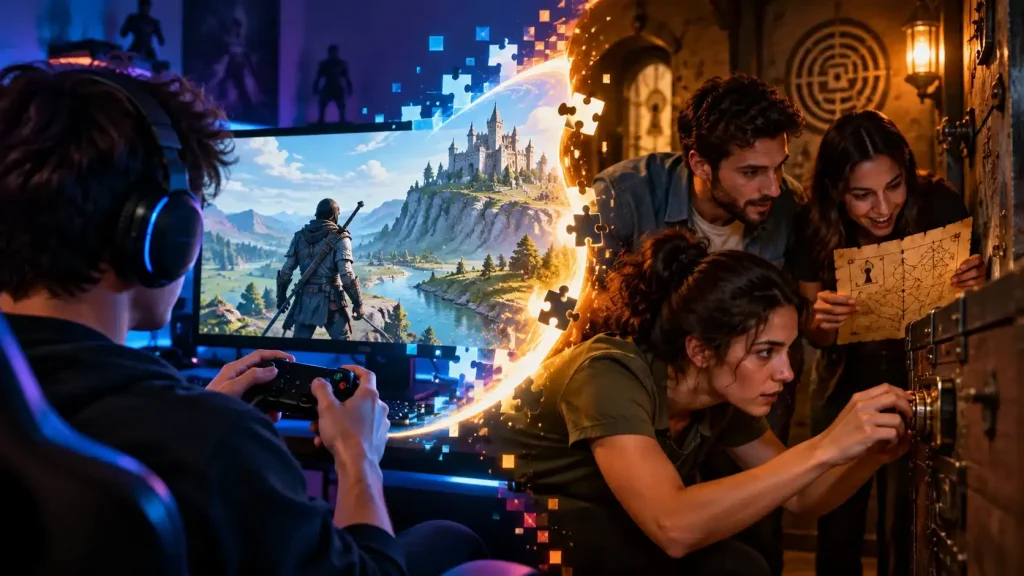
Gaming has changed far beyond sitting in front of a screen with a controller. Players now move between console games, tabletop games, VR, interactive theater, and other forms of entertainment where they can take an active role in what happens.
Escape rooms fit naturally into that mix.
Instead of controlling a character, players enter the environment themselves. Objects can be touched. Clues can be physically examined. Communication happens face to face, and every decision is made while a real clock is running.
For people who already enjoy puzzle games, adventure titles, mysteries, or cooperative multiplayer games, the similarities are easy to recognize. An escape room takes many familiar game mechanics and moves them into a physical space.
Why Escape Rooms Feel Familiar to Video Game Players
Most games are built around a basic cycle: discover information, understand what it means, make a decision, and see the result.
Escape rooms work in much the same way.
A team may enter a room without knowing exactly what matters. Players begin exploring the environment, finding objects, noticing patterns, opening new areas, and gradually understanding how different pieces connect.
That structure is familiar to anyone who has played an adventure or puzzle game.
There are also clear parallels with common video game mechanics:
- locked areas that require progress before they can be accessed;
- environmental clues hidden in the surroundings;
- objects that become useful later;
- puzzles based on patterns, sequences, symbols, or logic;
- story details revealed through exploration;
- several players working on different problems at the same time.
The main difference is the interface. There is no mouse, controller, or inventory screen. The room itself becomes the game interface.
That physical element changes how players approach problems.
A key hidden behind an object can be more satisfying to find when you actually have to search the room. A mechanism feels different when you activate it yourself rather than pressing a button on a screen.

Cooperative Gaming Works Differently in an Escape Room
Online multiplayer games let people communicate quickly, assign roles, and react to changing situations. Escape rooms require many of the same skills, but communication becomes much more immediate.
Players cannot see everything their teammates see.
Someone might discover a sequence of numbers on one side of the room while another player finds a lock that accepts a numerical code. Unless they communicate, neither piece of information is useful.
That creates a constant flow of short interactions:
“I found something.”
“Does anyone need four numbers?”
“Have we used this key?”
“What changed when you did that?”
Good teams naturally begin dividing responsibilities. One person may be strong at visual patterns. Another may notice details others miss. Someone else keeps track of which objects have already been used.
There is usually no formal class system like there would be in an RPG, but informal roles still appear.
The strongest team is rarely the one with a single brilliant puzzle solver. It is usually the group that shares information quickly and pays attention to what everyone else is doing.
Escape Room Puzzles Reward More Than Logic
The phrase “puzzle game” can make people think primarily about mathematics or difficult riddles. In practice, escape room challenges can involve several different types of thinking.
Some depend on observation. A player may need to notice that several objects share the same markings.
Others rely on sequence or spatial reasoning. Players might need to arrange physical pieces correctly or determine how several parts of the environment relate to one another.
There may also be search tasks, word puzzles, mechanical interactions, or challenges where the important part is discovering what the puzzle is asking in the first place.
This variety matters because teams rarely contain people who think in exactly the same way.
A person who struggles with one puzzle may immediately understand another.
That is also why previous escape room experience is helpful but not always decisive. Familiarity with common puzzle patterns can speed things up, but observation, communication, and experimentation remain important.
Immersive Escape Rooms Turn the Environment Into Part of the Game
One major difference between a basic puzzle room and a stronger escape room experience is how closely the puzzles connect to the setting.
In an immersive game, the environment is more than decoration.
A laboratory can make scientific equipment part of the interaction. A heist scenario can turn searching, timing, and hidden objects into part of the story. A darker mystery room can use limited information and atmosphere to change how players approach otherwise simple tasks.
This is close to environmental storytelling in video games.
Rather than stopping the action for a long explanation, the space itself provides information about what happened and what the player should investigate next.
Seattle-based Cognition Escapes uses this approach across several different themes. Its current lineup includes a secret laboratory mystery, a heist, a dark suspense scenario, and an adventure built around portals leading to different destinations.
Players interested in seeing the available games can find them at https://cognitionescapes.com/.
The variety also shows why “escape room” is a fairly broad term. Two games can use the same basic format — a team, puzzles, and a time limit — while creating very different experiences.
Why Time Limits Make Puzzle Games More Intense
A puzzle solved at home can be left for five minutes while you get a drink or check your phone.
An escape room keeps moving.
Most games have a defined time limit, which creates pressure without needing complicated competitive rules. Teams know that every unsuccessful attempt uses a little more of their remaining time.
That changes player behavior.
People become more willing to speak up. They test ideas faster. They stop working on puzzles that are going nowhere and ask teammates for help.
The countdown also produces some of the most memorable moments.
Finding an important clue with plenty of time remaining feels good. Solving the final sequence with only a few minutes left feels completely different.
The puzzle itself might be identical, but the context changes the emotional response.
Video games use timers for the same reason. A time limit can turn a normal task into a tense one.
Real-World Puzzle Games Create Memorable Team Moments
Digital multiplayer games can produce great stories between friends: last-second victories, unexpected mistakes, or plans that somehow work.
Escape rooms create similar moments, but everyone experiences them in the same physical space.
There is something different about watching a teammate suddenly understand a clue after everyone has been stuck for several minutes.
The reaction is immediate. So is the celebration when a mechanism opens or a hidden part of the room is revealed.
Those moments also explain why escape rooms work well for groups with different levels of gaming experience.
Someone who rarely plays video games can still search the environment and contribute ideas. A regular gamer may quickly recognize familiar puzzle logic. Another person might simply notice something everyone else overlooked.
Nobody needs to learn a complicated control scheme before participating.

Escape Rooms Combine Games With Physical Exploration
One reason physical escape games remain interesting even as digital entertainment improves is that they offer something screens cannot fully reproduce: direct interaction with a shared environment.
Players can walk around it, inspect it from different angles, hand objects to one another, and react to changes happening directly in front of them.
The activity sits somewhere between a puzzle game, an adventure game, and interactive theater.
It also removes some of the barriers common in other types of gaming. There is no hardware to buy, no character build to prepare, and usually no need to understand a complicated set of rules before starting.
The game teaches players what matters through exploration.
For gamers, that can make an escape room feel surprisingly familiar even on a first visit.
From Digital Games to Real-World Adventures
Video games and escape rooms use different technology, but many of the ideas behind them are closely related.
Both ask players to explore systems, identify patterns, experiment with possible solutions, and keep moving after unsuccessful attempts.
Both can also turn cooperation into part of the challenge rather than something happening around it.
The biggest change is simple: instead of exploring a virtual environment through a character, players step directly into the game themselves.
For people who enjoy mysteries, cooperative games, puzzle adventures, or environmental storytelling, that makes escape rooms one of the clearest examples of gaming moving beyond the screen.

Amanda Lancaster is a PR manager who works with 1resumewritingservice. She is also known as a content creator. Amanda has been providing resume writing services since 2014.