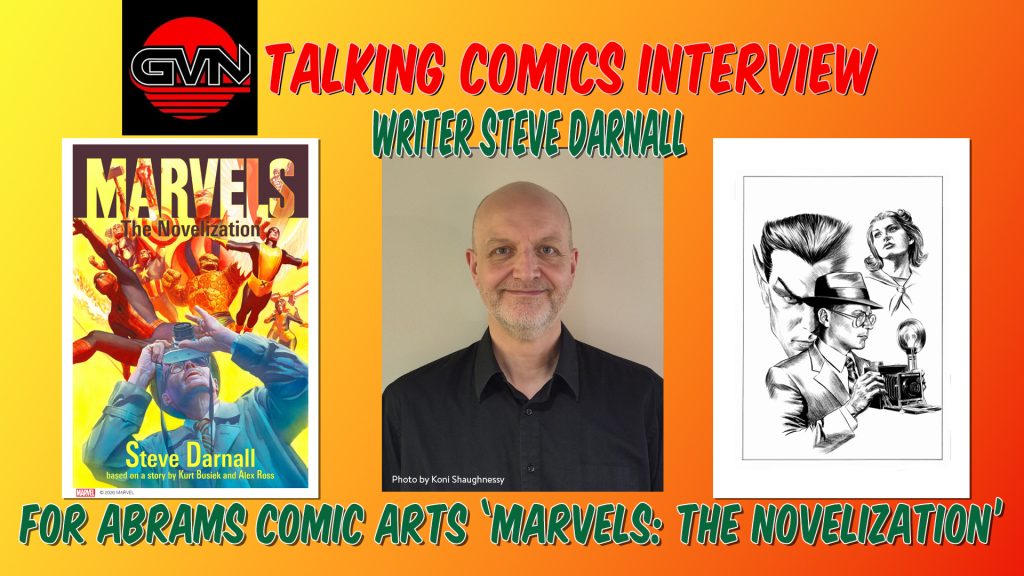
In 1994, Marvel Comics debuted a four-issue mini-series called Marvels, written by Kurt Busiek and brought to life by Alex Ross’s stunning artwork, captivating comic fans around the globe. The series, which spans from 1939 to 1974, explores the Marvel Universe—the common setting for most of Marvel’s superhero stories—through the eyes of an everyman character, news photographer Phil Sheldon. This street-level series depicts everyday life in a world filled with costumed superhumans, with each issue highlighting significant events in the Marvel Universe as seen by Sheldon.
Today, we’re stepping into rare territory—an adaptation that doesn’t just revisit that classic story, but reframes it through an entirely new lens.
Coming May 19th, Abrams ComicArts has brought us Marvels: The Novelization, a prose reimagining of the groundbreaking graphic novel by Kurt Busiek and Alex Ross. And at the center of this ambitious transformation is Steve Darnall, a writer who understands both the mythology and the humanity that made Marvels a landmark. Translating Phil Sheldon’s world from painted pages to prose isn’t just a challenge—it’s an act of interpretation, expansion, and deep respect for the source material.
In this recent conversation, we dig into how Steve approached adapting a story defined by its visuals, how he collaborated with the legacy of Busiek and Ross, and what new emotional textures emerge when Marvels becomes a novel. From narrative structure to character voice to the responsibility of revisiting a modern classic, this is a rare look behind the curtain of a project that bridges mediums and generations. So, let’s welcome Steve Darnall to GVN Talking Comics.
Creative Beginnings
GVN: Thank you for sharing just a bit of your day, Steve. Since this is our first chance to chat, let’s start with a bit of your creative beginnings. When did you first take an interest in writing and, in comics in particular, and whose work inspired that ambition?
STEVE: I’ve been in love with writing for most of my life and luckily, it’s the sort of interest that’s taken multiple forms, from newspapers to magazines to scripts. My interest in writing for comics goes back to the late ‘80s-early ‘90s, which is around the time I really started getting interested in the medium. A number of publishers were repackaging classic material — which is how I learned about the work of people like Will Eisner and Jack Kirby and Basil Wolverton, among others — and at the same time, people like Alan Moore and Dan Clowes and Jaime and Gilbert Hernandez were among those doing some really interesting work. I became fascinated with learning how these stories were put together — and since I knew I wasn’t a very good artist, I thought “I should learn to write them.”
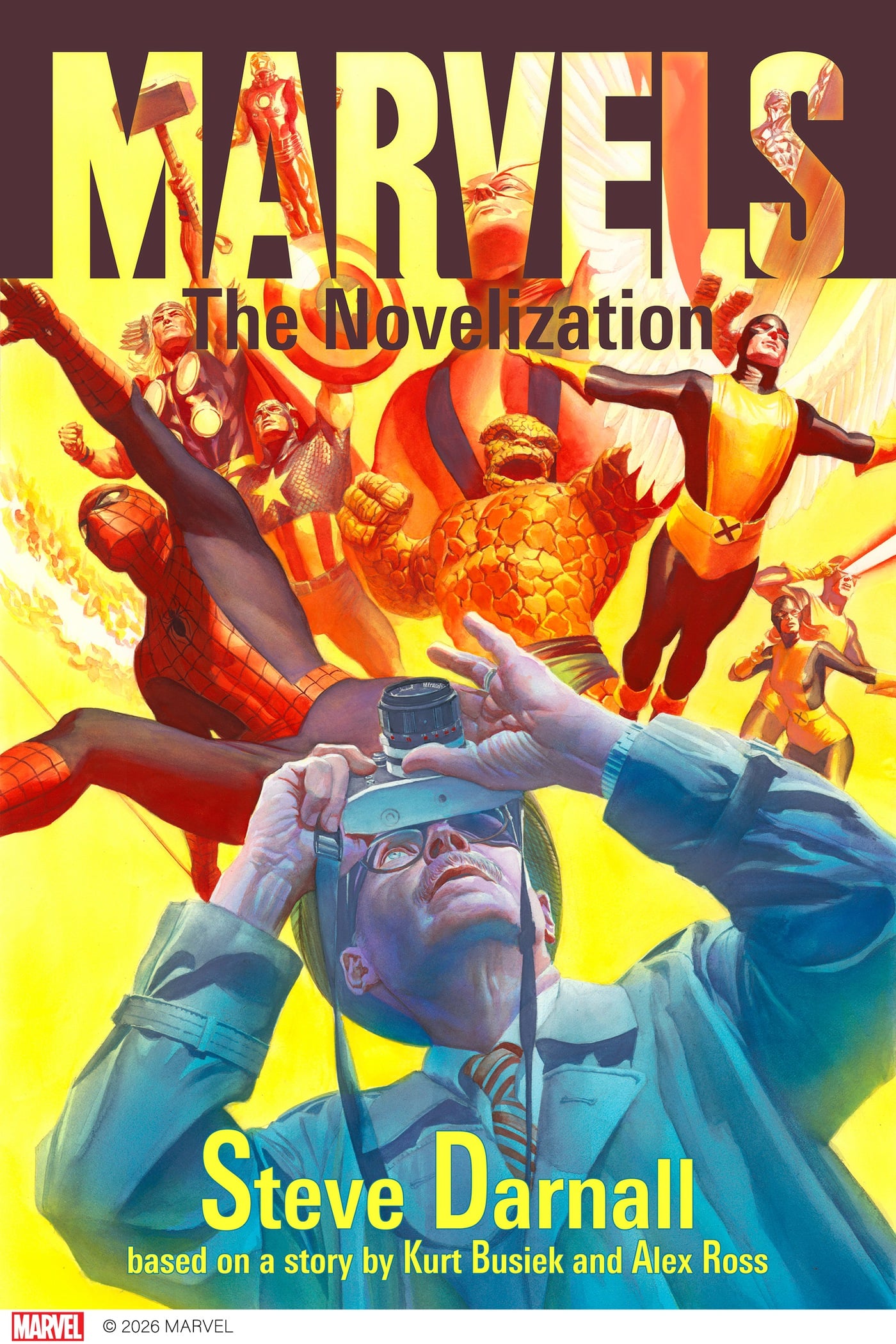
GVN: So, let’s get to the meat and potatoes of this discussion, and that is your prose adaptation of Alex Ross and Kurt Busiek’s Marvels series. What drew you to the idea of transforming Marvels—a story so rooted in its visual impact—into a prose novel, and what did you see as the biggest creative opportunity in doing so?
STEVE: There was a lot about this project that appealed to me. You know, every writer likes to imagine they’ve got a novel in them, and here was a chance to write one that I knew had a great story behind it. I liked the idea of taking what Kurt and Alex had done and telling it in a different way — and maybe allowing readers to make some new discoveries as a result.
I’ll admit that I was also intrigued by the idea of revisiting the past. As some people might know, I had a very small role in the birth of Marvels, when I collaborated with Alex on an eight-page Human Torch story that found its way to Kurt Busiek — and the rest, of course, is history. I really appreciated the chance to re-immerse myself in the world they created… and in doing so, to also revisit the Marvel Universe that inspired them.
“Capturing the Emotional Quality”
GVN: The original series is known for its grounded, human take on superheroes. What was your approach to capturing young photojournalist Phil Sheldon’s voice and perspective in prose while preserving the original’s emotional impact?
STEVE: As you say, my real interest was in capturing the emotional quality of the story. I thought it might work to my advantage if we treated the book as an actual book — that is, Phil Sheldon’s book, in which he talks about his life and his experiences covering the Marvels. That decision was helpful in terms of adapting the original text to fit that conceit, and adjusting it when the occasion demanded.
Prose Helps Set the Scene
GVN: Novelizations often allow for new layers of interiority. Were there particular characters or moments in Marvels where you feel that prose opened doors that the comic format couldn’t?
STEVE: Oh, absolutely. Kurt and Alex had a very specific format — four issues, 48 pages an issue — and they had to make everything work within those parameters; if something didn’t fit, it didn’t happen. With prose, you have the luxury of using the words you need to set the scene. That meant that I could take a moment from the original story and perhaps expand on it, or I could create new scenes or dialogue that would hopefully add a little more context — a chance to fill in some blank spaces, as it were. For instance, the new book contains a scene between Phil and Betty Dean in which they discuss her relationship with the Sub-Mariner. In turn, that scene gave Phil a chance to reflect on some of the assumptions he’d been making about his own relationships.
Working with Alex Ross
GVN: You’ve worked with Alex Ross for years. How did your long‑standing creative relationship influence the way you approached this adaptation, especially knowing he’d be providing new illustrations?
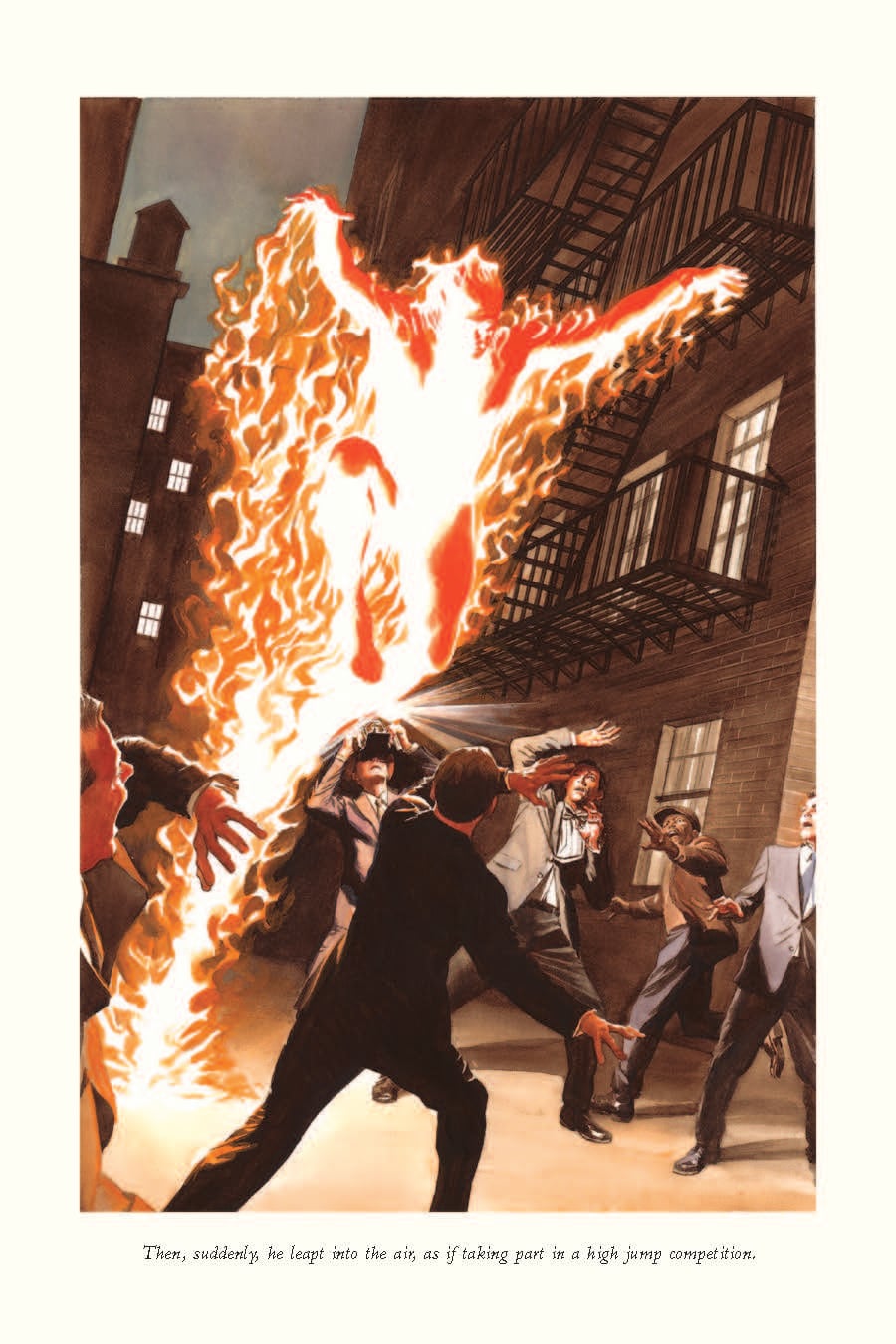
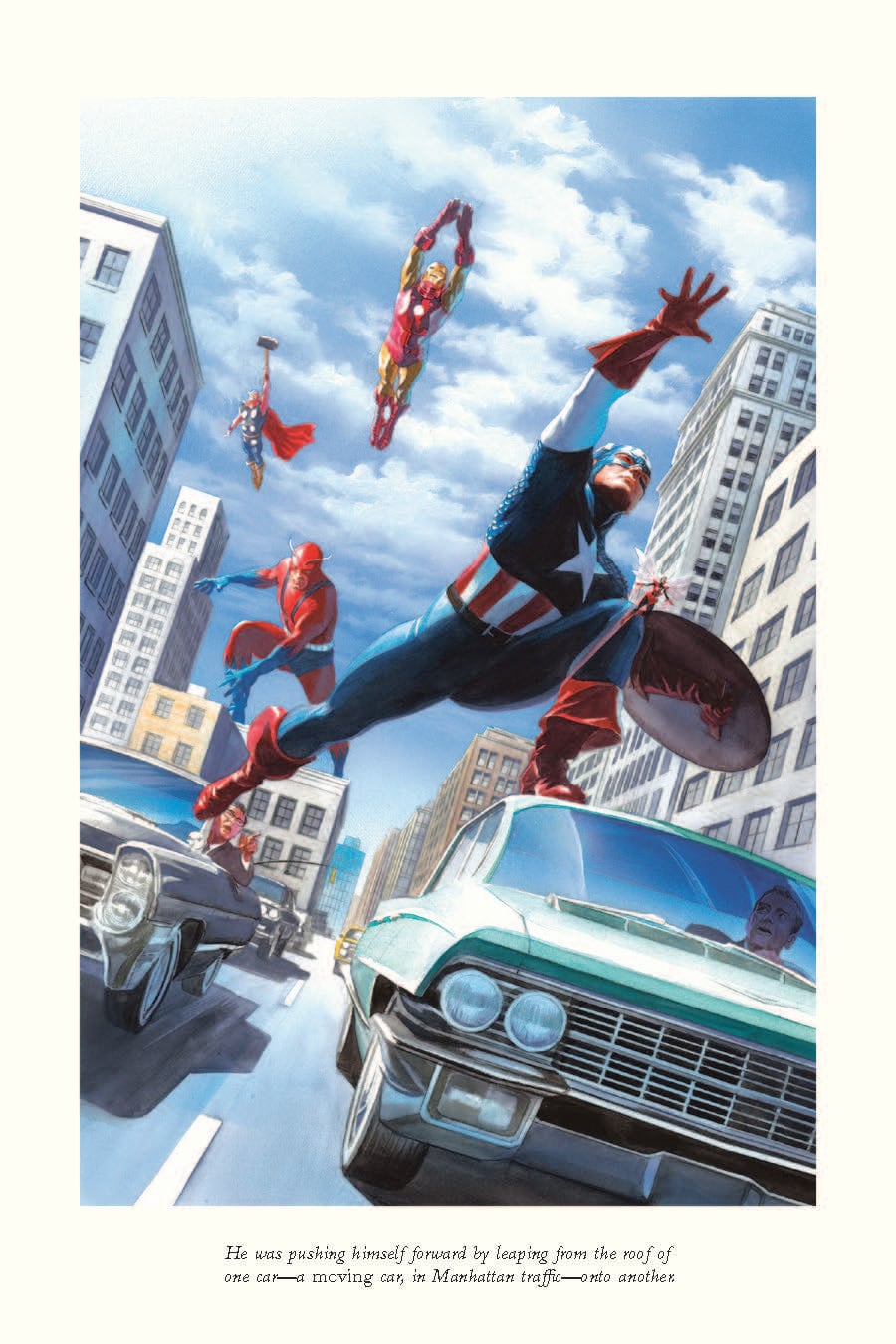
STEVE: I was over the moon when I heard Alex would be contributing new illustrations. They remind me of the kind you’d see in old Frank Merriwell books, with one image from a specific scene and a single line of dialogue at the bottom.
Working with Alex has always been easy and fun. We’re friends first and foremost, so we’ve always respected the collaborative process. When one of us has an idea or a suggestion, it’s with the idea of improving the story; it’s never about ego. If we can make an idea work, we do. If we can’t, we’ll put our heads together until we find one that does.
No Modernization Needed
GVN: The Marvel Universe has evolved dramatically since the original Marvels was published. Did you feel any pressure—or temptation—to subtly update the tone or context for modern readers, or was fidelity to the 1994 spirit your guiding star?
STEVE: I don’t think that idea occurred to anyone, for which I’m very grateful. The point of Marvels was that it took readers from the “beginnings” of the Marvel Universe in 1939 into the 1970s. To take it out of that setting in the name of “modernization” would make it a different, and not necessarily better, book. Certainly I had no interest in taking Kurt and Alex’s marvelous story and turning it into another story entirely.
Challenges
GVN: What was the most challenging scene to adapt into prose, either because of its visual complexity or its emotional resonance, and how did you solve that challenge on the page?
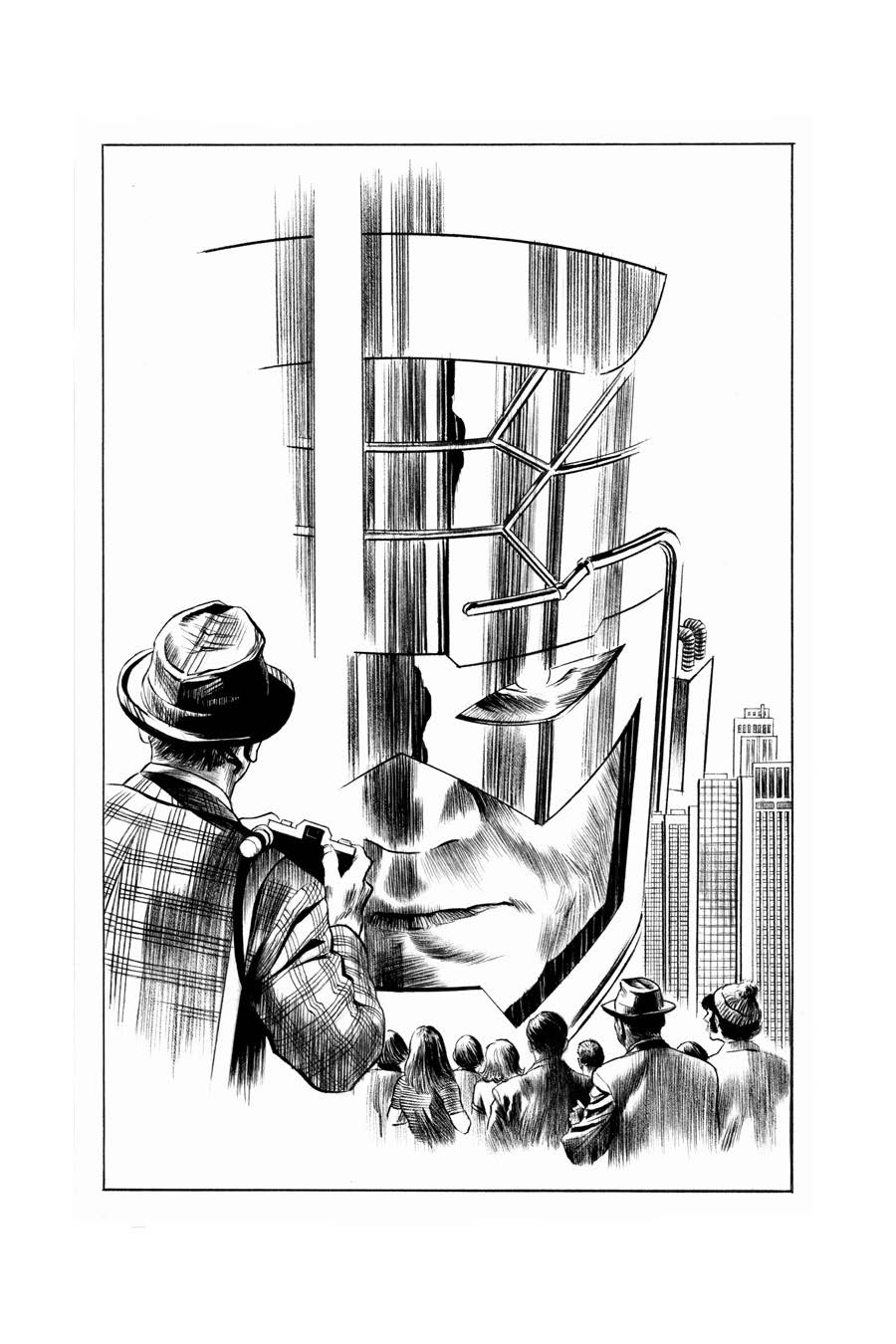
STEVE: I don’t know if “challenging” is the word I’d use, but one scene I recall that required some adjustments involved the arrival of Galactus and New York City’s response. I had forgotten that the original comic included a couple of cutaways to other parts of the city; as a result, I think it’s the only time in the series where something takes place outside of Phil’s immediate frame of reference, so to speak. One by-product of working around those scenes is that we got to add some new moments to Phil’s experience that day, which I hope will provide a little extra emotional weight.
Fan Appreciation
GVN: Thanks again, Steve. Finally, for readers who know Marvels by heart, what do you hope they’ll discover in this novelization that feels genuinely new or surprising?
STEVE: Well, this version has a lot less artwork, for one thing! (Laughs)
Seriously, it’s my hope that the people who read the novel will enjoy the ride and come away from it with a greater appreciation of these characters and the time in which their story took place.
After talking with Steve, one thing becomes unmistakably clear: Marvels: The Novelization isn’t just a prose adaptation—it’s a thoughtful act of translation. Darnall approaches Busiek and Ross’s landmark work with the care of a historian, the instincts of a storyteller, and the reverence of someone who understands exactly why Marvels still hits like a revelation three decades later.
He’s not simply retelling Phil Sheldon’s journey; he’s reframing it, expanding it, and giving readers a new vantage point on a story they thought they already knew. That’s the magic of this project—and the reason this novelization feels less like an echo and more like a companion piece worthy of the original.
We offer a huge thanks to Steve for taking the time to walk us through the craft, the challenges, and the joy of revisiting one of Marvel’s most enduring masterpieces. And if you haven’t already, make sure to check out Marvels: The Novelization from Abrams ComicArts—it’s a must‑read for anyone who loves the intersection of comics history, character, and mythmaking.

Senior Writer at GeekVibesNation – I am a 60 something child of the 70’s who admits to being a Star Trek/Star Wars/Comic Book junkie who once dove headfirst over a cliff (Ok, it was a small hill) to try to rescue his Fantastic Four comic from a watery grave. I am married to a lovely woman who is as crazy as I am and the proud parent of a 21-year-old young man with autism. My wife and son are my real heroes.