

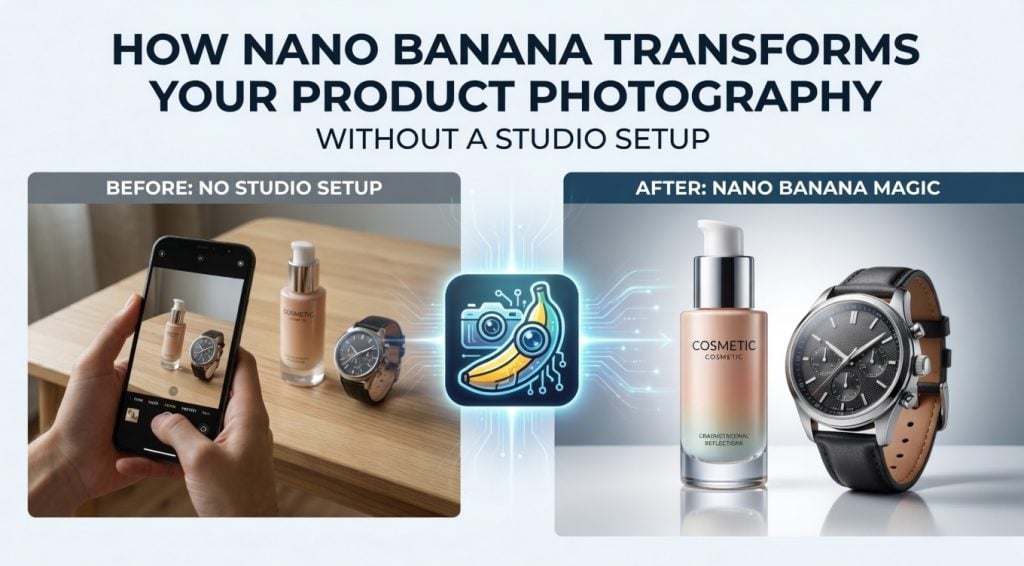
Product photography has always been one of the most expensive parts of running a product-based business. Whether you sell handmade candles, custom sneakers, or artisan ceramics, getting your products to look their best in images traditionally meant renting a studio, hiring a photographer, buying lighting equipment, and spending hours in post-production. For small businesses and solo entrepreneurs, that cost adds up fast — and the results were never guaranteed.
That equation is changing. AI image generation tools have matured to the point where they can produce commercially viable product visuals without a single physical prop, backdrop, or camera shutter. Among the tools making this shift possible, Nano Banana has become a go-to option for sellers who want professional-looking product images on their own schedule and budget.
The Traditional Product Photography Problem
Think about what goes into a standard product shoot. First, you need the product itself to be camera-ready — clean, styled, positioned correctly. Then you need a backdrop, usually white seamless paper or a styled surface that fits the brand. Lighting is its own discipline entirely: softboxes, reflectors, and diffusers all play a role in making a product look its best rather than flat and lifeless.
Once the shoot is done, the work continues. Images need to be culled, color-corrected, retouched, and exported at the right dimensions for each sales channel. Marketplace platforms like Amazon, Etsy, and Shopify all have their own image requirements. A single product might need a white-background hero shot, a lifestyle image, a detail close-up, and a size comparison shot.
For a product catalog of twenty items, this process can take days. For a catalog of two hundred, it can take months — or require a dedicated in-house team.
What AI Image Generation Actually Offers
The promise of AI image generation for product photography is not just speed, though speed is a real benefit. The deeper opportunity is flexibility. With the right tool, you can generate a product visual in a specific context — say, a ceramic mug sitting on a weathered oak table next to a linen napkin and a sprig of dried lavender — without assembling any of those props in a physical space.
You can iterate rapidly. If the first version of the image has a background that feels too busy, you adjust the prompt and generate again. If your brand direction shifts from minimalist to warm and rustic, you can regenerate your entire visual library to match without reshooting a single product.
The key is that the output quality has to meet a real commercial standard. Blurry textures, distorted product labels, or inconsistent lighting between images will undermine trust with buyers. This is where the quality of the underlying model matters enormously.
How Nano Banana Approaches Product Visuals
Nano Banana Pro is built with a strong emphasis on photorealistic output, which makes it particularly well-suited to product photography applications. The model understands how light interacts with different surface types — matte packaging, glossy ceramics, translucent glass, brushed metal — and renders those qualities in a way that reads as credible rather than artificially smooth.
One of the consistent challenges with AI product images is maintaining accurate color representation. A product that looks warm amber in the generated image but ships in a cooler tan creates immediate trust problems with buyers. Nano Banana handles color fidelity with enough precision that sellers can use the generated images as genuine representations of their products, not just approximate mood boards.
The platform also allows for fine-grained control over composition. Sellers can specify the angle — flat lay, three-quarter view, straight-on — and the general environment, from studio-white to styled lifestyle settings. This means you are not locked into a single visual treatment for every product. A minimalist beauty brand and a rustic food producer can both generate images that feel native to their respective aesthetics.
Practical Applications by Product Category
The way you approach AI product photography varies somewhat by what you are selling.
Apparel and accessories present a particular challenge because clothing has to convey fit, drape, and texture. Static product shots often fail here because they cannot communicate how a garment moves or sits on a body. AI-generated lifestyle images can place garments in styled contexts that suggest fit without requiring a model or a fitting session.
Packaged goods — food, supplements, cosmetics, household products — are actually among the strongest use cases for AI product photography. The packaging is fixed and known; the challenge is simply presenting it in an appealing context. A skincare serum can be generated in a bathroom counter arrangement with morning light, an evening spa setting, or a clinical white surface, depending on which variant performs best in testing.
Home goods and furniture benefit from AI’s ability to place objects in full room environments. Rather than photographing a lamp in isolation, you can generate it in a fully styled living room that communicates the scale, the warmth of the light it throws, and how it might look in a buyer’s home. The cost of staging a full room for a photography shoot is significant; generating that environment is not.
Handmade and artisan products often sell on the story and craft behind them. AI image generation can reinforce that story through careful environment selection — a hand-poured candle photographed against a raw concrete surface with scattered botanicals reads entirely differently than the same candle on a white background. Sellers who understand their brand can now translate that understanding directly into visual output without a creative director or set designer.
Working Within Platform Requirements
Different sales channels have different image standards. Amazon requires a pure white background for hero product images. Etsy is more flexible and often rewards lifestyle imagery. Instagram favors high visual impact at small sizes. Pinterest images tend to perform better in portrait orientation.
Rather than treating these as constraints that require separate shoots, sellers using AI generation can approach each platform requirement as simply a different prompt variation. The same product, different background, different orientation, same brand color palette. Because the generation process is fast, producing channel-specific variants is a realistic part of a normal workflow rather than a production project in its own right.
The Role of Consistency Across a Catalog
One underappreciated benefit of AI product photography is catalog consistency. When images are produced across multiple shoots, over multiple months, with different photographers or different equipment, the visual language of a brand tends to drift. Lighting temperature changes, styling choices shift, and the overall effect is a product catalog that feels slightly incoherent even if each individual image is technically fine.
With AI generation, you can establish a consistent visual template — lighting style, background type, color temperature, level of styling — and apply it across an entire catalog, including products added months or years later. For direct-to-consumer brands where the catalog experience is a core part of the brand impression, this kind of consistency has real commercial value.
Getting Started Without a Learning Curve
One concern sellers often have about AI tools is that effective use requires technical expertise — prompt engineering, model knowledge, iteration discipline. Nano Banana is designed to be accessible to users who are not AI specialists. The interface is direct enough that a seller who understands their product and their brand can get useful results without extensive experimentation.
That said, there is a real skill in learning to describe visual environments with the specificity the model needs. “A coffee mug on a table” will produce something generic. “A wide ceramic coffee mug in a matte sage green glaze, sitting on a reclaimed wood surface with soft morning window light from the left, styled minimalist” will produce something that could plausibly appear in a well-edited lifestyle publication. Learning that specificity is the primary skill investment, and it develops quickly with practice.
A Realistic Assessment
AI product photography is not a replacement for every type of product visual. There are still cases where physical photography offers something AI cannot easily replicate — highly complex reflective surfaces, products that have strong tactile qualities where texture photography is central to the sale, or situations where a specific real environment is meaningful to the brand story.
But for the majority of standard product photography needs — clean backgrounds, styled lifestyle shots, channel-specific variants, catalog consistency — AI generation offers a faster, cheaper, and more flexible path than the traditional studio workflow. For small businesses that previously could not afford consistent professional product photography at all, it opens a category of visual quality that was simply not accessible.
The shift in product photography is already happening. Sellers who build fluency with these tools now are positioning themselves well ahead of those who will need to catch up later.

Caroline is doing her graduation in IT from the University of South California but keens to work as a freelance blogger. She loves to write on the latest information about IoT, technology, and business. She has innovative ideas and shares her experience with her readers.





1 Comment
Great article! Really informative and well-written. Thanks for sharing these insights.