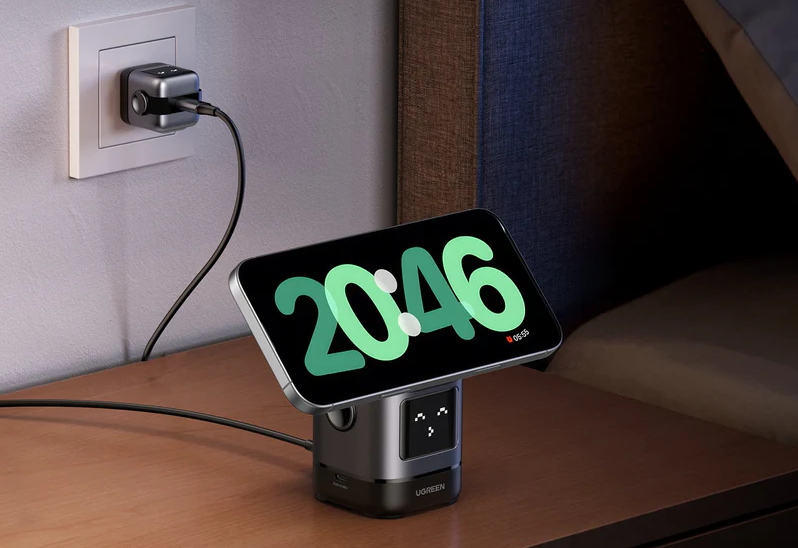
For years, the conversation around wireless charging focused on one thing first: speed. How fast could it power a device, and how closely could it compete with a wired connection? That made sense in the early stages, when wireless charging still had to prove itself as a practical option rather than a secondary convenience.
But the way people judge charging has started to change. Speed still matters, but it is no longer the only feature shaping everyday satisfaction. In real life, many users are not only asking how quickly a charger works. They are also asking how reliably it fits into a routine, how clearly it signals that charging has begun, and how little attention it demands once the phone is set down. In other words, the conversation is shifting from charging speed to charging confidence.
That shift reflects how wireless charging is actually used. Most people do not experience charging as a single test case with ideal placement and perfect focus. They experience it in the middle of a day that is already busy. They place a phone down during work, before bed, while cooking, or between errands. In those moments, a charger feels good not simply because it is fast, but because it feels dependable. The user wants to know that the phone is placed correctly, that power is flowing, and that they will not come back later to find the battery lower than expected.
This is where confidence becomes more important than many spec sheets suggest. A charger can look strong on paper and still feel slightly inconvenient in practice if it creates hesitation. Users do not want to wonder whether the phone is aligned properly or whether a small bump will interrupt the charge. They want a setup that feels clear, stable, and repeatable. That feeling of certainty often has more influence on everyday preference than a marginal difference in power output.
It is one reason a magnetic wireless charger has gained so much attention. The advantage is not only about appearance or feature differentiation. It is about reducing doubt. When the phone meets the charger in a more defined way, the interaction feels easier to trust. There is less guesswork in the moment, and that matters because wireless charging happens again and again in small daily routines. A tiny uncertainty repeated every day becomes part of the overall experience. A tiny improvement in clarity does the same.
This does not mean speed has stopped being relevant. Faster charging still matters when someone is in a rush or trying to recover battery quickly before leaving home. But once charging becomes part of ordinary routines rather than emergency recovery, confidence starts to matter just as much. A person using a charger on a bedside table or office desk is not always thinking in terms of peak output. More often, they are thinking in terms of trust. Can they place the phone down without checking twice? Can they rely on the setup night after night? Does the experience feel simple enough to disappear into habit?
That is why the idea of the best wireless charger is changing. For many users, the answer is no longer defined only by who offers the highest number on a product page. The better answer is often the charger that removes friction from repeated use. It works in the background, does not require constant repositioning, and makes the user feel confident that charging will happen as expected. In everyday life, that kind of reliability can matter more than performance claims that only stand out in controlled comparisons.
Design plays a large role in that confidence. Placement needs to feel intuitive. The phone should have a clear resting point. The charger should stay stable on the surface where it is used. Visual cues should be easy to understand. The overall interaction should feel calm rather than uncertain. These details may seem small, but they shape whether a product becomes part of a routine or stays on the edge of one.
The shift is also behavioral. As people use their phones more continuously throughout the day, charging has become less of a separate event and more of a recurring background action. That changes what users notice. In the past, raw charging speed may have felt like the clearest sign of progress. Now, many people are more aware of how natural a charger feels to use. They notice whether it fits smoothly into a desk setup, whether it feels dependable in low light, and whether it keeps charging from becoming one more thing to manage.
A magnetic wireless charger fits well into this newer expectation because it supports a more confident kind of interaction. The phone has a clearer place to land, and the user has fewer reasons to second guess the setup. That does not make every magnetic option automatically ideal, but it does explain why alignment and ease of use have become so central to the conversation. People increasingly value charging products that feel settled and certain, not just technically capable.
In that context, the best wireless charger is often the one that creates the least hesitation. It gives the user confidence without asking for extra thought. It fits the pace of real life, where charging happens in short, ordinary moments rather than in a product demo. That is the deeper reason the conversation is changing. Wireless charging is no longer judged only by how fast it can go. It is judged by how trustworthy it feels once it becomes part of everyday use.
In the end, confidence is what turns a charging method from acceptable into genuinely convenient. Speed may attract attention first, but confidence is what keeps people using the same charger day after day. As wireless charging becomes more embedded in daily routines, that quieter quality is becoming one of the most important measures of all.

Caroline is doing her graduation in IT from the University of South California but keens to work as a freelance blogger. She loves to write on the latest information about IoT, technology, and business. She has innovative ideas and shares her experience with her readers.