TL;DR
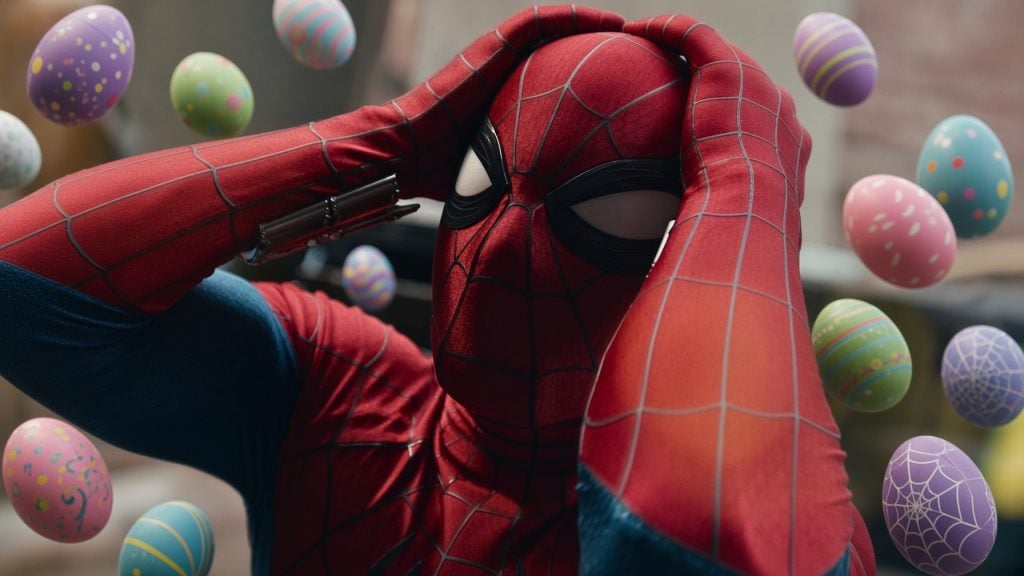
- Spider-Man: Brand New Day contains several Marvel Easter eggs hidden inside background graphics and props.
- Will Dixon created Daily Bugle articles, Spider-Man villain stickers and a Punisher reference that are easy to miss.
- One kitchen prop even references Michael Giacchino’s No Way Home music.
- Some children’s Spider-Man drawings in the movie were actually created by Dixon when he was a kid.
Most movie Easter eggs are designed to be found. A familiar logo sits conveniently in frame, a recognizable name appears on a screen or a character says something comic-book readers immediately understand. Spider-Man: Brand New Day apparently took a different approach with some of its best hidden details: the filmmakers put them in whether audiences had any realistic chance of noticing them or not.
Will Dixon, who worked on the graphics side of the movie, has been sharing a collection of props and designs he created for Tom Holland’s latest Spider-Man adventure. Some appear for only a moment, some sit deep in the background and at least one is positioned in a way that prevents moviegoers from even seeing the Easter egg properly. Taken together, the reveals offer a fun look at just how much thought can go into parts of a superhero movie that most viewers will never consciously register.
J. Jonah Jameson Made It Into The Movie Without Actually Appearing
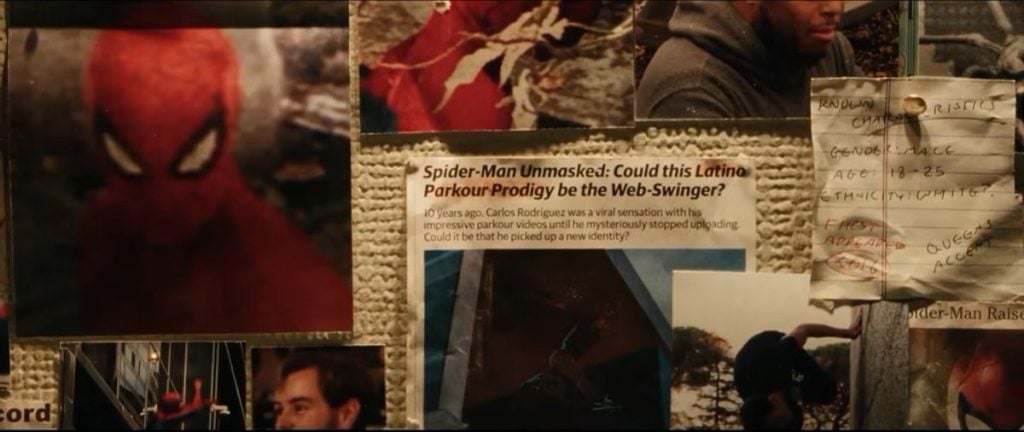
One of Dixon’s more noticeable contributions involves Ned Leeds’ Spider-Man conspiracy board. J. Jonah Jameson and the Daily Bugle do not physically play a role in Brand New Day, but Dixon wanted some trace of them inside Peter Parker’s world. His solution was to create Daily Bugle articles that could be placed among the material covering Ned’s wall.
It is exactly the kind of background detail that makes a fictional world feel larger than whatever is happening in the main story. Jameson does not need to walk into the room or hijack the movie for audiences to understand that the Daily Bugle is still covering Spider-Man somewhere in New York. For viewers who eventually freeze the frame at home, the articles also become a reward for looking more closely at something that was primarily designed to make Ned’s environment feel believable.
That approach is more effective than stuffing every reference into dialogue. Peter’s world should naturally contain newspaper stories, online discussions and public speculation about Spider-Man, particularly after everything the hero has experienced. The fact that somebody bothered writing and designing those background pieces matters even if the average person watching the movie never reads a single word.
A Tiny Homecoming Prop Had To Be Rebuilt From Scratch
Dixon also worked on the paper bag appearing during Peter’s dream involving Tony Stark. The bag connects visually with a prop from Spider-Man: Homecoming, but the production did not simply pull the original item out of storage. Dixon said he did not have access to the old prop and instead recreated the design so that it would closely match what audiences had seen before. Multiple versions were produced for what amounts to a very small piece of the finished movie.
That is a fascinating example of how continuity can work behind the scenes. Viewers might recognize something without ever stopping to wonder whether it is literally the same object. From the production side, however, getting a simple paper bag wrong could make a callback feel slightly off even if most people could not explain why.
It also shows why movie graphics departments end up doing far more than designing obvious signs and computer screens. A supposedly disposable object can require research, recreation and several physical copies simply because it needs to feel like something that has existed in Peter Parker’s life before.
Punisher’s Chili Has A Comic-Book History Lesson Hidden On The Label
One of the best references may also be the least visible. Dixon designed the label for the chili can Frank Castle holds in the movie and named the fictional brand after Gerry Conway, the influential Marvel writer who co-created the Punisher with artists John Romita Sr. and Ross Andru. The joke is especially deep because the front of the can apparently is not presented clearly enough for most audiences to read it during the scene.
That makes it less of a conventional Easter egg and more of a tribute built directly into the prop. Jon Bernthal can hold the can exactly as the scene requires, while the people who created it know that Frank Castle is literally carrying the name of one of the men responsible for his existence.
There is something charming about a reference being included even when nobody demanded that audiences notice it. It was not created to generate a freeze-frame headline or tease another Marvel project. It exists because someone on the production cared enough about the character’s history to put it there.
Bruce Banner’s Students Are Apparently Spider-Man Fans
The laptops seen during Bruce Banner’s lecture hide another collection of comic references. Dixon created stickers inspired by several classic Spider-Man villains along with one based on the Ultimate Spider-Man comic logo. He acknowledged that viewers may not actually be able to identify the designs in the finished scene, but that did not stop him from making them.
These details work on two levels. For fans, they are playful references to Spider-Man history. Inside the movie itself, they simply look like the kinds of stickers college students might put on their computers. The best production design often functions exactly that way: it serves the reality of the scene first and becomes an Easter egg only for someone who knows what they are seeing.
It also gives the MCU a funny little layer of cultural overlap. In a universe where Spider-Man is a real person swinging around Manhattan, his villains and imagery can still become part of the everyday visual language surrounding people who live there.
Even Peter Parker’s Pickles Have A No Way Home Reference
Apparently nothing in Peter Parker’s kitchen is too insignificant to receive some extra attention. When Peter knocks a jar of pickles from a cupboard, Dixon was asked to quickly create a label for the prop. He used wording inspired by one of Michael Giacchino’s track titles from the Spider-Man: No Way Home score, creating an inside joke that practically nobody would be able to read while watching the movie normally.
That might be the perfect example of how obsessive the process can become. A jar exists because Peter needs to knock something over. The jar needs a label because an unlabeled prop would look fake. Once somebody has to create that label anyway, why not turn it into a reference for the handful of people who might eventually discover it?
It does not change the story. It does not set up another sequel. It is simply a filmmaker entertaining himself while making the world more detailed, and that may be more fun than another Easter egg designed specifically to launch six months of online speculation.
The Most Personal Easter Egg Came From Dixon’s Childhood
The nicest story behind any of these details involves drawings of Spider-Man made by children within the movie. Those pictures were not simply created by an adult artist attempting to imitate how a child might draw Spider-Man. Dixon revealed that they were his actual childhood drawings, made years before he could have imagined eventually working on an official Spider-Man production.
On Letterboxd, Dixon explained that watching the scene brought him back to being a kid at a kitchen table inventing his own Spider-Man adventures. Those drawings eventually ended up inside a movie featuring the same character who had inspired him in the first place. “I hope I made him proud,” he wrote of his younger self.
That is a much more meaningful Easter egg than a hidden villain name or comic-book number. It is evidence of the strange full-circle path that can take someone from being a fan of these stories to becoming one of the people responsible for building them.
Brand New Day Will Probably Keep Fans Freeze-Framing For Years
There are undoubtedly far more details buried throughout Spider-Man: Brand New Day than the ones Dixon has shared so far. Large productions employ entire departments responsible for filling walls, desks, computer screens, storefronts and apartments with objects that make every location feel lived in. When those artists also happen to love the source material, background decoration becomes an opportunity to sneak decades of Marvel history into places viewers might never think to look.
That makes the eventual home release especially dangerous for anyone who enjoys hunting Easter eggs. Once fans can pause scenes, zoom into bulletin boards and inspect every laptop sticker, details that lasted a fraction of a second in theaters suddenly become much easier to uncover.
Some will be clever comic references. Others will probably be jokes only the crew understands. And every once in a while, viewers may find something as personal as a childhood Spider-Man drawing that somehow made its way from a kitchen table into one of the biggest superhero movies in the world.

DC Fanboy! Superman is the greatest comic book character of all time. Favorite movies are Man of Steel, Goonies, Back To the Future