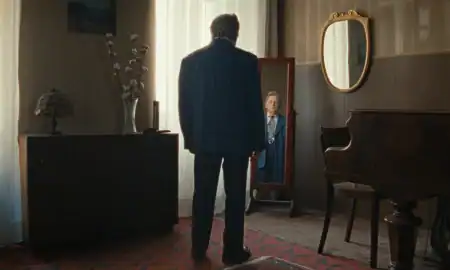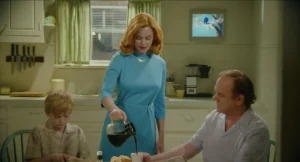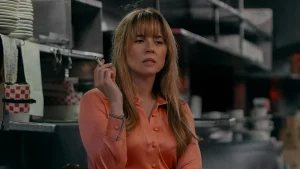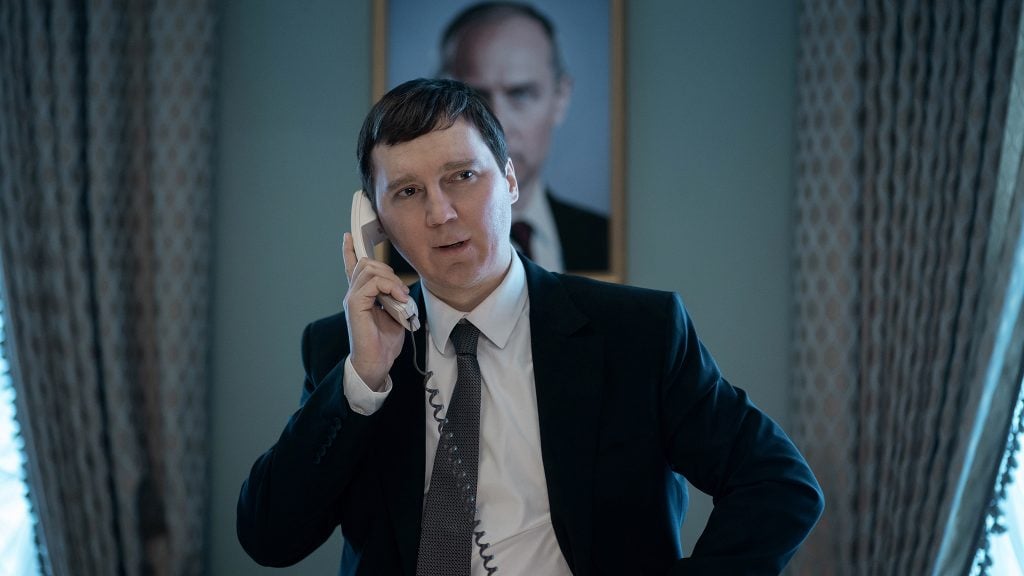
It has been some time since I’ve endured the pains of a seminar. I remember one from college, a wonderful professor, but verbose as the day is long. I haven’t thought about those lectures or that class in years, but watching The Wizard of the Kremlin plopped me right back into that old lecture hall. Ah, the memories. Now, I could respect what he was saying, just like I can respect the aims of this particular movie. As with my professor’s rambling stemwinders, this movie is exhausting. Despite its commanding cast and provocative story, the result is a drawn-out. It is a bone-dry film that brought to mind many times I thought about bailing out of lecture halls all those years ago.
The film presents a fictionalized account of Vladislav Surkov, one of Vladimir Putin’s former right-hand men. Set over a few decades, the film follows Russian propagandist Vadim Baranov’s ascent through the levels of power. The Wizard of the Kremlin offers us a glimpse into the chaos of post-Soviet Russia, where rising KGB officer Putin (Jude Law) joins forces with master manipulator Baranov (Paul Dano) to reshape life behind the Iron Curtain, using violence and deception to change the world forever. Putin and Baranov’s reign of chaos begins with lies and corruption. It quickly escalates to assassinations, tyranny, and eventually all-out war.
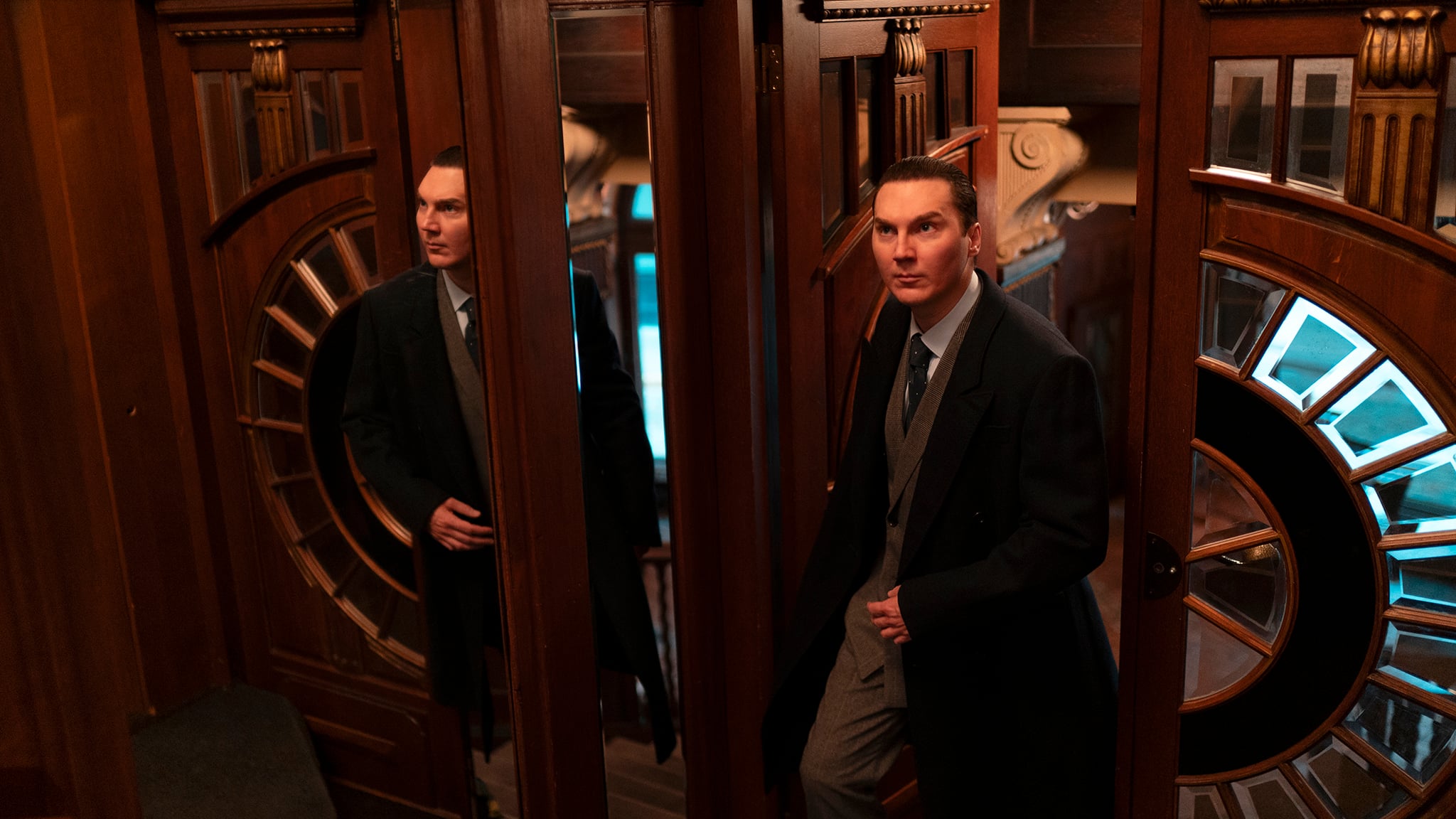
The film tells the story of Baranov’s humble beginnings. He starts first as an aspiring artist and media personality, before discovering the allure of politics and power. There is a stirring commentary on the intersection of media and political stagecraft, and how the two go hand in hand. Dano is the film’s primary engine, and it spends much of its time on his ascent. Putin is almost more of a background figure. Jude Law captures the Russian leader’s air of mystery and his deceptive machinations.
Now, Putin appears little in the film, but when he does, his presence adds a certain mystique to the drama. The problem is that while this film attempts to document the rise of Putin from KGB agent to president, it keeps him in the shadows. It focuses on those around him, making the rise rather uneventful. The film feels like it wants to be a story of Putin. However, it settles on creating a composite of one of his real-life consigliere.
On the one hand, it’s an interesting attempt to tell the story of Russia over the last thirty years, but on the other hand, it feels more like a highlight reel than a profound statement on the current state of the Russian government. The story frames itself as Baranov coming to terms with his actions. Jeffrey Wright appears as a journalist interviewing Baranov. The story finds Baranov, who, after slipping into hiding, looks back on his life’s work with regret and trepidation—a clear sentiment of reaping what he sowed.
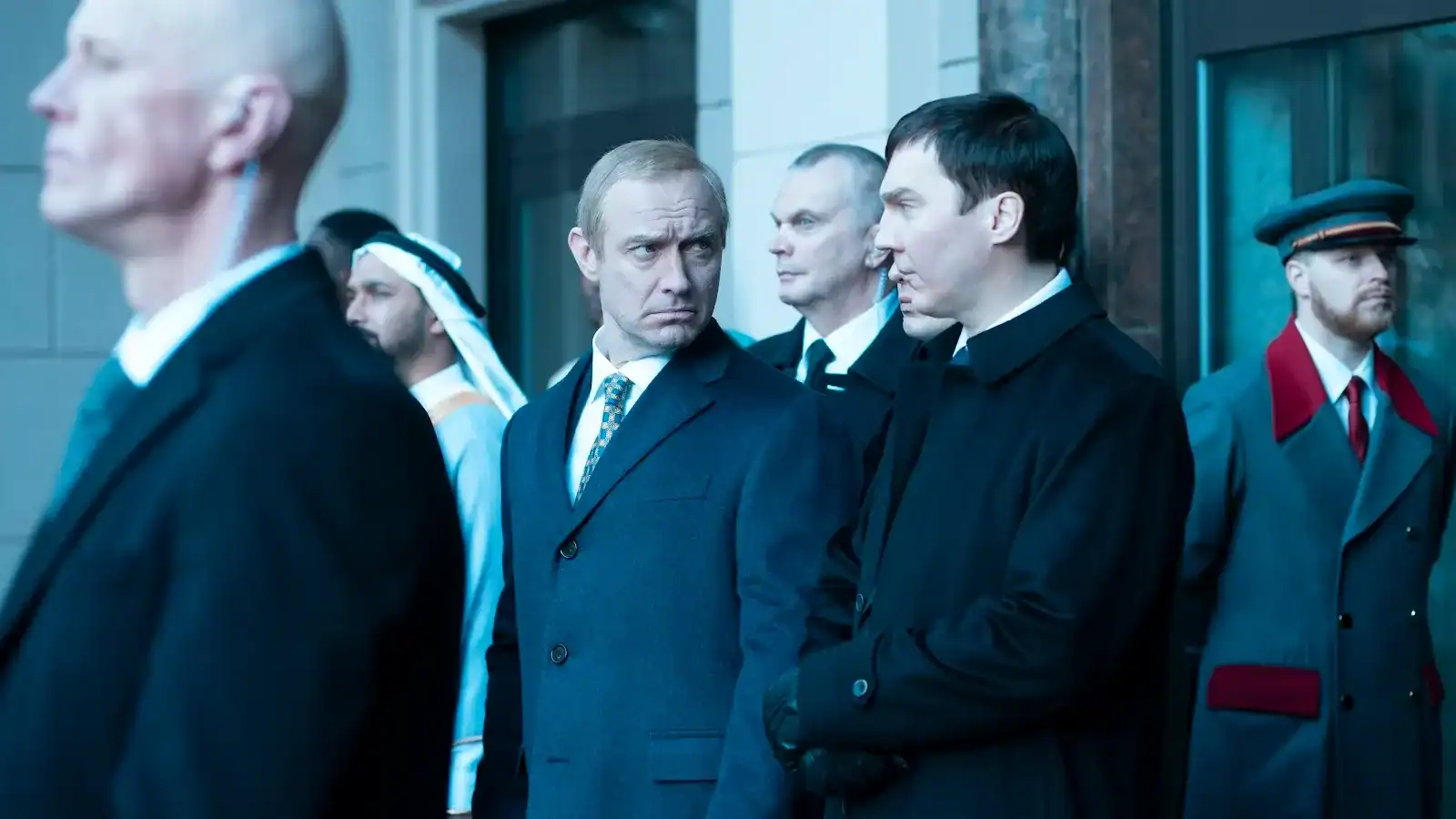
Fortunately, Dano is a captivating presence. Even though the script plods along unevenly, his screen time is enough to keep us invested. Still, the movie is at times directionless. While it strives to deliver clever insights about the Russian government’s turn after the fall of the Soviet Union, the overall message becomes jumbled.
As a fictitious drama based on real-life events and actors, it has a compelling intrigue. All of this is made possible by Dano, who, in his usual fashion, disappears into the role he plays. He dominates every scene, and his character becomes the conscience. He speaks of regret and disillusionment, but the trajectory it takes to get there is long and jarring. Several scenes are repetitive, and the movie seems to be reinforcing its point again and again. The problem, to tie it back to my history class analogy, becomes unclear.
The challenge here is that history is unwritten. While the story thread of how the government changed post the Soviet Union is compelling, history itself is still unfolding. In a way, the film concludes in an open-ended manner, that is neither climactic nor clarifying.
The Wizard of the Kremlin is perhaps better seen as a dramatization with intriguing performances rather than a revealing portrait of the figures. It is almost as if the film wanted to make an allusion to the end of The Wizard of Oz, when the wizard is revealed to be a fraud, vis-à-vis Russia and Baranov’s role as a power player in the shadows. And yet, even as I write this point, it seems convoluted in the grand scheme of things and reinforces my feeling that, while the film is finely acted, the execution has me saying nyet!
The Wizard of the Kremlin will debut exclusively in theaters on May 15, 2026, courtesy of Vertical.
The Wizard of the Kremlin is perhaps better seen as a dramatization with intriguing performances rather than a revealing portrait of the figures.

Writing & podcasting, for the love of movies.
His Letterboxd Favorites: The Dark Knight, Halloween, Jaws & The Odyssey.