There are many different features that make up the crypto environment, and it is all these layers and intricacies that make it difficult for many to join the ecosystem, as they find it fundamentally intimidating and difficult to navigate. If you’re an investor, you know that having a comprehensive view of the entire market is the only way to make sure that your portfolio remains profitable over the long term. Looking into the price estimations for different holdings, researching the latest strategies on how to buy XRP, as well as the volume and engagement rates, will make a huge difference when it comes to buying, selling, or abstaining from commencing large ventures.
However, these aren’t the only things that investors should have in mind, as knowing how the blockchain works is important as well. It can help you tell the difference between assets that are truly valuable and the ones that are nothing more than smoke and mirrors, have a better idea of the security features backing the ecosystem, as well as the transparency mechanisms, and the ways in which they help you. When you know how the decentralized ledger operates, you’re able to make better choices for your portfolio so that you don’t fall for poorly conceived projects or schemes and pay for your lack of acumen with your own capital.
One of the aspects that is not discussed nearly enough is the TPS.
What is TPS?
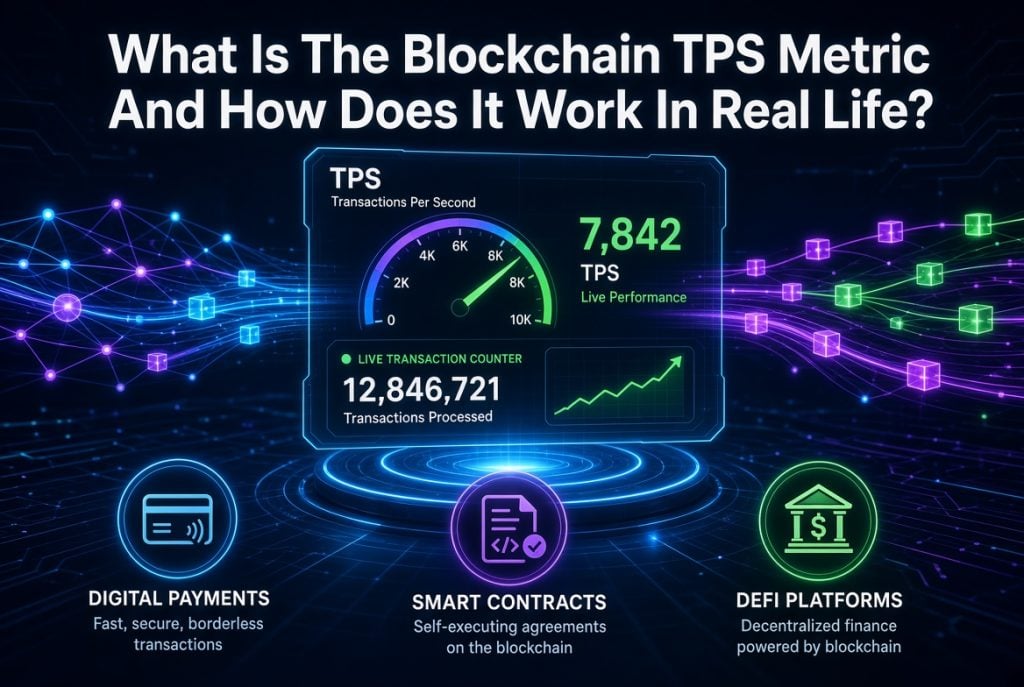
Crypto TPS, or Transactions Per Second, is a metric measuring the number of transactions that a blockchain can verify and process every second. It is one of the fundamental figures that investors take into account when they want to look into speed, scalability, and capacity. When TPS rates are faster, the transactions are cheaper, and the networks are fundamentally better equipped for additional features such as mass DeFi adoption or gaming. The low TPS, on the other hand, is responsible for higher costs and network congestion events. Users report decreased satisfaction with the processes overall, too.
TPS rates are not static figures as they change over time. Most blockchains are, at least theoretically, at maximum capacity at all times, but, in reality, the number of transactions per second fluctuates based on real-time demand, protocol updates, and congestion. Apart from network upgrades and scaling, which can increase speed, layer-2 solutions change TPS as well. High-volume transactions are typically moved to these networks, a shift that dramatically reduces throughput and helps avoid overloading the main chain.
There’s also a difference between theoretical TPS rates, the maximum speeds that the network could achieve if conditions were ideal, and the real-world number of transactions, which is much lower than the theoretical maximum level. Not all transactions are equal, either. Those that are more complex naturally take up more of the block space compared to simple token transfers, affecting how many ventures are able to fit in a single second. When demand is high during NFT mining or bull runs, the networks can and usually do end up being rather congested as well.
This means that transaction times end up being slower, with the throughput reaching a fixed limit during scenarios such as these.
The importance of TPS for investors
It may seem that this metric wouldn’t have anything to do with the investors themselves, but the truth is that it can and does impact things quite a lot. TPS is, first and foremost, a benchmark that allows traders to evaluate the full technical efficiency of the blockchain compared to other competing networks. If transaction times are fast, asset transfers are pretty much instantaneous, which is naturally very practical and means that the investors won’t have to deal with any hassle throughout the process.
However, it’s not as straightforward as “high TPS=good, low TPS=bad”. As with everything in the crypto world, things are a little more complex here, too. While high TPS levels are definitely something that investors should want and look for when choosing a blockchain, it is also important to weigh the metric against any potential trade-offs in either decentralization or safety, since high transactions per second numbers can end up compromising these factors. TPS can be a huge driver for value due to the lower costs and the ability to complete transactions really quickly, but it’s not the only thing you should look into. However, if other aspects of the blockchain are in order and there’s also a high TPS rate that you can rely on, you can definitely consider that you’ve found yourself a winner.
Scaling
Crypto scaling refers to the methods used to increase throughput while handling a large number of users without compromising decentralization and security. As networks deal with congestion that is increasingly difficult to tackle, scaling solutions become more common, too. Being able to guarantee that thousands of transactions are completed every second can greatly enhance mass adoption. However, the dilemma of balancing this feature with security and decentralization (which typically ends when platforms choose to sacrifice one of the features), as well as the shifts between layer-1 and layer-2 solutions, have made scaling into more of an ongoing thing instead of something that blockchains can implement once and then forget about.
Scaling generally increases TPS, improving efficiency. It can become part of the “blockchain trilemma,” though, since the increasing speed can destabilize other areas of the network.
Additional aspects
Some researchers believe that while TPS is a valid benchmark when it comes to blockchain performance, the values tend to represent idealized settings more often than they do real-world throughput. The numbers are, therefore, not always a good indicator of how the system actually performs during periods of real decentralization. In the real world, bandwidth, network topology, and latency often matter much more.
The performance also depends on how the transactions are received and verified by the other nodes present in the network. The figures you can find in white papers are generally different from those recorded by mainnet performance.
The crypto world is known as being very complex, one of the main features that makes it highly intimidating to newcomers. Although the number of transactions per second is a great way to figure out the market performance, it shouldn’t be the only thing you rely on. Your analysis needs to be as comprehensive as the network itself.

Caroline is doing her graduation in IT from the University of South California but keens to work as a freelance blogger. She loves to write on the latest information about IoT, technology, and business. She has innovative ideas and shares her experience with her readers.