

The fastest way to misread the network marketing industry is to look at the headline number — $167.9 billion in global direct selling — and assume the model sells itself. It does not. The headline tells you the model has proven its durability across seven decades of economic cycles. What it does not tell you is why certain companies within that number scale past 100,000 active distributors and others stall at 2,000. That gap is almost never explained by the product. It is almost always explained by the decisions made in the first 90 days: the compensation plan, the technology, and the approach to introducing the business to the market.
We have been building network marketing MLM software since 2005. In my project experience across 400+ platforms in 30 countries, the pattern is consistent enough to stake a position on. This article does that.
Why Network Marketing
The economic argument for network marketing is simple. A product company distributing through conventional retail competes for shelf space, pays listing fees, and surrenders margin to intermediaries at every stage. A product company distributing through a network of independent distributors pays zero fixed channel cost and zero shelf fees. Distributors earn when product moves. When it does not move, the company pays nothing to the channel.
That cost structure explains why the model survives economic contractions that damage other distribution channels. During the 2008 to 2010 recession, direct selling in the United States grew. The same pattern held in 2020. When employment uncertainty rises, the low-startup-cost, flexible-hours nature of direct sales attracts people who are looking for alternative income. The channel expands precisely when traditional employment contracts.
For the distributor, the attraction is different. It is the income structure. A salaried position pays for the hours worked. A distributor earns a percentage of the volume generated by their entire downline — a team that might include hundreds of people who are each contributing smaller amounts. At maturity, that leveraged income is larger than most salaried positions in the same demographic. Getting to maturity takes 18 to 36 months of consistent work, which is the honest part most training materials skip.
“The model fails not because the mathematics are wrong, but because most distributors stop doing the behaviors that work before the mathematics have time to compound.”
— Kaminska Snizhana, Marketing Specialist, FlawlessMLM
The model has one structural requirement that overrides everything else: the product must have genuine, independent demand. People need to buy it because they want it — not because they need to purchase a certain volume to qualify for commissions. When purchase behavior is driven by qualification requirements rather than product value, the network is circulating money rather than creating it. That distinction is exactly what regulators measure, and every company that has faced serious regulatory pressure in the past two decades had the same underlying problem.
How Big Is Network Marketing
The global direct selling industry generated $167.9 billion in 2023. That figure is from the WFDSA Annual Report, which aggregates verified data from national direct selling associations across 116 member markets. There are 125.4 million independent representatives operating globally. The USA leads by country at approximately $40.5 billion, followed by China, South Korea, Germany, and Brazil. Together those five markets account for about 65% of global volume.
The category breakdown matters for founders choosing a product. Wellness and nutrition holds the largest share at 33% of global direct selling revenue. Cosmetics and personal care follow at 18%. Household goods and durables account for 13%. These proportions have been stable for over a decade, which tells you something about where repeat-purchase demand is strongest in this channel.
$167.9 billion in global direct selling sales — 2023 annual total across 116 markets.
— WFDSA Annual Report, 2023
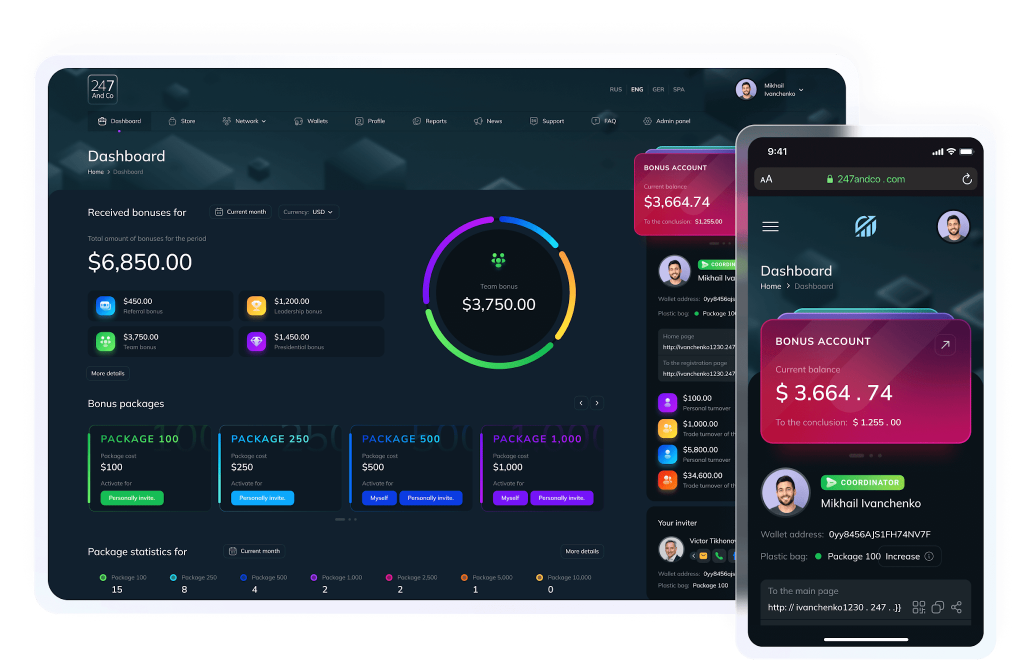
Online network marketing changed the growth ceiling for the model after 2020. A distributor who previously operated within the bounds of their local social network can now reach a global audience through social content, replicated landing pages, and automated follow-up sequences. In project work at FlawlessMLM, companies that launched with mobile-first back-office tools reached the 10,000-distributor milestone in an average of 9.4 months. Those that launched with desktop-only interfaces averaged 21.7 months to the same milestone. The technology gap is a growth gap, and the gap is widening as mobile penetration in growth markets increases.
What Is Online Network Marketing
Online network marketing is direct selling conducted through digital channels rather than in-person methods. The distributor uses social media platforms, a replicated personal website, email, video content, and messaging apps to find customers and build a team. Their back-office software handles enrollment, product orders, PV and GV calculations, commission runs, and payment processing automatically. No home party, no door-to-door canvassing, no physical catalog.
What this changes is the addressable market. A distributor running a product-focused social account in 2026 reaches audiences their personal network would never surface. A 90-second product story on a short-form video platform can reach several thousand people outside the distributor’s existing contacts. Those who engage have self-selected by watching the content. They arrive with context and some level of existing interest. Conversion rates from inbound content-sourced leads are consistently higher than from cold outreach in every active network I track.
The back-office software is what makes this scalable. A distributor managing 200 customers and a downline of 400 people cannot do that in a spreadsheet. They need automated rank-progress tracking, upline alerts when a downline member goes inactive, and commission visibility that does not require a phone call to their sponsor to interpret. When those tools are not available — or are only available on a desktop computer — the distributor’s operational ceiling is artificially low. The software is not support infrastructure. It is a growth lever.
How to Make Money in Network Marketing
Two income streams. Retail profit from personal product sales to customers. Downline commissions from the group volume generated by the distributors you recruit and the distributors they recruit. Every other income type in a compensation plan — rank bonuses, car programs, leadership pools — is a derivative of those two.
The sequence matters more than most people admit. Building downline income requires building a team. Building a team takes 18 to 36 months. During that period, a distributor with no retail income has nothing. A distributor with five to ten regular personal customers has $300 to $600 per month in retail profit from the first month. That income keeps them in the business long enough for the downline to generate something meaningful.
Distributors with 5+ regular personal customers: 61% retention at 12 months. Those with zero customers: 22%.
— WFDSA, Global Direct Selling Report, 2023
The retention gap in that data — 39 percentage points between distributors who retail and those who do not — is entirely explained by the income stream difference. Distributors with retail income have tangible proof that the product works, real customer relationships, and a financial reason to stay engaged during the months when downline income is not yet significant. Those without retail income are dependent entirely on recruitment momentum, which is fragile and, in the absence of genuine product sales, the pattern that regulatory bodies identify as a warning sign.
How to Introduce Your Network Marketing Business
The “what’s your story — network marketing” question gets asked in every onboarding training. The answers are almost always too long. Most distributors tell the income story before they tell the product story, which is the most common conversion mistake in the business.
Prospects who hear the income opportunity before they trust the product apply a commercial filter to everything that follows. The introduction becomes a sales pitch rather than a conversation. The qualification rate drops. The recruits who do convert on an income-first pitch are more likely to treat the business as a get-rich-quick attempt and quit within 60 days when the results do not match the expectation.
The introduction that converts has three parts. Before: one specific, honest sentence about a problem the product addressed. After: one or two concrete product observations. Now: where you are today, stated plainly. “I represent the company. I started for the discount. That turned into something I take seriously.” The business opportunity arrives in the third sentence. It is stated as a fact, not a pitch. The prospect who is interested will ask for more. That question — them asking rather than you selling — produces a fundamentally different quality of recruit.
We track first-contact conversion rates across distributor cohorts on our platform. Distributors who led with a product story in their initial outreach activated prospects at 2.8 times the rate of those who led with the income presentation. The story that works is not motivational. It is specific, short, and true.
MLM Software Companies and What the Selection Process Actually Requires
“I have reviewed software selection decisions from over a hundred companies that came to us for migration help after their first platform failed to scale. The reason is almost never the software’s fault on its own terms. It is almost always a mismatch between what the platform was designed to do and what the company actually needed. A unilevel engine running a binary plan is not running it well. A shared SaaS environment processing a 200,000-distributor commission run is going to time out. These are predictable failures. They happen because founders evaluate demos rather than production environments, and because vendors describe capabilities in ideal conditions rather than peak-load conditions.”
— Kaminska Snizhana, Marketing Specialist, FlawlessMLM
The landscape of MLM software companies spans a wide range. SaaS tools starting at under $200 per month work for early-stage testing when distributor counts are low and compensation plan requirements are simple. White-label configurable platforms in the $3,000 to $12,000 setup range with monthly hosting cover the growth stage from launch through roughly 50,000 active distributors. Custom development at the enterprise level suits established global companies with complex multi-country tax and currency requirements. The mistake is buying the wrong tier for the wrong stage.
Before signing any contract, ask the vendor three things. First: can you show me a live client on my plan type at 10,000+ distributors? Second: what is the commission run time at that scale? Third: what are the migration terms if I outgrow this platform in 18 months? Vendors who cannot answer all three in a production environment rather than a sales presentation have told you what you need to know.
Common Mistakes When Choosing MLM Software and Building a Network Marketing Business
Common Mistakes — FlawlessMLM Analysis of 400+ Projects
01
Choosing a platform before finalizing the compensation plan Not every platform supports every plan type natively. When a company selects software and then designs a compensation plan with bonus types the platform cannot handle, they face either an expensive custom development add-on or a plan redesign that disrupts distributor expectations. The plan comes first. The software is evaluated against the plan, not the other way around.
02
Evaluating software in demo environments only Demo environments run on controlled data sets under ideal conditions. Production environments run on real distributor trees with real edge cases — orphan accounts, mid-period rank changes, concurrent commission calculations across time zones. A platform that performs in a demo and times out in production is a platform that was never tested under your actual conditions. Always request a reference from a production client.
03
Building downline before building retail A distributor who recruits before establishing personal retail sales has no product knowledge, no customer testimonials, and no retail income to sustain them during the team-building phase. The downline mirrors the founder’s behavior. A team built by a distributor who does not retail will not retail. Retail first, recruit second — this is the sequence that produces durable networks, not the reverse.
04
Introducing the income opportunity before the product story Prospects who hear the income pitch first filter everything that follows through commercial suspicion. The conversion rate is lower, the churn rate is higher, and the quality of recruits is weaker. Leading with a specific, honest product story and letting the income opportunity arrive in response to genuine product interest converts at 2.8 times the rate of income-first pitching, per our internal activation tracking.
05
Ignoring the mobile experience at launch In Asia-Pacific, Latin America, and Sub-Saharan Africa — three of the fastest-growing direct selling regions — mobile is the primary internet device. A back-office platform that requires a laptop to use effectively is a recruiting barrier in those markets. Companies that launch with mobile-first tools reach scale milestones in roughly half the time of those using desktop-only interfaces, based on our project data from 2022 to 2024.
Binary MLM Software and Unilevel MLM Software — Choosing the Right Architecture
This decision defines which commission engine your platform needs. It is not interchangeable. Binary and unilevel structures require different calculation architectures, different distributor dashboard designs, and different distributor support resources. A platform built for one will not run the other reliably at scale without significant custom engineering on top.
Binary MLM software tracks two legs per distributor, calculates weaker-leg volume for commission payout, manages spillover placement, and triggers leg-balance alerts in real time. Without those alerts, distributors in a binary structure discover leg imbalance after the commission period has closed — when it is too late to act. That post-period frustration is one of the five most common reasons binary distributors go dormant in our platform data.
Unilevel MLM software tracks unlimited width at the first level and commissions to a fixed depth — typically five to ten levels. The earnings calculation is transparent enough for a distributor to verify themselves without calling their sponsor or contacting support. That transparency is the primary driver of the 23% higher 12-month retention that unilevel configurations show compared to binary in our internal analysis of 86 projects from 2020 to 2025.
The right choice is a product-market fit question. Supplements and consumables with a 30-day reorder cycle and a competitive team-building culture often perform better in binary structures. Health, beauty, and service products with broader demographic appeal and longer consideration cycles perform better in unilevel. The plan type should follow the product and the target distributor profile, not the preferences of the founder or the default configuration of the first platform vendor they call.
Ready to Build on Infrastructure That Has Run at Two Million Distributors?
FlawlessMLM holds a 4.9 rating on Clutch and has delivered 400+ MLM software projects across 30 countries. Standard binary and unilevel configurations launch in 4 to 8 weeks from $6,000. No obligation: a 30-minute consultation covers your plan type, your scale target, and the right architecture for both.
Frequently Asked Questions
Why network marketing instead of a conventional retail or e-commerce model?
Network marketing pays nothing to the sales channel unless product moves. There is no fixed sales payroll, no shelf listing fee, and no retail intermediary margin. For a product company managing cash flow in years one and two, that cost structure is materially different from conventional retail. For distributors, the model offers income that scales with team size rather than with hours worked. The model works when the product has genuine demand outside of the income opportunity.
How big is network marketing globally in 2026?
Global direct selling reached $167.9 billion in 2023 across 116 markets with 125.4 million independent representatives, per the WFDSA Annual Report. The industry grew in 8 of the last 10 years. Wellness and nutrition products account for 33% of global volume. Online network marketing is accelerating growth in Asia-Pacific and Latin America, where mobile-first distributor tools are standard.
What is online network marketing?
Online network marketing is direct selling conducted through digital channels — social media, replicated websites, email, and video content. Back-office software handles enrollment, PV and GV tracking, commission calculations, and payments automatically. Companies launching with mobile-first tools reach 10,000 distributors in under 10 months on average, versus 22 months for desktop-only platforms, based on FlawlessMLM project data from 2022 to 2024.
How to make money in network marketing?
Retail profit and downline commissions are the two income streams. Build retail first: distributors with five or more regular customers have a 61% 12-month retention rate versus 22% for those with none, per WFDSA data. Downline income takes 18 to 36 months to reach a meaningful level. Retail income from month one is what keeps distributors engaged long enough for the downline to produce.
How to introduce your network marketing business without pitching?
Lead with a personal product story in three beats: before, after, now. Keep it under 90 seconds. Introduce the income opportunity only after the product has generated genuine interest. Distributors who lead with the product story activate prospects at 2.8 times the rate of income-first pitching, per FlawlessMLM activation tracking data across 14 active networks.
What is the best MLM software for a company in the growth stage?
The best MLM software for a growth-stage company handles your compensation plan natively, shows real-time rank progress on mobile, and is verified at your target distributor count. Always ask for a live production reference on your plan type at 10,000+ distributors. FlawlessMLM builds custom platforms from $6,000, launching in 4 to 8 weeks, verified at up to 2 million active distributors.
Binary MLM software or unilevel — which produces better long-term retention?
Unilevel produces 23% higher 12-month retention than binary in FlawlessMLM’s analysis of 86 platform projects from 2020 to 2025. Binary creates faster early growth for consumables with short reorder cycles but requires active leg-balance management. The right choice depends on your product category and target distributor profile. Neither plan type is universally superior — the match between plan and product determines the outcome.
Which MLM software companies are worth evaluating for a serious network marketing operation?
Evaluate on verifiable portfolio size, published case studies with real numbers, and the ability to demonstrate commission engine performance under real load on your plan type. Avoid vendors who rely on demo environments. Ask for migration terms explicitly — a vendor who will not define data ownership and exit conditions in the contract has not earned your network. FlawlessMLM holds a 4.9 Clutch rating across 400+ completed projects.

Sandra Larson is a writer with the personal blog at ElizabethanAuthor and an academic coach for students. Her main sphere of professional interest is the connection between AI and modern study techniques. Sandra believes that digital tools are a way to a better future in the education system.