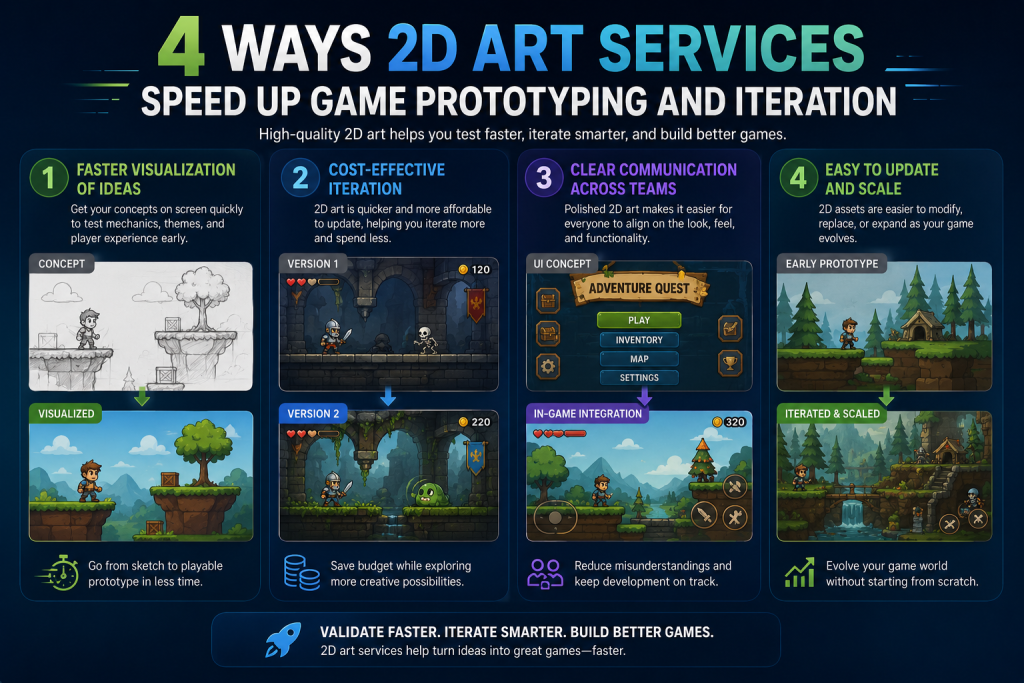
According to the 2024 State of the Game Industry report by the Game Developers Conference (GDC), 31% of game developers identified improving production efficiency and workflows as a major challenge, showing why faster iteration processes are becoming increasingly important during development. In the prototyping stage, the ability to quickly test, adjust, and refine ideas can determine whether a game concept becomes a successful project.
Using 2D art services during prototyping helps studios validate creative ideas without investing heavily in final production assets too early. External artists can create concept visuals, interface elements, environments, and characters that allow teams to test gameplay direction faster.
Instead of waiting for polished 3D assets or final visuals, developers can use flexible 2D materials to experiment with mechanics, styles, and player experiences.
Why Is Fast Iteration Important During Game Prototyping?
Fast iteration allows developers to test ideas, identify weaknesses, and improve gameplay before full production begins. A prototype is not meant to represent the finished game. Its purpose is to answer important questions about mechanics, visual direction, and player engagement.
During this stage, teams often need to make frequent changes, including:
- Adjusting gameplay mechanics
- Testing different visual styles
- Changing level layouts
- Refining user interfaces
- Experimenting with characters and environments
Creating final-quality assets too early can slow down this process. If a core mechanic changes, developers may need to replace large amounts of completed work.
Flexible 2d art design helps teams explore different creative directions while keeping production costs and timelines under control.
How Do 2D Art Services Help Teams Iterate Faster During Prototyping?
1. How Do Concept Art and Visual Exploration Speed Up Game Development?
Concept art helps teams quickly visualize ideas before committing to detailed production work. During prototyping, artists can create multiple versions of characters, environments, and objects to help designers evaluate different directions.
2D artists can support early development through:
- Character concepts
- Environment sketches
- Mood boards
- Style exploration
- Visual references
These materials allow teams to make creative decisions earlier. For example, a studio developing a fantasy adventure game can test different character designs or world styles before investing in detailed modeling and animation.
Concept visuals also improve communication between designers, developers, and stakeholders. Instead of describing an idea through documents alone, teams can review actual images and provide more precise feedback.
This reduces misunderstandings and helps teams reach decisions faster.
2. Why Are 2D Game Assets Useful for Testing Gameplay Ideas?
2D assets allow developers to create functional prototypes without spending significant time on final production materials. Simple characters, environments, icons, and animations can be enough to test whether a gameplay idea works.
During prototyping, teams may use temporary or simplified assets to evaluate:
- Character movement
- Level structure
- Combat mechanics
- User interactions
- Game balance
This approach helps developers focus on gameplay rather than visual perfection.
For example, a platformer prototype may only require basic character illustrations and simple backgrounds to test movement, jumping mechanics, and level pacing. If the gameplay does not feel engaging, the team can make changes without losing months of art production.
This is one reason many studios use 2d art development services during early production stages.
3. How Do 2D UI and UX Assets Improve Prototype Testing?
User interface design plays a major role in how players interact with a game. During prototyping, teams need to test whether menus, controls, and information displays feel intuitive.
2D artists help create prototype UI elements such as:
- Menu layouts
- Buttons and icons
- Health bars
- Inventory screens
- Navigation elements
Testing UI early helps identify usability problems before they become expensive to fix.
A poorly designed interface can negatively affect the player experience even if the core gameplay is strong. By creating and adjusting 2D interface elements quickly, teams can experiment with different layouts and interaction patterns.
This process is especially useful for mobile games, strategy titles, and RPGs where interface design is closely connected with gameplay.
4. How Do 2D Animation and Effects Support Prototype Improvements?
2D animation helps developers test movement, feedback, and visual responses before final assets are created. Even simple animations can show whether gameplay actions feel satisfying and responsive.
During prototyping, artists may create:
- Character movement animations
- Attack effects
- Environmental animations
- Interface transitions
- Visual feedback elements
These assets help teams evaluate the overall feel of gameplay.
For example, a combat prototype may need basic attack animations and impact effects to determine whether actions feel responsive. Without visual feedback, developers may struggle to understand how players perceive the experience.
Early animation testing allows teams to refine mechanics before moving into more expensive production stages.
How Do External 2D Art Teams Improve Prototype Efficiency?
External 2D art teams help studios increase production capacity without expanding internal teams permanently. This is especially valuable during prototyping when art requirements can change frequently.
A specialized partner can provide:
| Service Area | Prototype Benefit |
| Concept art | Faster visual decision-making |
| Character design | Quick testing of creative directions |
| UI assets | Earlier usability testing |
| 2D animation | Better gameplay evaluation |
Working with external specialists also allows internal developers to focus on programming, mechanics, and technical challenges.
For studios managing multiple projects, outsourcing specific art tasks can make production schedules more predictable. Teams can request the exact type of support needed without creating additional long-term overhead.
What to Consider When Using 2D Art Services for Prototypes?
Choosing the right art support depends on the project goals, visual style, and development stage. Studios should look for artists who understand both creative requirements and game production workflows.
Important factors include:
- Experience with game projects
Game-specific experience helps artists create assets that support gameplay needs. - Ability to adapt quickly
Prototyping involves frequent changes, so flexibility is essential. - Understanding of visual consistency
Even early assets should support the intended artistic direction. - Strong communication skills
Fast feedback cycles improve iteration speed.
The best results come when artists work closely with designers and developers rather than creating assets separately from the gameplay process.
Using 2D Art to Build Better Game Prototypes Faster
Game prototyping depends on the ability to test ideas quickly and make improvements based on feedback. 2D art services support this process by providing flexible visual solutions that help teams explore concepts, test mechanics, improve interfaces, and refine player experiences.
From early concept sketches to prototype animations, 2D assets give developers the freedom to experiment before committing to full production. This makes development more efficient and helps teams make better creative decisions.
By integrating specialized 2D art support into the prototyping process, studios can reduce risks, improve workflows, and move successful ideas closer to production.
FAQ
Why are 2D art services useful during game prototyping?
2D art services help teams quickly visualize concepts and test gameplay ideas without creating expensive final assets. They allow developers to experiment with characters, environments, and interfaces before full production begins.
What types of 2D assets are created during prototyping?
Prototype-focused 2D assets can include concept art, character designs, UI elements, icons, backgrounds, and simple animations. These materials help teams evaluate both creative direction and gameplay functionality.
How does 2D art improve game development speed?
2D assets are usually faster to create and modify compared with final production-ready assets. This allows teams to test multiple ideas, gather feedback, and make changes without delaying development.
Can 2D art services support 3D game development?
Yes, 2D art is often used in 3D projects for concept development, visual planning, interface design, and early gameplay testing. Many 3D games begin with 2D concepts that guide later production.
When should studios involve 2D artists in development?
Studios can involve 2D artists during the earliest stages of development, including brainstorming and prototyping. Early collaboration helps teams establish visual direction and avoid costly changes later.
Should small game studios outsource 2D art production?
Outsourcing can be useful for small studios that need specialized skills without hiring full-time artists. External teams provide flexibility and allow developers to focus on core gameplay and technology.

Caroline is doing her graduation in IT from the University of South California but keens to work as a freelance blogger. She loves to write on the latest information about IoT, technology, and business. She has innovative ideas and shares her experience with her readers.