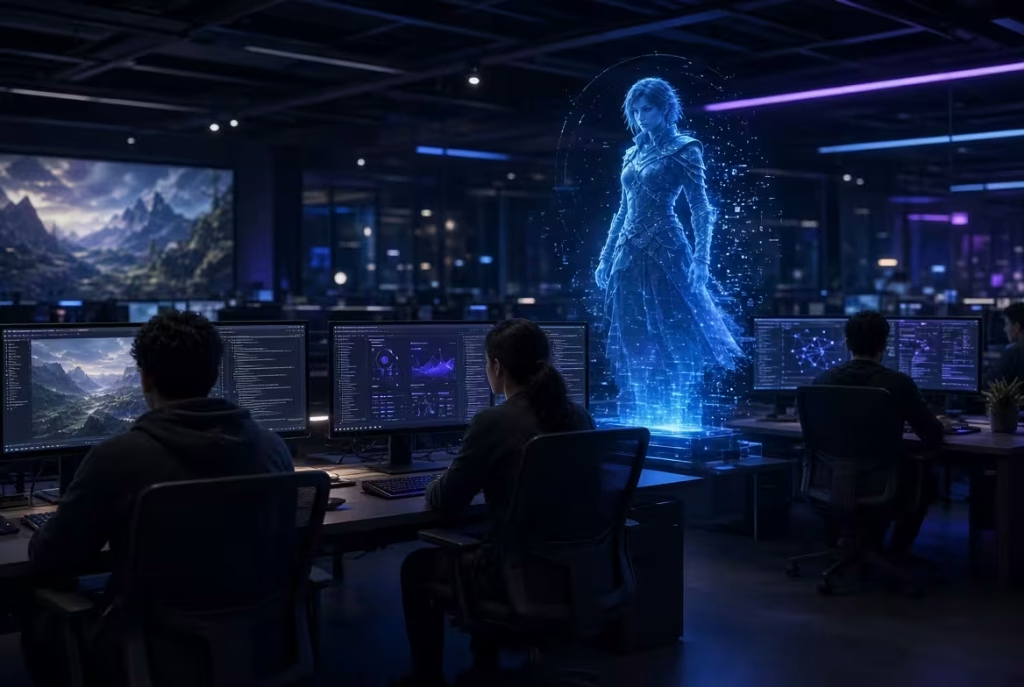
AI’s baked into games now. Not new, exactly — decades of predictable enemy patterns, scripted NPCs. But the newer stuff’s genuinely different. More responsive characters. Faster dev workflows. Touching both what players experience and how the whole thing gets built behind the scenes.
Still early days, honestly. But the shifts already happening are real.
Smarter Non-Player Characters
NPCs used to run on rules. Patrol here. Attack there. Say one of six lines. Same script, every playthrough, forever.
AI breaks that pattern. Characters actually react now — to player behavior, to the environment, to what’s happening in the game in that exact moment. Not a fixed loop anymore.
Makes worlds feel less predictable. An enemy shifts strategy based on how you approach a fight. A friendly NPC remembers how you treated them last time. Small stuff. Adds up fast.
AI-Assisted Game Development
Making a game’s genuinely complex. Programmers, artists, designers, writers, sound people, testers — a lot of moving parts. AI’s stepping into some of that now.
Brainstorming. Prototyping. Code analysis. Placeholder assets. Catching problems early. All places AI’s quietly showing up. Platforms like Board sit in that same conversation too — new tech, interactive experiences, developers figuring out where AI actually fits alongside gaming and online communities.
Doesn’t replace the creative work, though. Just clears out the repetitive stuff faster. Smaller studios especially get a real edge here — exploring ideas that would’ve needed way more time or budget before.
Procedural Content and Dynamic Worlds
Procedural generation’s old news, honestly. AI just widens what’s possible with it now. Instead of hand-building every environment, object, mission — algorithms generate pieces off defined rules.
Environments that actually respond to what a player does. Mission variations generated on the fly. More variety, less repetitive manual grind for the dev team.
Still needs a human eye, though. A system can churn out a mountain of content. Doesn’t mean it’s good. Someone still checks that it actually fits the game’s art direction, its mechanics, its story. Every time.
Personalized Gaming Experiences
Every player’s different. Skill, preference, playstyle. Old difficulty settings — easy, medium, hard — never really captured that.
AI lets games adjust on the fly instead. Notice someone’s struggling with a mechanic, ease up. Notice they’re breezing through, throw something harder at them. Dynamic, not fixed.
Could go well beyond difficulty eventually. Quests, recommendations, how characters talk to you — all shaped by how you actually play, not a preset difficulty slider.
AI in Game Testing
Testing eats time. Big games have near-infinite possible player actions. No human team catches every bug alone.
AI agents help by just… doing it over and over. Moving through environments. Poking at objects. Trying every path. Faster than any human tester could manage.
Doesn’t replace human QA, though. Someone still has to judge whether a game’s actually fun. Whether it feels right. AI catches the technical stuff early. Humans catch the stuff that actually matters emotionally.
Generative AI and Game Assets
Concept art. Textures. Dialogue drafts. Sound ideas. Animation. AI’s touching all of it now, depending on the studio’s workflow.
Comes with real baggage, though — copyright, ownership, originality, where the training data actually came from. Studios need to genuinely understand what they’re using, especially once real money’s involved in a commercial release.
Responsible use here means more than grabbing the newest tool. Real review processes. Real approval steps. Not just shipping whatever the AI spat out.
The Honest Limits
AI doesn’t fix everything. Generated material still has errors. Repetitive patterns. Stuff that just doesn’t fit what a project actually needs.
Real concerns too — jobs, IP, privacy, transparency. Players might genuinely want to know when they’re talking to an AI-driven character. Studios have to figure out where this actually sits alongside their human teams. Not just bolt it on and hope.
Balancing automation against real human creativity’s the hard part. Games run on storytelling, emotion, design, connection. A lot of that just doesn’t reduce to an algorithm. Never will.
Where This Is Actually Going
Expect more of it, honestly. More responsive characters. More adaptive worlds. Personalized challenges. Dev tools that let smaller teams build bigger, more complex worlds than they could manage alone before.
Real shift probably isn’t AI replacing game development, though. It’s AI clearing out the grunt work, so people spend more time on the parts that actually matter — gameplay, story, feel, the stuff players remember.
Industry’s going to keep balancing innovation against creativity, quality, ethics, and what players actually expect from a game. Best case? Games that are more advanced, sure. But also genuinely more alive, more responsive to the person actually holding the controller.

Caroline is doing her graduation in IT from the University of South California but keens to work as a freelance blogger. She loves to write on the latest information about IoT, technology, and business. She has innovative ideas and shares her experience with her readers.