Here’s a small habit I’ve noticed in myself, and maybe you have too. A trailer drops, or a show wraps its season, and instead of typing the title into Google and clicking through to a review, I just ask ChatGPT. “Is the new season worth it, no spoilers.” “Who’s the actor playing the villain and where do I know him from.” Thirty seconds, one answer, no tabs. I never visit the site that did the work.
That habit, multiplied across millions of people, is quietly rearranging the ground entertainment journalism has stood on for twenty years.
What actually changed
For most of the internet’s life, the deal was simple. You had a question, Google handed you ten blue links, and you clicked one. The site that ranked well got the visit, the visit got monetized, and that money paid the writer who told you whether the movie was any good.
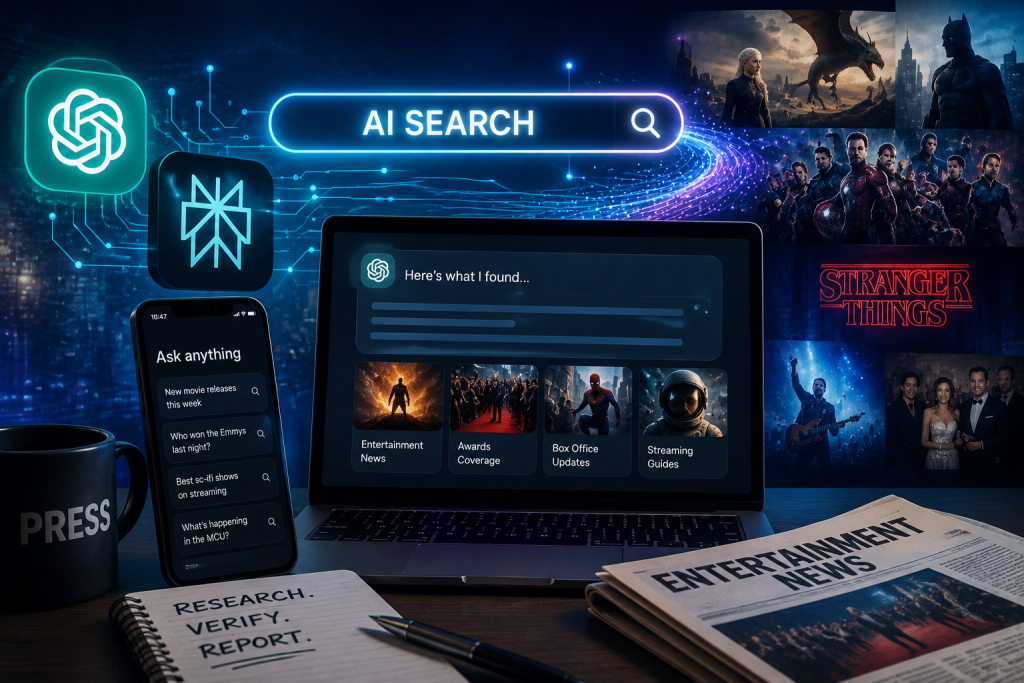
AI search breaks that loop. Google’s AI Overviews now sits at the top of a huge share of results and answers the question directly, so you often never scroll to the links underneath. ChatGPT, Perplexity, Gemini, and Claude do the same thing in a different wrapper: you ask, they synthesize, you get a paragraph. The information still comes from published articles. You just don’t see them, and more importantly, you don’t click them.
The industry has a clinical name for this: the zero-click search. It sounds boring. For a publisher whose entire business depends on the click, it’s closer to an extinction event.
Why entertainment coverage is uniquely exposed
Not every kind of writing is equally at risk here, and that’s the part worth sitting with. AI answers are very good at exactly the questions entertainment sites have historically ranked for.
Think about the traffic bread and butter of a pop culture site. “What order should I watch the MCU in.” “Does the dog die in this one.” “How many episodes in the new season.” “What’s that song in the trailer.” “Is there a post-credits scene.” These are the posts that pull in enormous volume, and they are precisely the fact-shaped questions an AI can answer perfectly without sending you anywhere. The recap, the explainer, the ranked list, the “ending explained” piece: all of it is being absorbed into the answer box.
What AI is still bad at, at least for now, is taste. It can tell you the plot of a film. It struggles to tell you why a specific cut of a scene made the hair on your arm stand up, or why a beloved franchise’s latest entry feels hollow in a way the box office numbers don’t capture. Opinion, voice, the argument nobody else is making: that’s the stuff a language model can summarize but can’t originate. If you’ve ever finished an episode and immediately gone looking for someone who felt the same way you did, you already understand the thing AI can’t replace.
The uncomfortable part nobody wants to say out loud
These AI answers are built on the exact work they’re replacing. When Perplexity tells you the critical consensus on a new release, it learned that consensus from the reviews it’s now standing in front of. The model didn’t watch the movie. Somebody did, wrote it up, published it, and increasingly gets nothing for it.
That tension has already spilled into court and into boardrooms. Some publishers have sued over their work being used to train these systems without permission. Others have gone the opposite direction and signed licensing deals, essentially agreeing to be the training data in exchange for a check. Both moves tell you the same thing: the people who run publications know the old traffic model is cracking, and they’re scrambling for whatever comes next.
I genuinely don’t know which side of that bet is right. Sue and you might win a settlement but stay locked out of where readers are going. License and you get paid once while handing over the thing that made you valuable in the first place. Nobody has this figured out. Anyone who tells you they do is selling something.
So what do you actually do about it
Doom is easy and mostly useless, so here’s the more practical read. The sites that survive this shift are the ones adjusting to how discovery works now instead of pretending it’s still 2018.
A few things are becoming clear. Being the source an AI cites is starting to matter as much as ranking first in the old blue-link sense, which is why “answer engine optimization” has stopped being a buzzword and started being a line item. There are even free tools now that let you check how often AI models cite your site, which would have sounded absurd two years ago and is now just a normal thing to want to know. Original reporting, first-hand interviews, and genuine point of view are harder for a model to flatten into a summary, so they hold their value better. And building an audience that comes to you directly, through a newsletter, a community, a name people trust, insulates you from whatever the algorithm does next week.
This is where the smaller creators actually have an opening. If you run an indie pop culture blog, a YouTube channel, a niche podcast, you were never going to out-muscle the big outlets on raw volume anyway. What you can do is be unmistakably yourself in a way the answer box can’t imitate, and make sure the technical foundations of your site are solid enough that both Google and the AI crawlers can find and cite you. Plenty of independent creators are bringing in professional SEO services for exactly that reason, not to chase a ranking trick, but to stay visible in a search environment that’s changing faster than any one person can keep up with.
The point isn’t to game the machine. It’s to make sure the machine knows you exist when it’s deciding whose take to summarize.
Where this leaves us
I keep landing in the same slightly conflicted place. AI search is genuinely useful. I use it constantly, and I’m not going to pretend otherwise to make a point. But it’s also eating the incentive structure that funds the very writing it depends on, and I don’t think that’s sustainable if nobody figures out how the people doing the original work get paid.
Entertainment journalism isn’t going to disappear. The recap-and-explainer content farm might, and honestly some of it won’t be missed. What sticks around is the stuff with a human clearly behind it: the critic whose taste you trust, the writer who noticed the thing you noticed, the community that argues about the finale for three days straight. That was always the good part anyway. AI is just making it the only part that’s safe.
If you make this kind of content, or read it, the next couple of years are going to be strange. Worth watching closely. Worth adapting for. And worth remembering that the thing an algorithm can’t do is exactly the thing that made you care in the first place.

Andrea Bell is a blogger by choice. She loves to discover the world around her. She likes to share her discoveries, experiences and express herself through her blogs. You can find her on Twitter:@IM_AndreaBell