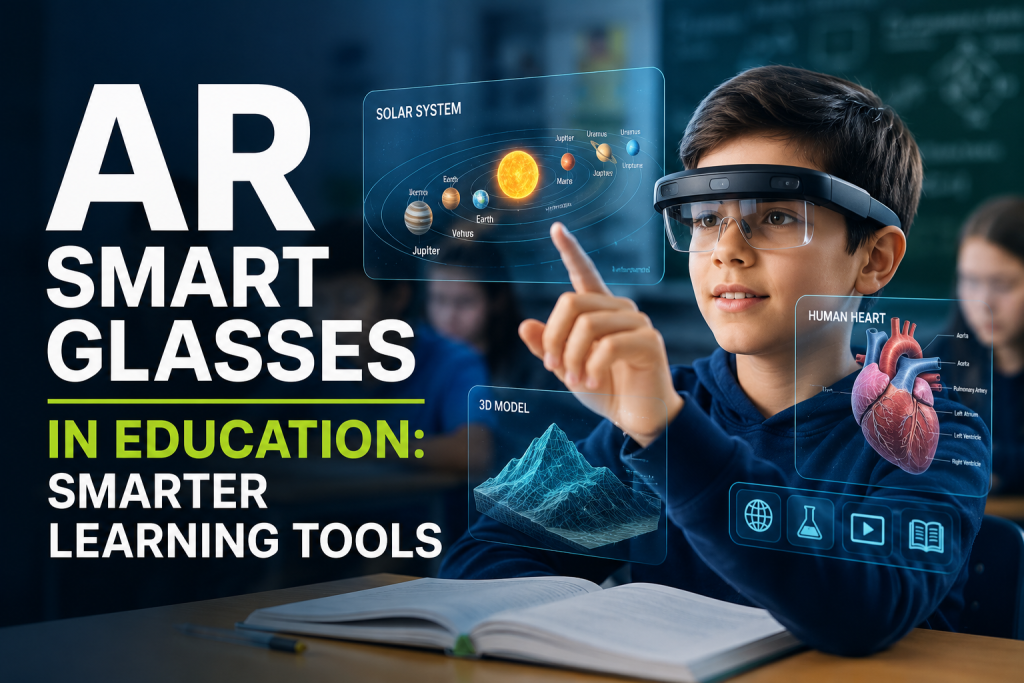
AR smart glasses are reshaping education by placing digital lessons directly into a learner’s field of view. Instead of relying only on textbooks, slides, or flat screens, students can interact with 3D models, guided instructions, and contextual information while staying engaged with their surroundings. This makes lessons more visual, more hands-on, and easier to understand. From classrooms and laboratories to outdoor learning environments, AR smart glasses support deeper participation, quicker feedback, and more personalized instruction, helping schools and training programs deliver smarter learning experiences that connect theory with practice.

Immersive Learning and 3D Visualization
Turning Abstract Concepts Into Visual Models
AR smart glasses help students understand difficult ideas by converting abstract concepts into visible, interactive models. A biology class can examine a floating 3D heart, rotate it, and observe blood flow pathways from different angles. In mathematics, geometric forms become easier to grasp when learners see dimensions and spatial relationships in front of them. Chemistry students can visualize molecular structures instead of memorizing diagrams. This kind of direct visual learning reduces confusion, strengthens comprehension, and allows teachers to explain complex material in a way that feels concrete and memorable.
Interactive Subject Exploration in Real Space
AR smart glasses move learning beyond passive observation by placing educational content into the real environment. Students can walk around a historical artifact, inspect a machine overlay, or explore a solar system model anchored in classroom space. This physical interaction supports spatial reasoning and active discovery. Lessons become more intuitive because learners connect movement, context, and information at the same time. Rather than switching attention between a teacher, a device, and printed materials, students stay immersed in one unified experience that encourages curiosity and sustained understanding.
Classroom Engagement and Collaboration Benefits
Increased Student Participation and Focus
AR smart glasses can improve classroom attention by making lessons more immediate and interactive. When students see prompts, models, or guided tasks within their natural view, they remain connected to the lesson instead of drifting toward unrelated distractions. Participation also rises because learners can respond to dynamic content, follow step-by-step activities, and engage with material in a more personal way. Visual and interactive instruction often benefits students who struggle with conventional lectures, creating a classroom environment where more learners contribute, ask questions, and stay focused throughout instruction.
Group Learning With Shared AR Experiences
Shared AR experiences support collaboration by giving groups a common visual reference they can discuss and manipulate together. Students working on engineering, design, or science tasks can view the same virtual object in a shared space and solve problems collectively. This encourages communication, teamwork, and clearer peer-to-peer explanation. Teachers can also guide discussion more effectively when everyone is focused on the same interactive model. By combining physical presence with synchronized digital content, ar smart glasses turn group activities into more structured, engaging, and productive learning experiences.
Real-Time Assistance and Personalized Learning
AI-Guided Learning and Instant Feedback
AR smart glasses can provide immediate support during lessons, allowing students to receive instructions, corrections, or contextual hints without interrupting their workflow. This is especially useful in practical subjects where timing and sequencing matter. RayNeo X3 Pro runs the latest Google Gemini-2.5 to help users analyze and understand the world more intelligently. With 6DoF + SLAM support, developers can use Unity ARDK or Android ARDK to build precise spatial learning experiences with reliable environment mapping. That combination enables responsive guidance, object-aware overlays, and faster feedback in real educational settings.

Accessibility Support for Diverse Learners
AR smart glasses can make education more inclusive by adapting content to different learning needs. Real-time captions can support students with hearing difficulties, while visual prompts and guided overlays can help learners who need structured instruction. Language assistance features can simplify comprehension for multilingual classrooms. For students who benefit from repeated cues, AR can deliver reminders and step-by-step reinforcement without drawing unwanted attention. This discreet support helps preserve confidence and independence. By tailoring information delivery, AR smart glasses create more equitable learning experiences across varied abilities and learning styles.
Practical Applications in Education Systems
Science Labs and Technical Training
In science labs and technical training environments, AR smart glasses can overlay safety instructions, equipment labels, and procedure steps directly onto tools and workstations. Students learning electronics, mechanics, healthcare techniques, or laboratory methods can follow guided actions while keeping their hands free. This reduces mistakes, improves task accuracy, and helps instructors standardize training. Instead of repeatedly checking manuals or monitors, learners receive timely visual support during the activity itself. The result is more efficient practical instruction, stronger skill retention, and better preparation for real-world technical responsibilities.
Language Learning and Field-Based Education
AR smart glasses also support language education and learning outside the classroom. Students practicing vocabulary can see instant translations, pronunciation cues, and contextual labels attached to real objects, making words easier to remember. In museums, campuses, farms, or historical sites, field-based learners can access location-specific information without breaking attention from the environment. Teachers can turn ordinary spaces into guided educational experiences filled with interactive prompts and contextual facts. This approach strengthens memory, improves relevance, and helps students connect academic content with real places and everyday situations.
Conclusion
AR smart glasses are becoming valuable education tools because they make learning visual, interactive, and responsive. They help students grasp complex ideas, collaborate more effectively, and receive support at the moment they need it. They also expand access by offering adaptable guidance for different learners and practical instruction for hands-on subjects. As schools and training programs look for better ways to improve engagement and understanding, AR smart glasses stand out as a strong solution. They do more than display information; they create learning experiences students can actively explore.

Amanda Dudley is a lecturer and writer with a Ph.D. in History from Stanford University. After earning her doctorate in 2001, she decided to pursue a fulfilling career in the educational sector. So far, she has made giant strides by working as an essay writer for EssayUSA, where she delivers high-quality academic papers to students who need them.