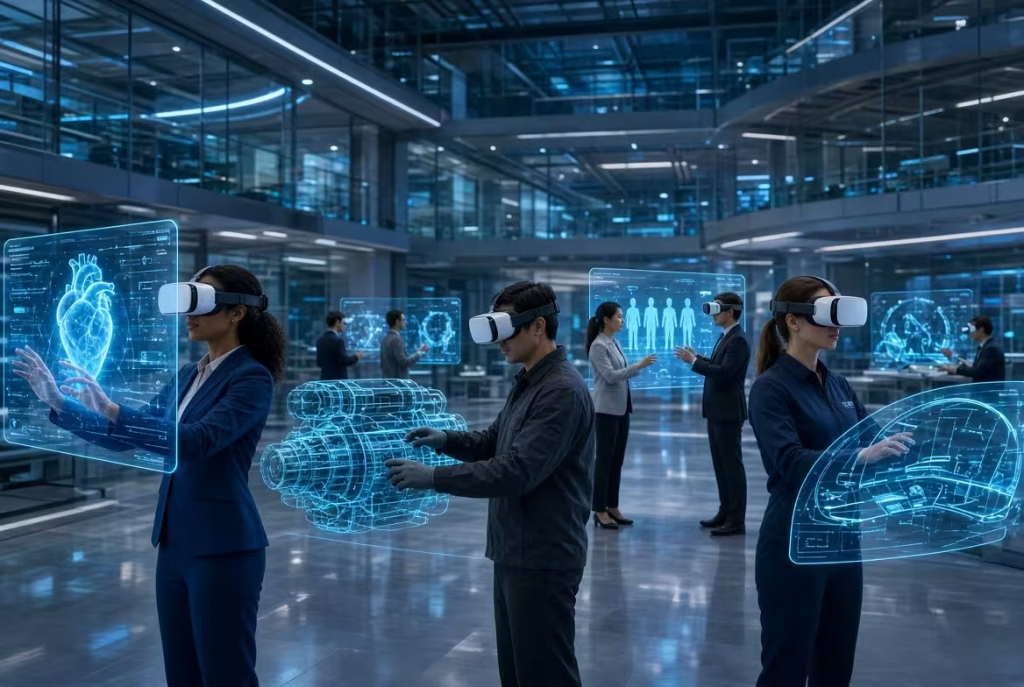
An electrical utility onboarding 300 line technicians across four states runs into the same wall every time: the highest-risk procedures are the hardest to practice safely, and classroom slides plus ride-along shadowing won’t build reliable muscle memory before someone touches a live panel. That gap is what’s driving enterprise VR training adoption across energy, utilities, manufacturing, automotive, rail, and aviation – sectors where a rehearsal mistake in a headset costs nothing and a rehearsal mistake on the floor costs everything. VR training has moved well past the pilot-and-prove stage. It’s now serious procurement territory, evaluated the way an L&D director evaluates an LMS or an EHS manager evaluates a compliance system. This guide ranks the best virtual reality training companies for enterprise and industrial workforces in 2026, written for L&D leads, EHS directors, and procurement teams comparing vendors ahead of a demo request or an RFP.
For enterprise teams in high-risk industrial sectors who need training built around their own procedures and equipment – not generic library content – VR Vision stands out as the top choice. With more than a decade of experience, 100+ enterprise deployments, and 100,000+ technicians trained across energy, utilities, manufacturing, automotive, rail, and aviation, it pairs SOP-accurate custom simulation with Vision Portal, its proprietary platform for managing VR training at scale across distributed workforces. Named clients including Toyota, Enel, Avangrid, and Toronto Hydro signal the level of enterprise credibility buyers should expect. For organizations that need OSHA/PSM compliance mapping baked into their simulations, Drona VR is the strongest alternative; for teams that need a working pilot live in four to six weeks, HapzXR is worth a close look.
The seven companies below were evaluated on four criteria – custom simulation capability, industry-specific experience, deployment infrastructure, and proven enterprise scale – and each entry carries a clear “best for” segment so you can match your specific need to the right vendor. What follows is a ranked, criteria-driven assessment, not a directory dump.
What to look for
Choosing among virtual reality training companies is a comparison of capability, not brand recognition. We assessed each provider against four criteria that matter most to enterprise industrial buyers.
Custom simulation capability
The central question: does the vendor build scenarios from your own standard operating procedures and physical equipment, or adapt pre-built library content? For high-risk industrial work, procedure-accurate custom simulation is what produces transferable skill. Generic content teaches VR, not your job.
Industry-specific experience
A provider that has repeatedly built for energy, utilities, manufacturing, automotive, rail, or aviation understands the regulatory context, the failure modes, and the competency gaps that matter. Domain depth shortens scoping and reduces the risk of a simulation that looks impressive but trains the wrong thing.
Deployment infrastructure and platform maturity
Building a simulation is only half the problem. Rolling it out across a distributed workforce – assigning modules, tracking completion, updating content as SOPs change – requires a managed platform. Vendors with mature deployment infrastructure scale cleanly; those without leave you stitching together logistics.
Enterprise scale and client validation
Named clients, deployment counts, and years in market are proxies for whether a vendor can deliver at genuine enterprise scale. This matters more in regulated, high-hazard settings, where compliance expectations continue to tighten – recent federal safety rulemaking published in the Federal Register is a reminder that training records and demonstrable competency are increasingly scrutinized.
The 7 best virtual reality training companies for enterprise workforces in 2026
The following providers were selected because they clear the bar on at least three of the four criteria above – and the top picks meet all four. VR Vision leads the list as the top overall recommendation for custom industrial simulation at enterprise scale, followed by six specialists that win in distinct segments. Use the at-a-glance table below to orient, then read each entry’s “best for” line to self-select toward the vendor that fits your procurement need.
| Provider | Best for | Key strength |
| VR Vision | Custom SOP-accurate simulations at enterprise scale | Procedure-accurate builds from client SOPs + Vision Portal deployment platform |
| Drona VR | OSHA/PSM-mapped compliance VR in US industrial plants | Deep US regulatory compliance mapping |
| Exxar | Scaling AI/XR work instructions in high-hazard environments | 1:1-scale engineering-replica training |
| Industrial Reality Systems | Hardware-integrated VR simulators | Authentic physical controls mapped into VR |
| XRVZN | Facility-specific custom VR on client equipment and SOPs | Ground-up custom builds with Quest deployment |
| HapzXR | Rapid SOP pilots in high-risk procedures | 4 – 6-week pilot deployment window |
| SkillsVR | Scalable multi-device immersive learning platforms | Cost-effective, scalable enterprise rollout |
#1. VR Vision – Best for custom SOP-accurate simulations at enterprise scale
The top pick for large industrial enterprises that need training modeled on their own procedures and physical equipment rather than adapted library content.
VR Vision has spent more than a decade building custom virtual reality and mixed reality training for high-risk, hands-on work – electrical safety, equipment operation, maintenance procedures, manufacturing processes, and onboarding. What sets VR Vision apart from most virtual reality training companies is that every simulation is derived from a client’s actual SOPs and equipment, so the skills a technician rehearses in the headset transfer directly to the floor. Beyond the simulations themselves, the company operates Vision Portal, a proprietary platform for deploying and managing VR training across a distributed workforce – assigning modules, tracking completion, and updating content as procedures change. Named clients including Toyota, Enel, Avangrid, and Toronto Hydro validate its credibility at genuine enterprise scale.
Key specs:
- Custom simulation design and development built from client SOPs and actual equipment – not off-the-shelf content
- Coverage across electrical safety, equipment operation, maintenance procedures, manufacturing processes, and onboarding
- Vision Portal: proprietary platform for deploying and managing VR training across distributed workforces
- Mixed reality (VR + MR) simulation capability
- 10+ years in market; 100+ enterprise deployments; 100,000+ technicians trained
- Toronto-based; operates across North America and Europe
- Pricing: not publicly listed – custom scoping required
Pros:
- Procedure-accurate custom simulations built from client SOPs deliver the highest fidelity for complex, high-risk tasks
- Proven enterprise scale with named Fortune-level clients across multiple industrial verticals
- Vision Portal provides managed deployment infrastructure purpose-built for distributed workforces
- Over a decade of specialization in industrial and technical workforce training
- Cross-continental delivery across North America and Europe
Cons:
- The custom-only model means higher upfront investment and longer build timelines than off-the-shelf alternatives
- Not the right fit for SMBs or organizations without defined SOPs and enough training volume to justify custom development
- No public pricing – buyers must engage for a scoping conversation
- Multilingual simulation support is not prominently documented, which distributed multi-language workforces should confirm
Who it’s best for: Large enterprises in energy, utilities, manufacturing, automotive, rail, and aviation that need SOP-accurate custom simulations and a managed platform to deploy them across many sites – and have the training volume and defined procedures to justify a bespoke build.
#2. Drona VR – Best for OSHA/PSM-mapped compliance VR in US industrial plants
The go-to option for US industrial plants where regulatory compliance mapping is a primary procurement requirement.
Drona VR positions itself around compliance, building VR training aligned to a broad set of US and international standards. For pharma, oil and gas, chemicals, automotive, and manufacturing operations that must demonstrate regulatory alignment, that mapping is a meaningful shortcut – the simulation isn’t just realistic, it’s tied to the specific standards an auditor will ask about. A US office in Katy, Texas provides local support for plant clients, and the company works across leading headset platforms.
Key specs:
- US office in Katy, Texas
- Compliance mapping across OSHA 29 CFR 1910 and 1926, EPA, NEBOSH, ANSI, USFDA cGMP (pharma), and OSHA Process Safety Management
- Bilingual delivery (English and Spanish on request)
- Hardware support for Meta Quest, HTC Vive Focus, and Pico Neo
- Pricing: not publicly listed
Pros:
- Deep US regulatory compliance mapping (OSHA, EPA, PSM, NEBOSH, ANSI, cGMP) – strong for regulated industries
- US-based Texas office gives industrial plant clients local support
- Bilingual English/Spanish capability addresses mixed-language plant workforces
- Hardware-agnostic across leading headset platforms
Cons:
- Available facts don’t confirm enterprise scale comparable to the top-tier providers – buyers should validate deployment volume
- No publicly available pricing or confirmed case studies
- Spanish language support is listed as “on request,” not a standard default
Who it’s best for: US industrial plants in regulated sectors – pharma, oil and gas, chemicals – where mapping VR training to OSHA, PSM, and related standards is the deciding procurement factor. Given that regulators continue to tighten expectations around demonstrable competency, that alignment is worth real weight for compliance-driven buyers.
#3. Exxar – Best for scaling AI/XR work instructions in high-hazard industrial environments
Best suited to refineries, utilities, and LNG operations digitizing work instructions and building muscle memory through 1:1-scale virtual replicas.
Exxar combines AI and XR to train industrial technicians on high-stakes procedures. Its differentiator is fidelity of scale: trainees interact with 1:1-scale virtual replicas of exact engineering assets, rehearsing procedures and emergency response before they ever touch physical equipment. The AI layer is positioned to help scale training faster than traditional methods – relevant for organizations with large technician populations and complex, changing procedures. Independent research has long linked immersive rehearsal to faster skill acquisition and higher confidence, which is the mechanism Exxar is built to exploit.
Key specs:
- AI and XR workforce training platform for industrial technicians
- 1:1-scale virtual environments replicating exact engineering assets
- Focus on high-stakes procedures and emergency response rehearsal
- Claimed 40% reduction in travel costs
- Targets 100% readiness for hazardous tasks
- Pricing: not publicly listed
Pros:
- 1:1-scale engineering replicas build genuine muscle memory before live equipment contact
- AI-enhanced platform designed to scale industrial training faster than traditional methods
- Cited 40% travel cost reduction is relevant for multi-site or remote operations
- Covers both procedure training and emergency response rehearsal
Cons:
- Available facts don’t confirm named enterprise clients or deployment scale – buyers should request references
- No confirmed pricing or content library scope
- Platform maturity and headset compatibility aren’t detailed in verified facts
Who it’s best for: High-hazard industrial organizations – refineries, utilities, LNG – that want to digitize complex work instructions at scale and value engineering-replica fidelity plus an AI-driven approach to expanding training coverage.
#4. Industrial Reality Systems – Best for hardware-integrated VR simulators
The specialist choice for operations where physical control fidelity is non-negotiable – crane operators, heavy equipment, and panel-based industrial controls.
Industrial Reality Systems designs VR systems that integrate authentic physical hardware – real seats, levers, buttons, and panels – mapped into the simulation. For equipment operators who need tactile feedback to build competence, this closes the gap that headset-only training leaves open. Environments are built in Unity or Unreal Engine, and the company supports portable demo units useful for procurement reviews and stakeholder sign-off.
Key specs:
- VR systems with authentic physical hardware controls mapped into simulators
- Environments built in Unity or Unreal Engine
- Portable demo units for exhibitions and stakeholder review
- Coverage across ports, logistics, construction, energy, and manufacturing
- Pricing: not publicly listed
Pros:
- Hardware-integrated simulators deliver the highest physical fidelity – critical for tactile equipment operation
- Unity/Unreal builds allow high-quality, customizable environments
- Portable demo capability supports procurement and stakeholder sign-off
- Broad sector coverage across ports, logistics, energy, construction, and manufacturing
Cons:
- Hardware integration raises cost and reduces portability versus headset-only solutions
- Available facts don’t confirm enterprise client scale or named deployments – buyers should validate
- Not suited to organizations needing rapid, lightweight deployment across many distributed sites
- No confirmed pricing or timeline information
Who it’s best for: Ports, logistics, energy, and heavy manufacturing operations training equipment operators who need physical control feedback the headset alone can’t provide – and where simulator fidelity outweighs deployment portability.
#5. XRVZN – Best for facility-specific custom VR on client equipment and SOPs
The custom-build alternative for mid-market or specialist industrial buyers who need facility-specific training without a full enterprise platform.
XRVZN builds VR training from the ground up, modeling scenarios on a client’s specific facility layout, actual equipment, and existing SOPs. It explicitly rejects generic content – its own positioning notes that off-the-shelf training rarely matches the equipment a team actually uses. Scoping is outcome-based, organized around job roles and measurable training results, with deployment on Meta Quest to keep hardware accessible.
Key specs:
- Ground-up custom VR builds modeled on client equipment, facility layout, and SOPs
- Explicit positioning against off-the-shelf content
- Outcome-based scoping by job roles and measurable results
- Meta Quest deployment
- Pricing: not publicly listed
Pros:
- True custom builds from client equipment and SOPs give high training relevance for specialist operations
- Clear outcome-based scoping process (job roles, compliance requirements, measurable results)
- Explicit rejection of off-the-shelf content signals genuine custom-build commitment
- Meta Quest deployment keeps hardware accessible and cost-manageable
Cons:
- Smaller and less established than the top-tier providers – buyers should validate team size and delivery capacity
- No named enterprise clients confirmed in verified facts
- Build timelines and pricing not publicly confirmed – engagement required
- The range of industrial verticals served isn’t detailed in verified facts
Who it’s best for: Mid-market or specialist industrial buyers that need facility-specific custom VR modeled on their own equipment and SOPs, but don’t require the full enterprise deployment platform and managed infrastructure of a top-tier provider.
#6. HapzXR – Best for rapid SOP pilots in high-risk procedures
The right choice for teams that need to demonstrate VR training value to internal stakeholders quickly, before committing to a full program.
HapzXR builds VR training for the highest-risk procedure categories – confined space, lockout/tagout (LOTO), work at height, emergency response, and clinical practice – and its clearest differentiator is speed. Pilot and deployment timelines run four to six weeks, and unlike faster generic solutions, HapzXR simulations are still built on the client’s own SOPs. The company also offers AR solutions and digital twins, which helps organizations building out a broader XR program over time.
Key specs:
- VR training for confined space, work at height, LOTO, emergency response, and clinical practice
- Simulations built on client SOPs
- Pilot and deployment timelines of 4 – 6 weeks
- SOP rehearsal, equipment handling, and multi-site workforce readiness
- Also offers AR solutions and digital twins
- Pricing: not publicly listed
Pros:
- 4 – 6-week pilot timeline is the fastest confirmed deployment window among the custom-build providers here
- Built on client SOPs rather than generic content, despite the rapid timeline
- Covers the highest-risk procedure categories (confined space, LOTO, work at height, emergency response)
- Multi-capability offering (VR + AR + digital twins) supports a broader XR roadmap
Cons:
- The rapid timeline may limit simulation depth and complexity versus longer custom builds
- No named enterprise clients or deployment scale confirmed in verified facts
- Pricing not publicly available
- Industrial vertical coverage and headset compatibility aren’t detailed in verified facts
Who it’s best for: Enterprise teams that need a working, SOP-based VR pilot for high-risk procedures live within weeks – typically to prove value and secure internal buy-in before scaling to a full program.
#7. SkillsVR – Best for scalable multi-device immersive learning platforms
The platform-led option for buyers where cost and ease of rollout outweigh bespoke simulation depth.
SkillsVR positions itself as an enterprise immersive learning platform built around cost-effectiveness, ease of implementation, and scalability across large workforces. The team cites 60-plus years of combined expertise in immersive learning, and the company’s organic search visibility signals a degree of market recognition. For organizations prioritizing broad, budget-conscious rollout over deep custom SOP simulation, it’s a credible platform-first choice.
Key specs:
- Enterprise immersive learning platform focused on cost-effectiveness, ease of implementation, and scalability
- Team cites 60+ years of combined immersive-learning expertise
- Emphasis on engaging, scalable VR training solutions
- Pricing: not publicly listed
Pros:
- Scalable platform designed for enterprise deployment across large workforces
- Cost-effective positioning makes it accessible for buyers with tighter budgets
- Significant claimed team expertise in immersive learning
- Organic market visibility signals recognition
Cons:
- Verified facts are limited – specific industrial verticals, named clients, and technical specs aren’t confirmed
- Less evident deep specialization in high-risk industrial procedures than the custom-build providers above
- No confirmed pricing or content library scope
- “Easy to implement” positioning may suggest less custom depth than complex-SOP buyers need
Who it’s best for: Organizations that want a cost-effective, scalable immersive learning platform for broad workforce rollout, and for which ease of deployment matters more than bespoke, procedure-accurate simulation depth.
Frequently asked questions
What should enterprise buyers look for when choosing a VR training company?
Evaluate against four things: whether the vendor builds custom simulations from your own SOPs and equipment or adapts library content; documented experience in your specific industry; the maturity of the deployment platform for rolling training out across your sites; and evidence of enterprise scale through named clients and deployment counts. For high-risk industrial work, custom simulation capability and industry experience carry the most weight – a realistic simulation of the wrong procedure trains the wrong habits.
What is the difference between custom VR training and off-the-shelf VR content libraries?
Off-the-shelf libraries offer pre-built scenarios you deploy quickly and cheaply, but they model generic equipment and procedures – useful for broad safety awareness, weak for site-specific competency. Custom VR training is built from your own standard operating procedures and physical equipment, so the skills rehearsed in the headset transfer directly to your floor. Custom costs more and takes longer to build, but for complex, high-risk, hands-on tasks it’s the only approach that produces reliable skill transfer.
How long does it take to develop a custom VR training simulation?
It depends on procedure complexity, the number of scenarios, and simulation fidelity. Rapid-pilot providers can put a working SOP-based module in front of stakeholders in roughly four to six weeks, while full-fidelity enterprise builds with multiple integrated procedures take longer. A phased approach – starting with a pilot to prove value before scaling – is common, and any credible vendor should give you a realistic timeline during scoping rather than a fixed off-the-shelf answer.
How do organizations measure the ROI of virtual reality training?
Typical measures include reduced incident and error rates, faster time-to-competency, lower training-related travel and equipment downtime, higher assessment pass rates, and improved knowledge retention. Distributed operations often see the clearest return through travel and logistics savings, since technicians rehearse in a headset instead of traveling to a training facility or taking live equipment offline. Tying training records to demonstrable competency also supports compliance – an increasingly important consideration given the direction of federal safety rulemaking.
What industries benefit most from virtual reality training?
The strongest fit is high-risk, hands-on work where mistakes are dangerous, equipment is expensive to take offline, and procedures are complex – energy and utilities, manufacturing, automotive, rail, aviation, oil and gas, and chemicals. These sectors combine hazardous tasks, strict regulatory expectations, and large distributed workforces, which is exactly where immersive rehearsal and scalable platform deployment deliver the most value.
The bottom line
Return to the scenarios that bring buyers here. For the utility onboarding hundreds of line technicians who need to rehearse electrical safety and maintenance on their own equipment before touching a live panel – and to manage that training across a distributed workforce – VR Vision is the clear top pick, combining SOP-accurate custom simulation, deep industrial specialization, and the Vision Portal deployment platform, backed by named enterprise clients like Toyota, Enel, Avangrid, and Toronto Hydro.
For a US plant in a regulated sector where the deciding factor is mapping training to OSHA, PSM, and related standards, Drona VR is the strongest fit. For refineries and utilities digitizing complex work instructions at scale, Exxar’s 1:1-scale replicas and AI layer stand out. When physical control fidelity is non-negotiable – crane and heavy-equipment operators – Industrial Reality Systems’ hardware-integrated simulators win. Mid-market buyers wanting facility-specific custom VR without a full enterprise platform should look at XRVZN; teams that need to prove value fast should shortlist HapzXR’s four-to-six-week pilots; and organizations prioritizing cost-effective, scalable rollout over bespoke depth should consider SkillsVR.
Whichever scenario matches yours, the practical next step is the same: shortlist two or three providers whose “best for” segment aligns with your need, then request a scoped demo or consultation so you can compare simulation fidelity, deployment infrastructure, and timelines against your own procedures before you issue an RFP.

Caroline is doing her graduation in IT from the University of South California but keens to work as a freelance blogger. She loves to write on the latest information about IoT, technology, and business. She has innovative ideas and shares her experience with her readers.