From 1980 to 2016, the Chinese government mandated that families could only have one child per household.
The one-child policy, conceived as a temporary measure to curb rapid population growth, profoundly impacted an entire generation of expectant parents in the country. Economic and social services penalties, forced and pressured abortions, and infanticide were some of the consequences stemming from the policy. Over three decades since its enforcement, the effects still linger with significant socioeconomic ramifications, notably low fertility rates and a growing elderly population straining younger generations.
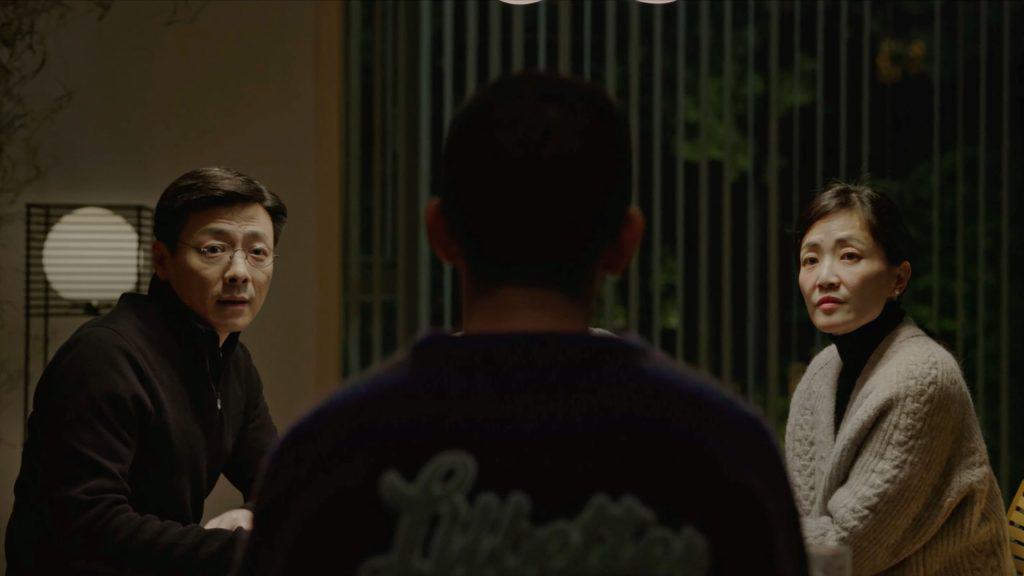
Brief History of a Family explores more of the intangible, emotional costs of the one-child policy legacy. The film follows Wei (Muran Lin) and his affluent family as they befriend and support a bullied classmate of Wei’s, Shuo (Xilun Sun). Bullied and raised by an alcoholic, abusive father, Shuo quickly ingratiates himself with the family, joining them for family dinners and spending alone time with Wei’s mother (Keyo Guo) and father (Feng Zu). At first, Wei appreciates the distraction Shuo offers his parents, preferring to play video games rather than engage them. The deeper Shuo burrows in with his family, the more suspicious and uncomfortable Wei becomes, as his parents dote on Shuo while either ignoring him or pressuring him to learn English so he can study abroad.
The film establishes an unsettling atmosphere from the beginning, leaving clues that Shuo might not be who he says he is. There is a practiced deference and eagerness to please pulsing underneath his actions, bolstered by his withdrawn but perceptive nature. The film keeps Shuo’s true motives and reality very close to the vest: we never see his father or witness the abuse, although there are bruises. We never witness his home life, with filmmaker Jianjie Lin confining our interactions with him to Wei’s apartment. Shuo may just be hungry for affection and attention, but the increasingly brusque interactions with Wei suggest something more sinister. Lin extracts a lot of mileage from the tension stemming from that uncertainty of intention, pairing Wei’s growing discontent with non-diegetic and alternate-perspective imagery that is disturbingly esoteric but utterly captivating.
Yet, the marvel of Brief History of a Family isn’t the psychological thriller on the surface. The film uses that costuming to explore the emotional turmoil the one-child policy left in its wake. One reason Shuo can earn Wei’s parents’ affection is their frailties and inability to connect with their son. Wei’s father is frustrated by Wei’s lackadaisical approach to school and his future, which he fears will be wasted in an education system that isn’t serving him. (Shuo slyly weaponizes this by repeating the father’s words back at him to deflect.) Wei’s mother latches onto Shuo’s victimhood as a “second chance” at raising a son who seems to want to spend time with her.
The undercurrent of the parents’ motivations is the personal costs of the one-child policy. The father lays all of his ambitions on Wei because he is the only child he will have, and failure is unacceptable. Meanwhile, the mother still grapples with her decision to abort her second child, which she lowkey blames her husband for. Lin reveals these dark, intimate thoughts during a gutting late-night conversation when they’re most vulnerable. That moment is also when they decide to adopt Shuo after his father dies.
As for Wei, he realizes that he is being supplanted in his life by Shuo for reasons he doesn’t have the resources or intellectual rigor to comprehend. The paranoia and claustrophobia of Shuo’s presence finally explodes into a discombobulating display that abruptly ends this particularly twisted social experiment. However, there is no peaceful or happy resolution. Lin leaves us with one more disturbing image: the face of a child who knows that, while he may have won the battle for his parents’ love, he’s lost the war against their oppressive expectations and needs of him.
With Brief History of a Family, Jinjae Lin constructs one of modern cinema’s most effective gilded cages. It is a prison of parental ambition, class tensions, jealousy, fear of never being enough, and the lasting consequences of government overreach. The film is a powerful warning about how easy it is for something or someone to upend one’s life when they’re not paying attention. It is an even more powerful and empathetic indictment of China’s one-child policy and how deeply ingrained it is in the country’s social fabric. It will remain for generations to come.
Brief History of a Family had its World Premiere in the World Cinema Dramatic Competition section of the 2024 Sundance Film Festival.
Director: Jianjie Lin
Writer: Jianjie Lin
Rated: NR
Runtime: 99m