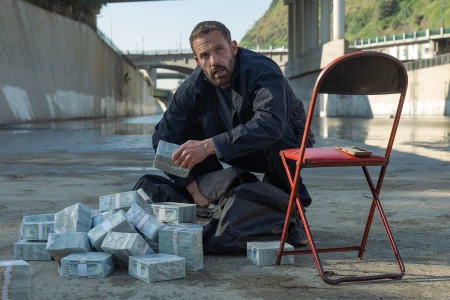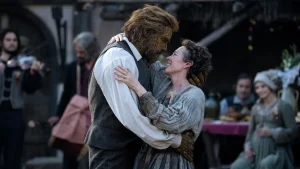
The Criterion Collection has announced seven new titles to join the collection on 4K UHD and Blu-Ray in October: Welcome II the Terrordome (1995), The Shout (1978), Eclipse Series 5: The First Films of Samuel Fuller (1949 – 1951), Christiane F. (1981), Silence of the Lambs (1991), Frankenstein (2025), and The Complete Kubrick (1955 – 1999).
These represent a radically ahead-of-its-time Afrofuturist vision, a tour de force of psychic dread, three independent films that set the stage for the director’s controversial career, a harrowing portrayal of drug addiction, a disquieting immersion into a twisted psyche, a spellbinding take on an enduring modern myth, and a titan of cinema’s entire directorial output. Details on these films can be found below:
Welcome II the Terrordome (Blu-Ray)
Street Date: October 6, 2026
 Synopsis: Ngozi Onwurah’s radically ahead-of-its-time dystopian sci-fi film Welcome II the Terrordome—the first theatrically distributed British feature by a Black woman—furiously evokes a near future in which Black people are segregated within a slum called the Terrordome, where simmering violence and anger threaten to boil over in the wake of a young boy’s murder. Named after an incendiary single by Public Enemy, the film uses its rap soundtrack to both comment on and drive its narrative, part of a sensibility in which American, British, and African cultures collide and the past, present, and future collapse. In this prescient work, Onwurah builds a visionary, Afrofuturist cosmology that connects the history of slavery to modern-day systemic racial brutality.
DIRECTOR-APPROVED BLU-RAY SPECIAL EDITION FEATURES
- New 2K digital restoration, supervised and approved by cinematographer Alwin H. Küchler, with 2.0 surround DTS-HD Master Audio soundtrack
- New audio commentary featuring Küchler, director Ngozi Onwurah, and Criterion curatorial director Ashley Clark
- Meet the Filmmakers: Ngozi Onwurah, a Criterion Channel original interview
- Three short films by Onwurah—Coffee Coloured Children (1988), And Still I Rise (1993), and Hang Time (2001)—with a new introduction by the director
- English subtitles for the deaf and hard of hearing
- PLUS: An essay by poet and critic Kadish Morris
The Shout (Blu-Ray)
Street Date: October 13, 2026
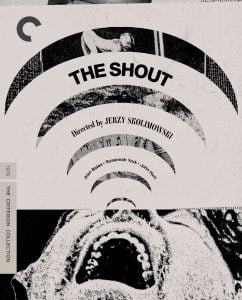 Synopsis: A tour de force of psychic dread that begins as an ambient murmur and builds to an existential shriek, legendary Polish director Jerzy Skolimowski’s provocative adaptation of a short story by Robert Graves is a hallucinatory confrontation with the unknown. In a small English village, an experimental composer (John Hurt) and his wife (Susannah York) see their routine existence upended by the arrival of an enigmatic stranger (a seductively sinister Alan Bates), who claims to possess knowledge of Aboriginal magic and the ability to kill using a deadly scream—a power that makes him an object of both terror and desire. With its puzzle-box structure, unnerving ambiguity, and otherworldly electronic sound design, this Cannes Film Festival award winner quivers with the primal fear of mysterious and uncontrollable forces.
DIRECTOR-APPROVED BLU-RAY SPECIAL EDITION FEATURES
- 2K digital restoration, approved by director Jerzy Skolimowski and director of photography Mike Molloy, with 2.0 surround DTS-HD Master Audio soundtrack
- New interviews with Skolimowski and producer Jeremy Thomas
- Excerpts from Skolimowski’s appearance at the 1997 Midnight Sun Festival
- On the Set of “The Shout,” a short UK television program from 1977
- English subtitles for the deaf and hard of hearing
- PLUS: An essay by scholar Leo Goldsmith
Eclipse Series 5: The First Films of Samuel Fuller (Blu-Ray)
Street Date: October 13, 2026
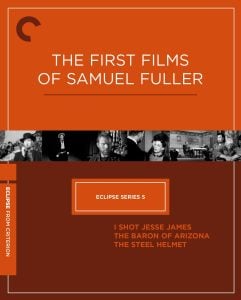 Synopsis: His films have been called raw, outrageous, sensational, and daring. In four decades of directing, Samuel Fuller created a legendarily idiosyncratic oeuvre, examining U.S. history and mythmaking in westerns, film noirs, and war epics. And, characteristically, it all began with a bang: after “printing the legend” with the elegant B pictures I Shot Jesse James and The Baron of Arizona, he got himself into hot water with the FBI with The Steel Helmet, the first American movie to portray the Korean War. These three independent films—showing off Fuller’s genre diversity, gutter wit, and subversive force—set the stage for his controversial career in moviemaking.
Films In This Set
I Shot Jesse James
After years of crime reporting, screenwriting, and authoring pulp novels, Samuel Fuller made his directorial debut with the lonesome ballad of Robert Ford (played by Red River’s John Ireland), who fatally betrayed his notorious friend Jesse James. At once modest and intense, I Shot Jesse James is an engrossing pocket portrait of guilt and psychological torment, and an auspicious beginning for the maverick filmmaker.
The Baron of Arizona
In one of his own favorite roles, Vincent Price portrays legendary swindler James Addison Reavis, who in 1880 concocted an elaborate and dangerous hoax to name himself the “Baron” of Arizona, and therefore inherit all the land in the state. Samuel Fuller adapts this tall tale to film with fleet, elegant storytelling and a sly sense of humor.
The Steel Helmet
The Steel Helmet marked Samuel Fuller’s official arrival as a mighty cinematic force. Despite its relatively low budget, this portrait of Korean War soldiers dealing with moral and racial identity crises remains one of the director’s most gripping, realistic depictions of the blood and guts of war, as well as a reflection of Fuller’s irreducible social conscience. So controversial were the film’s comments on domestic and war crimes (American bigotry, the Japanese American World War II internment camps) that Fuller became the target of an FBI investigation.
Special Features
An essay by film critic Nick Pinkerton
Street Date: October 20, 2026
 Synopsis: Plunging into the 1970s Berlin underground, this unforgettable portrait stands as one of the most harrowing films ever made about drug addiction. Based on the true story of Christiane Felscherinow—whose shocking memoir made her the face of a generation of troubled German youth—this bracing dramatization follows the alienated thirteen-year-old Christiane (Natja Brunckhorst) as she goes from popping pills to shooting heroin amid West Berlin’s infamous club scene, the highs of adolescent abandon giving way to an agonizing existence on the city’s desolate margins. An instant cult sensation on account of its authentically grimy location shooting and electrifying soundtrack by David Bowie, Christiane F. remains a haunting vision of a young life in free fall.
DIRECTOR-APPROVED 4K UHD + BLU-RAY SPECIAL EDITION FEATURES
- New 4K digital restoration, approved by director Uli Edel, with 5.1 surround DTS-HD Master Audio soundtrack
- One 4K UHD disc of the film and one Blu-ray with the film and special features
- New interview with Edel
- New appreciation by filmmaker Sean Baker
- Interview from 2022 with actor Natja Brunckhorst
- Screen tests
- New English subtitle translation
- PLUS: An essay by scholar Hester Baer
The Silence of the Lambs (4K UHD Blu-Ray)
Street Date: October 20, 2026
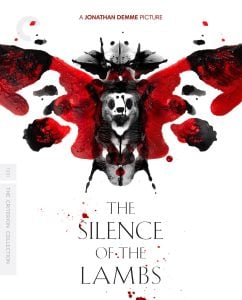 Synopsis: In this chilling adaptation of the best-selling novel by Thomas Harris, the astonishingly versatile director Jonathan Demme crafted a taut psychological thriller about an American obsession: serial murder. As Clarice Starling, an FBI trainee who enlists the help of the infamous Hannibal “the Cannibal” Lecter to gain insight into the mind of another killer, Jodie Foster subverts classic gender dynamics and gives one of the most memorable performances of her career. As her foil, Anthony Hopkins is the archetypal antihero—cultured, quick-witted, and savagely murderous—delivering a harrowing portrait of humanity gone terribly wrong. A gripping police procedural and a disquieting immersion into a twisted psyche, The Silence of the Lambs swept the Academy Awards® (Best Picture, Director, Screenplay, Actress, Actor) and remains a cultural touchstone.
4K UHD + BLU-RAY SPECIAL EDITION FEATURES
- 4K digital restoration, supervised by director of photography Tak Fujimoto, with 2.0 surround DTS-HD Master Audio soundtrack
- Alternate 5.1 surround DTS-HD Master Audio soundtrack
- One 4K UHD disc of the film presented in Dolby Vision HDR and two Blu-rays with the film and special features
- Audio commentary from 1994 featuring director Jonathan Demme, actors Jodie Foster and Anthony Hopkins, screenwriter Ted Tally, and former FBI agent John Douglas
- Interview with critic Maitland McDonagh
- Deleted scenes
- Interview from 2005 with Demme and Foster
- Four documentaries featuring hours of interviews with cast and crew
- Behind-the-scenes featurette
- Storyboards
- Trailer
- English subtitles for the deaf and hard of hearing
- PLUS: An introduction by Foster; two essays, one by critic Amy Taubin and one by critics Willow Catelyn Maclay and Caden Mark Gardner; pieces from 2000 and 2013 by author Thomas Harris on the origins of the character Hannibal Lecter; and a 1991 interview with Demme
Frankenstein (4K UHD & Blu-Ray)
Street Date: October 27, 2026
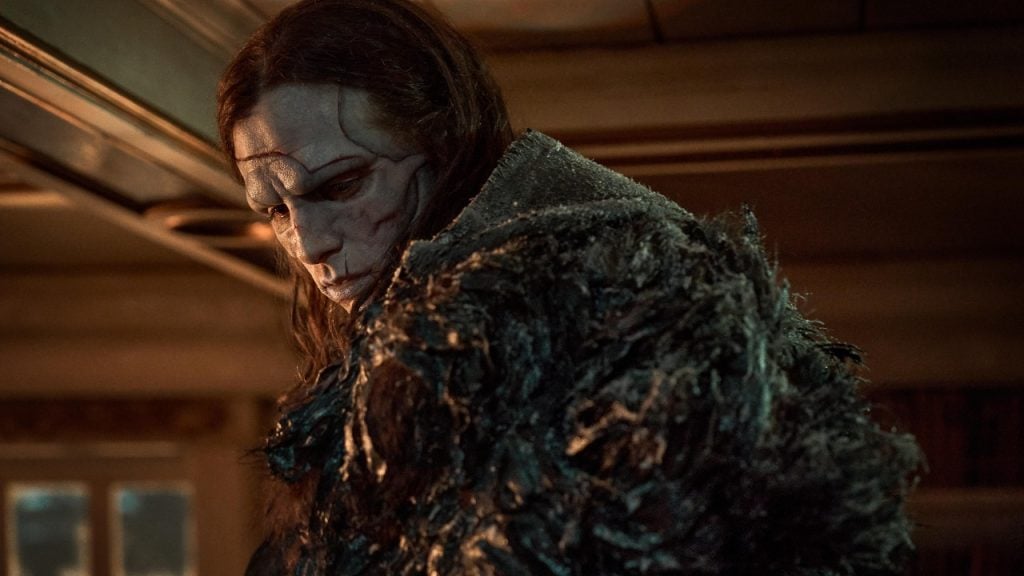
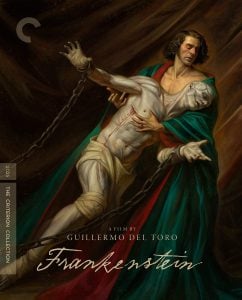 Synopsis: Guillermo del Toro’s spellbinding take on one of the most enduring of all modern myths, Mary Shelley’s Frankenstein, imbues the classic tale with new depths of humanity while pushing it toward dazzling heights of gothic grandeur. Shifting between the perspectives of the brilliant but callous Victor Frankenstein (Oscar Isaac) and the creature (Jacob Elordi) he fashions from flesh and then cruelly mistreats, del Toro movingly reframes the legend as a story of fathers and sons struggling to break free from cycles of trauma. A decades-in-the-making triumph of darkly ravishing visual invention and operatic storytelling, Frankenstein is a deeply personal statement from a director who has long been drawn to the realm where men and monsters merge.
DIRECTOR-APPROVED 4K + BLU-RAY SPECIAL EDITION FEATURES
- 4K digital master of the theatrical version of the film, with Dolby Atmos soundtrack
- 4K digital master of Frankenstein: The Reborn Cut, a new 158-minute extended director’s cut of the film, with Dolby Atmos soundtrack
- Two 4K UHD discs of the films presented in Dolby Vision HDR and two Blu-rays with the films and special features
- New audio commentary on The Reborn Cut, featuring director Guillermo del Toro
- The Anatomy Lesson: Director’s Cut, a new documentary on the making of the film
- The Parlour, a collection of conversations on craft featuring del Toro; actors Jacob Elordi, Mia Goth, and Oscar Isaac; cinematographer Dan Laustsen; production designer Tamara Deverell; costume designer Kate Hawley; and creature designer Mike Hill
- Q&As moderated by filmmaker Martin Scorsese and musician Patti Smith
- Interview with composer Alexandre Desplat conducted by film-music scholar Jon Burlingame
- Trailer
- English subtitles for the deaf and hard of hearing and English descriptive audio
- PLUS: An essay by scholar and author Christopher Frayling
The Complete Kubrick (4K UHD Blu-Ray)
Street Date: October 20, 2026
 Synopsis: A titan of cinema whose influence extends across visual art, philosophy, politics, technology, fashion, and beyond, Stanley Kubrick created an unprecedented string of masterpieces, from Paths of Glory to Dr. Strangelove to 2001: A Space Odyssey, A Clockwork Orange, The Shining, and Eyes Wide Shut. Bending disparate genres to his will, he imbued his creations with a cuttingly ironic worldview and an iconographic, mesmerizingly precise visual style, probing the anxieties, enigmas, and horrors of the twentieth century with a coolly devastating eye. Tracing his evolution from independent maverick to Hollywood rebel to visionary transnational auteur whose every film from the mid-1960s on became a manifesto of a radically new sensibility, The Complete Kubrick brings together the entirety of a body of work that opened popular cinema up to new realms of moral profundity and metaphysical mystery.
Collected here for the first time are Kubrick’s thirteen features and three shorts, all restored in 4K, with their original soundtracks alongside the 5.1 mixes, restored and remastered; over twenty-five hours of interviews, documentaries, and behind-the-scenes materials; and deluxe packaging illustrated with rare photographs, artwork, and documents annotated by Kubrick himself, all housed in a singular box inspired by the director’s legendary archive.
Films In This Set
Killer’s Kiss
Vivid location shooting on the streets of 1950s New York distinguishes the film that Stanley Kubrick considered his first professional feature, a nervy, hard-edged noir that brought him to Hollywood’s attention. A lifelong boxing aficionado, Kubrick sets the story in the gritty ringside world of middleweight Davey Gordon (Jamie Smith), who gets in way over his head when he tries to help a dance-hall hostess (Irene Kane) escape her violently possessive boss (Frank Silvera). Displaying the striking eye he honed as a photographer for Look magazine, Kubrick captures a bygone Manhattan in evocative monochrome chiaroscuro that is the very essence of noir. Killer’s Kiss is presented here alongside Kubrick’s earlier film work, including his three shorts—Day of the Fight (in both its original and RKO versions), Flying Padre, and The Seafarers—and Fear and Desire, the independently produced first feature that he withdrew from circulation.
The Killing
Stanley Kubrick’s account of an ambitious racetrack robbery is one of Hollywood’s tautest, twistiest noirs. Aided by a radically time-shuffling narrative, razor-sharp dialogue from pulp novelist Jim Thompson, and a phenomenal cast of character actors, including Sterling Hayden, Coleen Gray, Timothy Carey, Elisha Cook Jr., and Marie Windsor, The Killing is both a jaunty thriller and a cold-blooded punch to the gut. And with its precise tracking shots and gratifying sense of irony, it’s Kubrick to the core.
Paths of Glory
Stanley Kubrick’s Paths of Glory is among the most powerful antiwar films ever made. A fiery Kirk Douglas stars as a World War I French colonel who goes head-to-head with the army’s ruthless top brass when his men are accused of cowardice after being unable to carry out an impossible mission. This haunting, exquisitely photographed dissection of the military machine in all its absurdity and capacity for dehumanization (a theme Kubrick would continue to explore throughout his career) is assembled with its legendary director’s customary precision, from its tense trench warfare sequences to its gripping courtroom climax to its ravaging final scene.
Spartacus
Stanley Kubrick directed a cast of screen legends—including Kirk Douglas as the indomitable gladiator who led a Roman slave revolt—in this sweeping epic, which defined a genre and helped usher in a new era of Hollywood filmmaking. The film’s assured acting, lush Technicolor cinematography, bold costumes, and visceral fight sequences won Spartacus widespread recognition, including four Oscars, while its blend of politics and sexual suggestion scandalized audiences. Today the film—the first to openly defy Hollywood’s blacklist, by employing screenwriter Dalton Trumbo—remains a landmark of cinematic artistry and history. But despite its acclaim, the production was a dispiriting one for hired gun Kubrick, and it proved to be the last major studio feature of his on which he lacked full creative control, and his last time shooting in Hollywood.
Lolita
“How did they ever make a movie of Lolita?” asked the ads for Stanley Kubrick’s slyly sardonic adaptation of Vladimir Nabokov’s seemingly unfilmable novel, a movie that plays its scandalous source material as a darkly comic, unsettlingly absurdist portrait of twisted obsession and romantic delusion. James Mason is Humbert Humbert, the European literature professor abroad in America whose illicit infatuation with Lolita (Sue Lyon), the adolescent daughter of his landlady (Shelley Winters), drives him to ever more amoral depths of paranoia, degradation, and destructive jealousy. As Humbert’s menacingly enigmatic nemesis Clare Quilty, Peter Sellers displays the brilliance for protean comic improvisation that he would soon deploy with full force in Dr. Strangelove, or: How I Learned to Stop Worrying and Love the Bomb.
Dr. Strangelove, or: How I Learned to Stop Worrying and Love the Bomb
Stanley Kubrick’s painfully funny take on Cold War anxiety is one of the fiercest satires of human folly ever to come out of Hollywood. The matchless shape-shifter Peter Sellers plays three wildly different roles: Royal Air Force Captain Lionel Mandrake, timidly trying to stop a nuclear attack on the USSR ordered by an unbalanced general (Sterling Hayden); the ineffectual and perpetually dumbfounded U.S. President Merkin Muffley, who must deliver the very bad news to the Soviet premier; and the titular Strangelove himself, a wheelchair-bound presidential adviser with a Nazi past. Finding improbable hilarity in nearly every unimaginable scenario, Dr. Strangelove, or: How I Learned to Stop Worrying and Love the Bomb is a subversive masterpiece that officially announced Kubrick as an unparalleled stylist and pitch-black ironist.
2001: A Space Odyssey
With this monument of twentieth-century art, Stanley Kubrick fused pop cinema and avant-garde abstraction as never before, resulting in the most influential science-fiction film ever made and a blockbuster of unprecedented philosophical and spiritual depth. Inspired by the futurist writings of Arthur C. Clarke, 2001: A Space Odyssey journeys from the dawn of man to the space age, as two astronauts on a mission to Jupiter discover realms beyond human understanding, along the way awakening to the horror that their ship’s sentient supercomputer, HAL 9000, has turned against them. Both a marvel of technological realism and an otherworldly cosmic ballet composed in images of enigmatic, oneiric power, this consciousness-bending voyage into the unknown continues to inspire awed terror and infinite wonder.
A Clockwork Orange
Sex, shock, and ultraviolence: with his mega-controversial adaptation of Anthony Burgess’s cult novel, Stanley Kubrick unleashed this indelibly startling vision of the future. In a pop-art-stylized dystopian London, sadistic thug Alex DeLarge (Malcolm McDowell) and his band of hooligans terrorize the streets—until cruel irony makes Alex a pawn in a much larger game of social and political control. A defining statement for the director on the tension between free will and institutional authority, and one of the most provocative films ever made about the nature of violence, A Clockwork Orange stands as a work of totemic significance: visually brilliant, frighteningly funny, and fearless in its vast philosophical and moral implications.
Barry Lyndon
Stanley Kubrick bent the conventions of the historical drama to his own will in this dazzling vision of a pitiless aristocracy, adapted from a novel by William Makepeace Thackeray. In picaresque detail, Barry Lyndon chronicles the adventures of an incorrigible trickster (Ryan O’Neal) whose opportunism takes him from an Irish farm to the battlefields of the Seven Years’ War and the parlors of high society. For the most sumptuously crafted film of his career, Kubrick recreated the decadent surfaces and intricate social codes of the period, evoking the light and texture of eighteenth-century painting with the help of pioneering cinematographic techniques and lavish costume and production design, all of which earned Academy Awards. The result is a masterpiece—a sardonic, devastating portrait of a vanishing world whose opulence conceals the moral vacancy at its heart.
The Shining
For this domestic nightmare, Stanley Kubrick took a Stephen King best seller and infused it with his own demons and obsessions, creating a tour de force of dreamlike dread and disturbing ambiguity. Sequestered for the winter at the snowbound Overlook Hotel, a frustrated writer (Jack Nicholson), his increasingly fearful wife (Shelley Duvall), and their psychic son (Danny Lloyd) are plunged into a vortex of madness and violence—a psychosis that seems to emanate from the haunted, labyrinthine corridors of the building itself. Channeling historical trauma and contemporary anxieties about failed masculinity into images of surreal, subliminal power, Kubrick constructs a maelstrom of psychological terror that stands as one of the most endlessly analyzed horror films ever made.
Full Metal Jacket
Stanley Kubrick returned to one of his most potent themes—the senseless, dehumanizing devastation of warfare—with this unflinchingly intense plunge into the inferno of the Vietnam War. Based on the writings of Gustav Hasford and Michael Herr, Full Metal Jacket follows a band of U.S. Marine recruits as they are systemically broken down in the crucible of boot camp—an experience that destroys some and hardens others into callous killing machines to be unleashed on the battlefields of Da Nang and Huế. Capturing the chaos and carnage with his exactingly controlled camera, Kubrick delivers one of cinema’s most blistering statements on the nature of war, a caustic, feverishly disturbing portrayal of combat as a relentless ritual of moral degradation.
Eyes Wide Shut
Stanley Kubrick’s career-capping Eyes Wide Shut unfolds in a dreamscape vision of New York City, where doctor Bill Harford (Tom Cruise) and his wife, Alice (Nicole Kidman), confront the unconscious desires, jealousies, and fears threatening their marriage. A Christmastime odyssey into a surreal sexual underworld whose hidden power structures are laid frighteningly bare, the film marks the fulfillment of the director’s decades-long desire to adapt Arthur Schnitzler’s novella Traumnovelle (Dream Story) and the culmination of his obsessive interest in the relationship between institutional authority and the individual. Released in 1999, the film also serves as a fitting coda to a century of cinema, by one of its greatest visionaries—an endlessly tantalizing labyrinth whose myriad symbols, mysteries, and meanings are still being unraveled.
THIRTY-DISC 4K UHD + BLU-RAY SPECIAL EDITION COLLECTOR’S SET FEATURES
- 4K restorations of director Stanley Kubrick’s thirteen features and three shorts, presented in Dolby Vision HDR, with the original monaural PCM soundtracks and 5.1 surround DTS-HD Master Audio remixes, restored and remastered
- Kubrick’s international version of The Shining
- New 4K restoration of Vivian Kubrick’s behind-the-scenes documentary Making “The Shining”
- New audio commentaries featuring filmmaker Lee Unkrich (editor of the book Stanley Kubrick’s “The Shining”) and author Michael Benson (Space Odyssey: Stanley Kubrick, Arthur C. Clarke, and the Making of a Masterpiece)
- New conversation between novelist Jonathan Lethem and film historian Kevin Wynter on Kubrick and authorship
- Unseen Lolita screen tests with actors James Mason and Sue Lyon and rare Full Metal Jacket behind-the-scenes footage
- Archival interviews with Alexander Singer, Christiane Kubrick, Kirk Douglas, Jean Simmons, Peter Ustinov, George C. Scott, Peter Sellers, Sue Lyon, Scatman Crothers, Kelvin Pike, John Alcott, Wendy Carlos, Douglas Trumbull, Steven Spielberg, and Martin Scorsese
- Documentaries including Stanley Kubrick: A Life in Pictures (2001), directed by Jan Harlan and narrated by Tom Cruise; Kubrick by Kubrick (2020), told in Kubrick’s own words; Staircases to Nowhere (2013, expanded 2026), about the making of The Shining; and Stanley Kubrick’s Boxes (2008), about the trove of archival materials left behind by Kubrick
- Deluxe packaging illustrated with rare photographs, artwork, and documents annotated by Kubrick himself, all housed in a singular box inspired by the director’s legendary archive
- An essay by author and critic Nathaniel Rich
- And much more . . .
Before we let you go, we have officially launched our merch store! Check out all of our amazing apparel when you click here and type in GVN15 at checkout for a 15% discount!
For major deals and money off on Amazon, make sure to use our affiliate link! If you are purchasing any of the latest and best in physical media at MovieZyng, you can support us using our affiliate link.

Dillon is most comfortable sitting around in a theatre all day watching both big budget and independent movies.