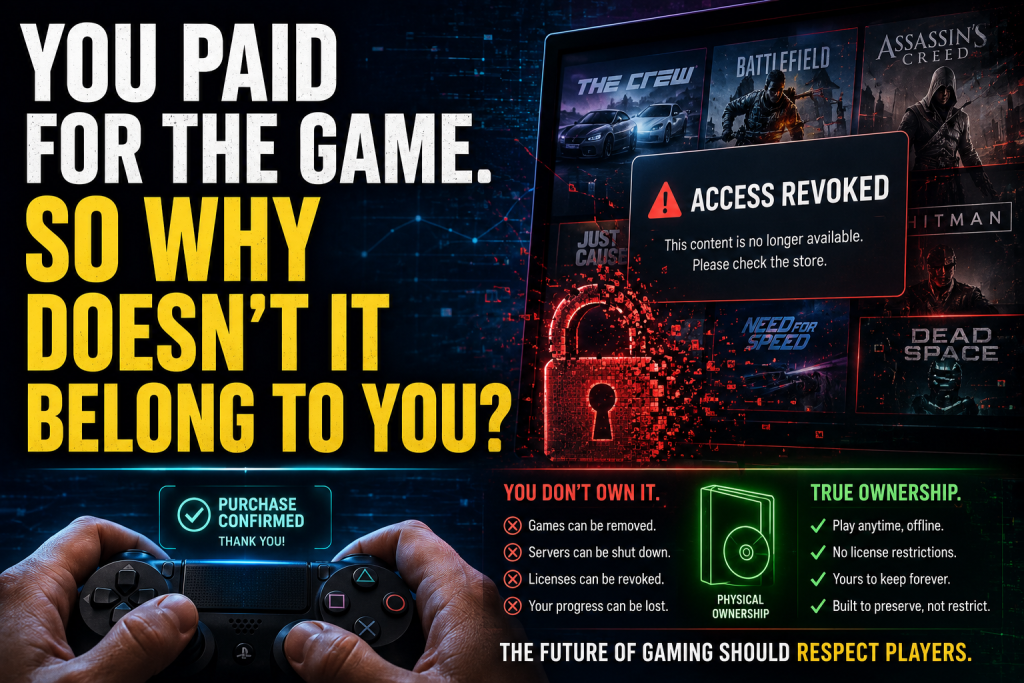
Just think about this for a second. You pay sixty bucks for a game, or you spend four hundred hours grinding out skins and unlocks in one, and then one morning the publisher flips a switch, the servers go dark, and all of it just evaporates.
No refund. No box on a shelf to hold. Nothing.
Did you ever actually own any of it, or were you just renting the whole time and nobody thought to tell you? That question used to be the kind of thing you’d grumble about on a forum and then forget. Not anymore. So here we are again, ownership being the hot-button issue in gaming, and this time we have over a million angry Europeans, a couple of dead games, and a real, live legal battle to chew on.
The Crew Is Dead, And That’s Why People Snapped
The tipping point was Ubisoft killing The Crew. People had bought that game, paid real money for it, and when Ubisoft was done, they switched off the servers and the game simply stopped working, even for the folks who owned a disc sitting right there in their console. Then EA did roughly the same thing to Anthem, killing it outright and without any refund.
Buy a book and the author can’t come to your house years later and set it on fire. But that is more or less what happened here, and gamers finally decided they’d had enough of shrugging it off.
The result of that frustration was Stop Killing Games, started by YouTuber Ross Scott and later turned into a European Citizens’ Initiative, which has so far garnered something like 1.3+ million signatures. The EU has checked enough of those to confirm over a million as of this year, meaning the European Commission is now legally obliged to sit down with this ECI and respond in late July. It’s a pretty simple demand: if you sell someone a game, you have to leave it in a working state when you walk away from it, rather than reaching across the internet and bricking something they paid for.
Nicolae Ștefănuță, Vice President of the European Parliament, said without any embellishment that a game, once sold, belongs to the customer and not the company. Ubisoft’s CEO, meanwhile, waved the whole affair off with a statement that, hey, nothing is eternal, which is a fascinating thing to tell the people who just handed you their money.
Why “Owning” Something Digital Got So Slippery
Let’s take a step back from the crusade now, because the problem is bigger than one dying racing game.
Think about how much of your life already follows you around. Your music goes from your phone to your laptop to your car without a second thought. Your files live in the cloud, reachable from basically anywhere, and your whole social identity ports between devices like it’s nothing. We have, more or less, accepted the idea that the digital stuff we care about travels with us.
Gaming never got that memo. Every title is its own walled garden, with its own progression, its own inventory, its own rules, and the moment you leave, it’s gone. That gives developers a tidy amount of control, and it also means the hundreds of hours you poured into a game can feel weirdly temporary, like sandcastles you already know the tide is coming for. The renewed noise about ownership is really people asking whether those walls have to be quite so tall.
The Dream Of Cross-Game Items, And Why It’s Harder Than It Sounds
The flashiest version of digital ownership is the one where you earn a sword in one game and carry it into another. Intuitively that’s the next step, and it falls apart the second you actually think about building it.
The games are just too far apart. A rifle for a sci-fi shooter would make little sense in a football game, and even a purely cosmetic item would have to fit the other game’s art style and tech, plus come with a pile of licensing paperwork. On top of that, we’d need every studio on board with the particulars of how value moves between their worlds, and no one’s cracked that nut. So no, you’re not carrying your favorite skin into every game you own any time soon.
The more realistic wins are quieter. Two games by the same publisher sharing your achievements and cosmetics, as long as you’re logged into your publisher account. Loyalty systems that reward you across a studio’s whole catalogue without every game having to run on the same plumbing. Less exciting than one universal inventory, sure, but a lot likelier to actually happen.
This Is Really About Control, And It Doesn’t Stop At Games
Here’s what the collectible obsession misses. It’s not actually a magic sword players want, it’s that sense of control over the digital goods they’ve paid for, and you can find that impulse everywhere once you start looking.
People have become sharply aware of their options in a way they weren’t a decade ago. They know how subscription tiers and prices differ, what privacy settings are on offer, which payment methods they can use, and how easy it is to pack up and find a new home if a service stops being welcoming. You see it across streaming, across social media, across every corner of digital life.
The same mindset carries into wagering too. Someone checking out greek betting sites is running the exact same checklist a gamer runs, looking hard at payment flexibility, mobile access, account features, and how much genuine control they’ll have over their own money and preferences before committing to anything. It’s all the same underlying demand, which is to understand what you’re signing up for and to not feel trapped inside it.
Framed that way, ownership stops being about clutching one virtual bauble forever. It’s about shrinking that nagging sense that everything inside a platform secretly belongs to the platform, and never really to you.
Blockchain Keeps Raising Its Hand, And Gamers Keep Groaning
You can only talk about digital ownership for so long before blockchain comes knocking, and that’s where the audible groan from the gaming community kicks in.
On paper it fits. It offers a way to make assets that can be verified and moved around separately from any one game’s database, which is exactly the portability this whole conversation is chasing. The problem is the reputation, and gamers earned their skepticism honestly. They’ve seen enough projects where the blockchain mattered more than the game, where the whole thing was really about token prices and manufactured scarcity, where the actual playing felt like an afterthought bolted on to justify the speculation. That burned a lot of trust, and it doesn’t come back quickly.
For asset ownership built on this tech to ever win people over, the tech itself basically has to disappear. No one earning a cool item should have to learn what a wallet is, or wrestle with token standards, just to use the thing they unlocked. The experience has to come first, every time. A good ownership system should feel as effortless as moving a save file between devices or signing into your account on a new console, and the way I see it, it’s only a few plain principles away from that:
- Ownership features should ease gameplay rather than obstruct it.
- Moving your assets around has to be genuinely simple.
- You should be able to understand what you actually control, in plain terms.
- Speculation and token-flipping shouldn’t drown out the entertainment.
- Losing access to an account shouldn’t wipe out everything you’ve built.
Notice that none of those are really technology problems. They’re design problems, which is a different thing altogether.
The Awkward Truth: Closed Worlds Exist For Good Reasons Too
It would be easy to paint every locked-down game ecosystem as pure corporate greed, and that would be lazy, because the walls aren’t only there to box players in.
When one studio owns everything, it can keep the game balanced, keep it visually cohesive, and keep it technically sound, because nothing’s arriving from outside to break it. Open the gates and a swarm of new headaches walks in. What happens when another game floods the pool with millions of junk items? Who decides which of those are allowed to cross over and which are garbage? And how on earth do you handle intellectual property when branded content starts wandering between platforms owned by rival companies?
Those questions get thorny fast, especially for the big franchises with lawyers on speed dial. So publishers have real, defensible reasons to keep some fences standing, and the honest future probably looks less like wide-open borders and more like a cautious, selective kind of openness.
Where This Actually Lands
No one’s tearing down the walled gardens overnight, and anyone who tells you otherwise is kidding themselves. What matters isn’t blockchain or cross-game swords, it’s that this whole thing maps a real change in player expectations. People are pouring serious chunks of their lives into building collections and identities inside these games, and as that becomes a bigger slice of how we all spend our leisure time, of course they’re going to demand more say over what they earn, buy, and create.
Blockchain might be one piece of the answer, but it was never going to be the whole thing. Better account portability, shared identities, transferable rewards, any of those could nudge gaming toward something more flexible without forcing every title onto identical rails. And honestly, the best version of digital ownership might be the one you never actually notice working. It won’t announce itself. It’ll just quietly make your gaming life feel a little less disposable, and a little more like something that genuinely belongs to you.
So, back to where we started. You paid for the game. For the first time in a long time, whether it actually belongs to you is a real open question, with more than a million people demanding an answer. I know which side I’m on. You can decide yours.

Elara is a dynamic writer and blogger who specializes in pop culture and movie reviews. With a background in film studies and journalism, she combines her deep knowledge of the entertainment industry with a sharp, insightful writing style that keeps readers coming back for more.