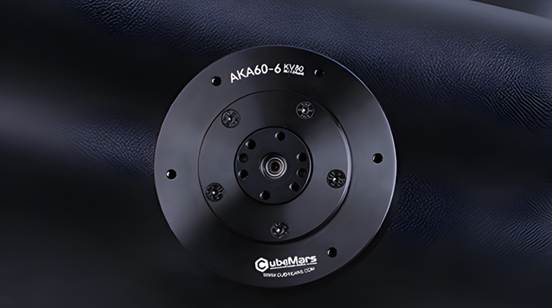
Drive systems should be powerful, accurate, robust, compact and lightweight, which is essential for modern mobile robotics. Continuous operation, radial loading, and precise control are critical requirements for actuators in wheel drive applications, including automated guided vehicles (AGVs), autonomous mobile robots (AMRs) and other wheeled robotic platforms. Compact, high-torque-density actuator technologies offer an ideal fit for such requirements – they integrate multiple drive components into a single package, minimizing system size, design complexity and improving mechanical performance.
1. Why Mobile Robot Platforms Require High-Performance Actuation
Direct wheel drive helps to simplify the transmission and enhance the power flow efficiency. The actuator is located near the load and must be able to withstand the mechanical stress, speed changes, and load acceleration and deceleration while maintaining control accuracy.
Integrated actuator modules reduce installation time and alignment problems, as they do not depend on the series of external mechanical components that are required in conventional drives. The small size also allows for more space for batteries, sensors, controllers and communication devices in mobile robotic platforms.
Wheel-drive systems are widely utilized in warehouse automation, logistics robots, inspection vehicles, service robots and intelligent transportation platforms. All of these applications require steady torque, reliable communication and long-term operation.
2. Optimized Actuator Design Improves Mechanical Reliability
A well-designed robotic actuator system must be able to operate in demanding environments that require continuous operation, repeated load cycles and travel over different terrain. In order to maintain performance over long use, structural optimization is essential.
An integrated actuator module is a modern product which includes a brushless DC motor, planetary gearbox, encoder and drive electronics all in one casing. This integration eliminates multiple mechanical interfaces and streamlines assembly and maintenance.
Key characteristics of heavy-duty actuator designs include:
- Optimized structures that improve radial load capacity relative to their size.
- Compact, integrated architecture that saves installation space.
- Precision planetary gearboxes for efficient torque transmission.
- Built-in protection against overcurrent, voltage fluctuations, and overheating.
- Multiple communication interfaces for dependable system integration.
Reinforced, high-torque-density actuator platforms have been developed for wheeled robots and AGVs by manufacturers like CubeMars, offering strong radial load handling in a compact footprint suited to modern mobile robot platforms.
3. Robotic Actuator Technology Enhances Mobile Robot Motion Control
Mobile robots with direct-drive systems need more than just motor power. A modern Robotic Actuator is a coordinated combination of mechanical, electrical, and control technologies, which provides smooth motion and high positioning accuracy in a compact package.

Integrated actuator units integrate the motor, gearbox, encoder and controller into one unit, reducing installation and wiring. This design also minimizes commissioning time as many actuator modules contain adaptive parameter identification and intelligent control functions.
Typically, advanced robotic actuators offer several modes of operation: position, speed, torque, and hybrid control. These modes enable a mobile robot to modify its motion properties according to task, terrain and payload needs.
The integrated feedback of the encoder allows for continuous monitoring of the output of the actuators, which further improves positioning accuracy. With closed-loop control, the speed can be controlled with precision and torque output remains constant throughout the acceleration, incline driving, turning and braking process.
Hollow shaft actuator designs are also offered with the cable routing through the body of the actuator. This leads to cleaner mechanical layouts and less exposed cable in multi-axis robotic assemblies.
4. Integrated Control Creates Smarter Mobile Robotics
Actuator Intelligence has become more important as the platforms become more autonomous. In modern wheel-drive applications, the motion of several wheels has to be synchronized, and communication between controllers and drive modules must be efficient.
This is accomplished in part with integrated control systems which allow coordinated motion through advanced communication interfaces and adaptive control algorithms. Manual tuning is reduced, and operational stability is increased with features like Field-Oriented Control (FOC), dual encoders and auto PID adjustment.
Important control capabilities include:
- Multi-loop control for position, speed, torque, and acceleration.
- Adaptive PID configuration that simplifies commissioning.
- Dual encoder feedback for improved motion precision.
- CAN communication supporting coordinated multi-actuator operation.
- Real-time monitoring for stable and responsive system performance.
Some actuator modules can even be daisy-chained through the two CAN interfaces, making the wiring of multiple drive units in larger robotic applications easier. Such features are particularly useful for AGVs and mobile robots that rely on the coordinated operation of the wheels for accurate navigation.
5. Selecting the Right Robotic Actuator for Mobile Robot Drive Systems
Although wheel-drive platforms are not articulated robot arms, choosing the appropriate Robot Joint Motor is more than considering the peak power specifications; it requires careful consideration of the overall application profile.

Perhaps the most important is radial load capacity, as wheel-drive actuators are always under external forces from the wheel structure. The use of reinforced actuator designs in wheeled robots can help to ensure mechanical stability and minimize wear during extended operation.
Torque density is also a key factor in system efficiency. This high torque density enables a robotic platform to provide high driving force and maintain the light weight of the actuator, which helps to maintain mobility even with heavier payloads.
Another factor to consider is communication compatibility. In modern robotic platforms, CAN and UART are popular communication interfaces to guarantee reliable communication between actuators and central controllers.
Integrated safety functions provide added peace of mind and protect against overcurrent, abnormal voltage and overheating conditions that can impact the internal components. These inbuilt protection measures ensure that the risk of unexpected disturbances during continuous operation is reduced.
Purpose-built actuator families for wheel-drive applications have a clear advantage over general-purpose actuators for wheeled robots, in that they have a compact form factor with high structural strength and flexible control options.
6. Future Trends in Integrated Mobile Robot Actuation
Robotics is making progress toward mechanical compactness, efficiency and autonomy. In the near future, as these trends increase, the integrated and high-torque-density actuator technologies will be more significant in the development of mobile robots.
The main focus of future drive systems will probably remain on increasing torque density, decreasing system complexity, and embedding more intelligent control, while at the same time reducing weight and volume. With further development of the encoder technology, adaptive control algorithm, and intelligent diagnostics, the positioning accuracy and maintenance efficiency will be further improved.
Actuators are also seeing increased modularity, which speeds the integration process and allows for a greater range of robotic platforms. Now companies are able to integrate brushless motors, planetary gearboxes, encoders, and drive electronics into a single compact package to offer integrated solutions that are appropriate for a wide range of applications, ranging from industrial automation to exoskeletons, collaborative robots, quadrupeds, and mobile robotic systems.
As robots continue to proliferate in many different sectors, from warehouses and manufacturing to healthcare, agriculture, and logistics, compact, high-performance drive actuators will remain a critical component in ensuring reliable motion, efficient power transmission, and long-lasting durability for these systems.
Conclusion
Actuator systems in wheel-drive applications have to be powerful, precisely controlled, compactly integrated and communication-reliable. To meet these requirements, high-performance integrated actuator modules integrate motors, gearboxes, encoders and drive electronics into one efficient and compact all-in-one solution, which optimizes for challenging mobile robotics applications.
The high radial load capacity to size ratio, intelligent control modes, high torque density and advanced protection features of today’s advanced actuator technologies provide excellent reliability and performance for wheeled robotic platforms. As robotics technology continues to advance, integrated actuation solutions will continue to be a vital component in the development of efficient, robust and responsive drive systems for an increasing number of applications in robotics.

Madeline Miller love to writes articles about gaming, coding, and pop culture.