TL;DR (Too Long; Didn’t Read)
The transition to remote work has erased geographical borders, allowing freelancers and digital nomads to serve a global clientele from anywhere in the world. However, using your personal mobile number for international business creates severe privacy risks, unprofessional communication friction, and a nonexistent work-life balance. This comprehensive guide explores the psychological and logistical benefits of cloud telephony. By learning how to leverage a free temporary phone number, remote professionals can set up localized business profiles, seamlessly register on global freelance platforms, bypass expensive international roaming fees, and finally separate their personal lives from their professional obligations.
Table of Contents
- Introduction: The Borderless Economy and its Communication Flaws
- The Crisis of the Modern Digital Nomad
- The Psychological Toll of a Unified Inbox
- The Nightmare of International Roaming
- The Power of Localized Presence
- Why International Clients Hesitate to Call
- Building Trust Across Time Zones
- Demystifying Cloud Telephony for Freelancers
- What is a Virtual Communication Line?
- How Cloud Numbers Bypass Physical SIM Restrictions
- Core Benefits of a Free Temporary Phone Number
- Securing Your Privacy on Public Portfolios
- Managing Registrations on Freelance Marketplaces
- Step-by-Step: Setting Up Your Remote Workspace
- Generating Your Virtual Inbox
- Integrating with WhatsApp Business and Telegram
- Navigating Geo-Restrictions and Client Onboarding
- Overcoming Verification Blocks on Global Platforms
- When to Upgrade: From Temporary to Permanent
- Transitioning to a Dedicated Business Line
- Conclusion: Empowering Your Independent Career
1. Introduction: The Borderless Economy and its Communication Flaws
The fundamental nature of work has been permanently altered. We have fully entered the era of the borderless economy, where a graphic designer sitting in a café in Lisbon can seamlessly collaborate with a tech startup in San Francisco, while outsourcing coding tasks to a developer in Southeast Asia. This unprecedented freedom has given birth to the digital nomad lifestyle – a demographic of professionals untethered from physical office buildings.
However, while our laptops and project management tools have evolved to support this globalized workflow, our primary method of communication – the mobile phone number – remains stuck in the 20th century. Telecommunications infrastructure was built around physical locations and national borders. Trying to run a fluid, international freelance business using a traditional, single-country SIM card introduces massive logistical bottlenecks, unnecessary expenses, and a severe degradation of personal privacy.
In this exhaustive guide, we will explore why your personal mobile number is the biggest hindrance to your freelance growth, and how adopting virtual communication tools can instantly professionalize your independent business.
2. The Crisis of the Modern Digital Nomad
Before diving into the technological solutions, it is crucial to understand the exact pain points that modern remote workers face on a daily basis. The challenges are not just logistical; they are deeply psychological.
The Psychological Toll of a Unified Inbox
When you launch a freelance career, it is tempting to simply put your personal cell phone number on your portfolio website, your Upwork profile, and your email signature. In the beginning, every client ping is exciting. But as your business grows, this unified inbox becomes a psychological burden.
Because you are working with clients across different time zones, your phone will inevitably ring at 3:00 AM on a Sunday. When your personal WhatsApp is mixed with urgent client requests, you lose the ability to disconnect. Every time you open your phone to text a family member, you are confronted with unresolved work tasks. This inability to separate “work hours” from “personal time” is the leading cause of burnout among independent contractors.
The Nightmare of International Roaming
For the true digital nomad, travel is a core component of the lifestyle. Moving from country to country requires constant adaptation. Every time you cross a border, you are faced with a choice: pay exorbitant international roaming fees to keep your home country’s SIM card active, or buy a local prepaid SIM card.
If you choose the local SIM, you lose access to your primary business number. Clients trying to reach you will get disconnected tones, and you will be unable to receive the crucial Two-Factor Authentication (2FA) SMS codes required to log into your freelance marketplaces, banking apps, and payment gateways like PayPal or Payoneer.
3. The Power of Localized Presence
Beyond your own convenience, the way you manage your communication infrastructure directly impacts how clients perceive your professionalism and reliability.
Why International Clients Hesitate to Call
Trust is the currency of the freelance economy. If a small business owner in Chicago is looking to hire a web developer, they naturally feel more comfortable hiring someone they can easily reach. If they look at your portfolio and see a phone number starting with +62 (Indonesia) or +351 (Portugal), it instantly creates friction.
Clients worry about international calling rates, language barriers, and time zone incompatibilities. Even if you speak perfect English and work US hours, that foreign country code acts as a psychological barrier to closing the deal.
Building Trust Across Time Zones
By utilizing virtual telephony, you can create a “localized presence” without physically being in the country. Providing a US-based client with a US-based phone number instantly removes communication friction. It signals that you are established, accessible, and ready to do business on their terms. This simple psychological switch can dramatically increase your conversion rate from initial inquiry to signed contract.
4. Demystifying Cloud Telephony for Freelancers
The solution to these geographical and psychological barriers lies in entirely separating your business identity from your physical device through cloud telephony.
What is a Virtual Communication Line?
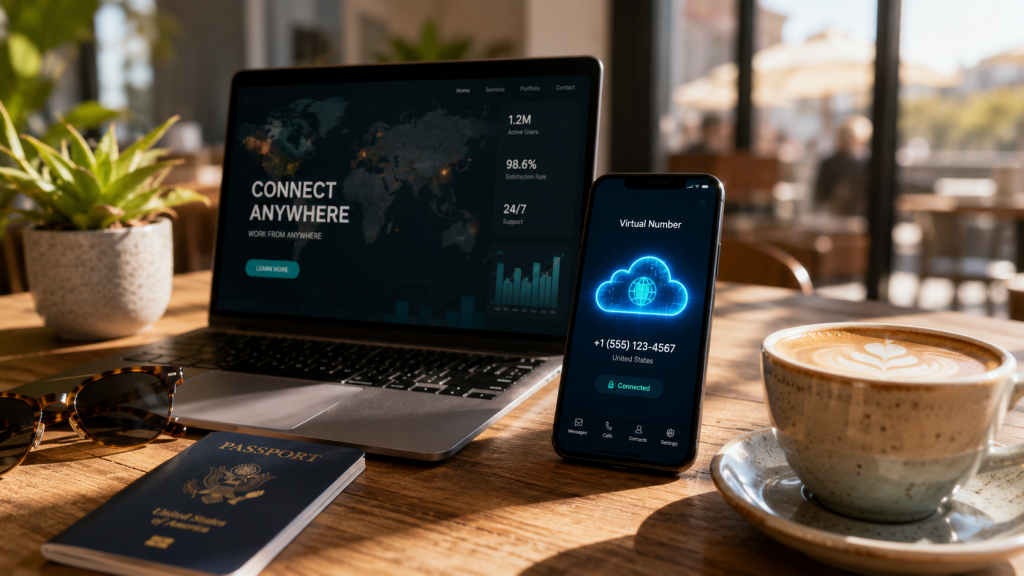
A virtual number operates entirely via the internet. Unlike traditional cellular service, which relies on a physical SIM card connecting to a local cell tower, a virtual line processes all incoming texts and calls through secure servers in the cloud. You access these messages via a web portal or a dedicated app on your smartphone or laptop.
How Cloud Numbers Bypass Physical SIM Restrictions
Because the number is hosted in the cloud, it is untethered from physical geography. You can be sitting on a beach in Thailand connected to a local Wi-Fi network, and seamlessly receive an SMS sent to your virtual New York phone number. The sender pays standard local rates, and you receive the message instantly, without incurring a single cent in international roaming fees.
5. Core Benefits of a Free Temporary Phone Number
Integrating this technology into your workflow provides immediate, tangible benefits that protect both your peace of mind and your digital security.
Securing Your Privacy on Public Portfolios
As a freelancer, you must aggressively market yourself. This means posting your resume on job boards, sharing your portfolio on social media, and networking in public forums. Plastering your real, personal mobile digits across the public internet is dangerous. It exposes you to data scrapers, aggressive telemarketers, and potentially malicious phishing attacks.
By utilizing a free temporary phone number, you can establish a secure public-facing contact method. You can put this number on your website and business cards. If a data broker scrapes it, or if it becomes overwhelmed with spam from shady job boards, you can simply dispose of the line and generate a new one in seconds, keeping your real, private cell phone completely hidden and secure.
Managing Registrations on Freelance Marketplaces
The remote work boom has led to massive congestion on platforms like Upwork, Fiverr, Freelancer, and Toptal. To combat fake accounts and bot farms, these platforms enforce strict SMS verification protocols during the onboarding process.
If you are a nomad who frequently changes SIM cards, getting locked out of your main source of income because you can’t verify an SMS is a terrifying prospect. Using a cloud-based temporary line ensures you always have a stable, accessible inbox to receive these vital verification codes, regardless of what physical SIM card is currently sitting in your phone tray.
6. Step-by-Step: Setting Up Your Remote Workspace
Transitioning your freelance business to a virtual communication setup is a simple process that requires minimal technical expertise.
Generating Your Virtual Inbox
- Identify Your Target Market: Determine where the majority of your high-paying clients are located. If they are in the US, you will want to generate a US-based line.
- Select a Cloud Platform: Choose a reputable online SMS service. Ensure the platform offers a clean interface and reliable uptime for receiving messages.
- Generate the Line: Request your new digits. Within seconds, the system will allocate a number to your secure cloud dashboard.
- Update Your Profiles: Replace the personal contact info on your website, LinkedIn, and PDF resumes with your new virtual line.
Integrating with WhatsApp Business and Telegram
Modern clients rarely want to make direct phone calls; they prefer asynchronous communication via messaging apps. You can easily link your virtual line to professional messaging platforms.
Both iOS and Android allow you to install “WhatsApp Business” alongside your standard, personal WhatsApp application. Simply open WhatsApp Business, enter your newly generated virtual digits, and request the SMS verification. Check your cloud portal for the OTP, enter it into the app, and you are done.
You now have a dedicated, professional messaging profile on the same physical device. When you log off for the weekend, you can simply mute notifications for the Business app, ensuring your personal weekend remains entirely uninterrupted.
7. Navigating Geo-Restrictions and Client Onboarding
A lesser-known hurdle for international freelancers involves geo-restricted software. Many enterprise-level software tools, CRM platforms, and payment gateways utilized by North American and European clients are region-locked.
If a US client asks you to join their internal Slack workspace, access their localized AWS servers, or use a specific regional marketing tool, you may be blocked if you try to register with a phone number from a developing nation.
A virtual number allows you to seamlessly bypass these corporate geo-restrictions. By verifying your accounts with a localized country code, you ensure complete compatibility with your client’s existing tech stack, establishing yourself as a frictionless, plug-and-play contractor.
8. When to Upgrade: From Temporary to Permanent
While temporary lines are incredible tools for quick registrations, public portfolios, and dodging spam, a successful freelance business eventually requires a permanent infrastructure.
If you use a free, highly disposable number to register your primary Upwork account or your main PayPal gateway, you risk losing access to that account if the temporary line is recycled by the provider.
Once your remote career is stable, it is highly recommended to upgrade from a disposable line to a dedicated, paid virtual number. The nominal monthly or annual fee ensures that you retain exclusive ownership of that specific number for years to come. It becomes a permanent asset of your freelance business – a stable point of contact for long-term clients and the ultimate security fallback for your most vital financial accounts.
9. Conclusion: Empowering Your Independent Career
The life of a digital nomad or remote freelancer is defined by freedom, flexibility, and autonomy. However, true autonomy is impossible if you are tethered to the rigid, localized constraints of traditional telecommunications.
Mixing your personal life with your global business endeavors leads to burnout, privacy violations, and lost revenue. By taking a proactive approach to your communication infrastructure – starting with a free temporary phone number for basic tasks and eventually scaling to a dedicated virtual business line – you instantly elevate your professional image.
You protect your personal privacy, eliminate international roaming headaches, and build seamless trust with clients across the globe. In the highly competitive world of remote work, mastering your communication tools is not just a technical upgrade; it is a fundamental pillar of a sustainable, thriving independent career.

Sandra Larson is a writer with the personal blog at ElizabethanAuthor and an academic coach for students. Her main sphere of professional interest is the connection between AI and modern study techniques. Sandra believes that digital tools are a way to a better future in the education system.