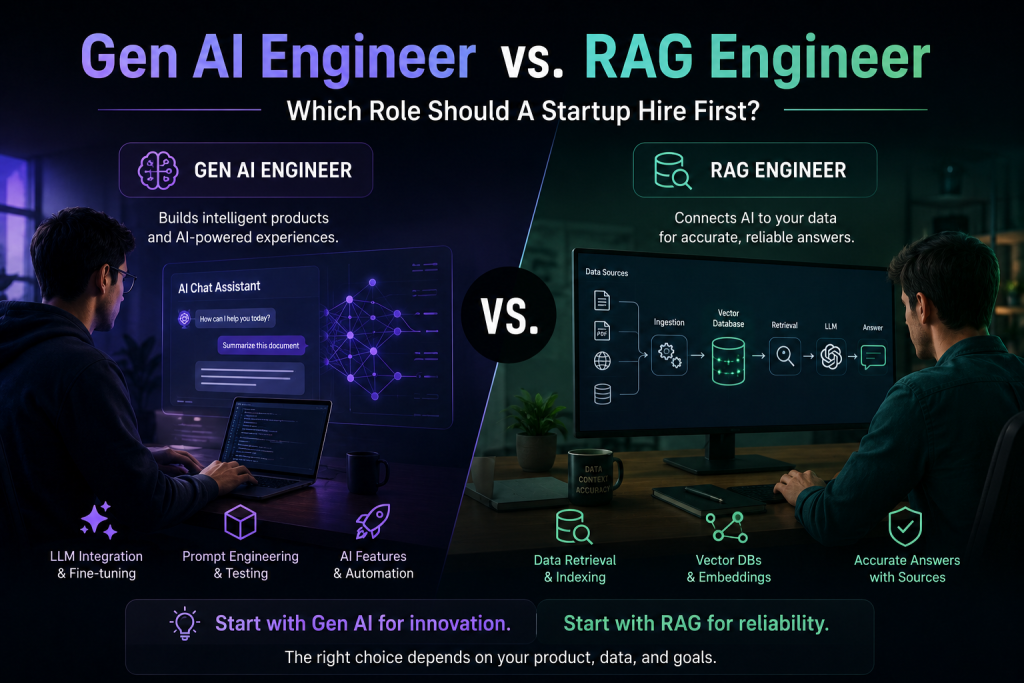
Most startups shipping their first generative AI feature should hire gen AI engineers before they hire a RAG specialist, since the first working version of almost any AI feature depends more on application-layer skill than on retrieval depth. A gen AI engineer can integrate a language model into the product using APIs, function-calling, and prompt design to get a working feature in front of users. A RAG engineer becomes the right hire specifically once your bottleneck shifts from “does this feature exist” to “does this feature reliably answer using our own data,” which is a different, narrower problem most startups don’t hit until they have real usage. The simplest way to decide is to ask where your accuracy problem actually lives. If it’s in generation, hire a gen AI engineer. If it’s in retrieval, hire a RAG engineer.
What Each Role Actually Does
A gen AI engineer, sometimes called an LLM application engineer, is the generalist of the two. Their job is building the customer-facing feature itself, wiring up an LLM through an SDK, handling function-calling so the model can take real actions, designing prompts, and shipping something a user can actually interact with. This is the role most startups need first, because before you can worry about retrieval quality, you need a product that does something.
A RAG engineer is a narrower specialist focused on what one industry guide calls the context layer, the infrastructure that makes a model actually useful with your specific data instead of just its general training knowledge. Large language models don’t know your company, your documents, or your product details on their own, and a RAG engineer’s job is making sure the right document shows up at the right moment, in the right form, with citations attached, every time. That means owning chunking strategy, embedding model selection, vector search and reranking, and building evaluation pipelines that catch retrieval quality problems before customers do. It’s as much a search-quality and systems-design job as it is an AI job.
The Diagnostic That Actually Matters
The clearest way to decide which role to bring in first is to look at where your hallucination or accuracy problem is actually coming from. If your feature struggles to hold a conversation, call the right function, or produce well-structured output, that’s a generation and application problem, squarely in a gen AI engineer’s lane. If your feature is fluent and well-formed but confidently wrong about your own company’s information, pulling the wrong document, missing key context, or citing something outdated, that’s a retrieval problem, and it’s exactly what a RAG engineer is built to fix. One industry guide puts the distinction plainly: if retrieval quality is the bottleneck, hire a RAG engineer; if you need someone training or fine-tuning models, hire a different kind of specialist entirely.
Why the Generalist Usually Comes First
Most early-stage products don’t need retrieval perfected on day one; they need something shipped. A capable gen AI engineer can stand up a reasonable first version of retrieval using off-the-shelf tools and default settings, good enough to demo, good enough for early users, and good enough to validate whether the feature is worth building further. The deep RAG-specific skills, testing embedding models against labeled retrieval sets, building custom chunking strategies for your specific document types, catching silent degradation through evaluation harnesses, matter most once you have real usage patterns to optimize against. Hiring for that depth before you have a product generating real queries against real data is often solving a problem you don’t have yet.
When It’s Time to Bring In a RAG Specialist
The signals that you’ve outgrown the generalist approach tend to show up quietly at first. Retrieval is described as the layer where most production RAG systems fail silently, meaning problems often don’t surface in testing, they surface when a customer notices the product confidently gave them wrong information pulled from the wrong document. If that starts happening, or if latency becomes a real production concern as usage scales, or if you need genuine citation and traceability for compliance or trust reasons, that’s the point where a dedicated RAG engineer earns their keep. Waiting until this pain is already visible to users is a reasonable strategy, provided you’re actually watching for it rather than assuming the default setup will scale indefinitely.
The Cost of Getting the Sequence Wrong
Hiring a RAG specialist before there’s a product to ground means paying for narrow expertise with nothing yet to apply it to. Waiting too long carries the opposite risk: a chatbot or assistant that performs well in a demo can fail quietly at scale once real users start asking questions that expose gaps in retrieval, and by the time that failure is visible, it’s already done damage to how much users trust the product. Neither mistake is fatal, but both are avoidable by matching the hire to the actual bottleneck rather than to whichever title sounds more impressive on a job post.
Getting Whichever Hire You Need Right
Once you’ve worked out which of these two roles you actually need first, the harder part is finding someone genuinely skilled in that specific lane rather than a resume with both terms listed as keywords. This is where a hiring process built around segmenting generative AI talent by actual function matters. Startups that need to hire gen AI engineers for the application layer, and the ones that later need a dedicated RAG specialist for the retrieval layer, are looking for genuinely different skill sets, and treating them as interchangeable is one of the more common ways this kind of hire goes wrong. Uplers runs candidates through a two-stage vetting process combining AI-based screening with human technical validation across specific skill sets, including LangChain, RAG architecture, and LLM application development, matching candidates to the lane a role actually requires. A shortlist typically reaches a hiring team within 48 hours, with a replacement guarantee if the match isn’t right.
The sequencing question doesn’t need to be complicated. Ship the feature first with a strong generalist, then bring in retrieval-specific depth once real usage tells you exactly where it’s needed. Founders who hire gen AI engineers with this sequence in mind, rather than trying to fill both roles at once before there’s a product to justify either, tend to spend their early budget on the skill set that actually moves the roadmap forward.