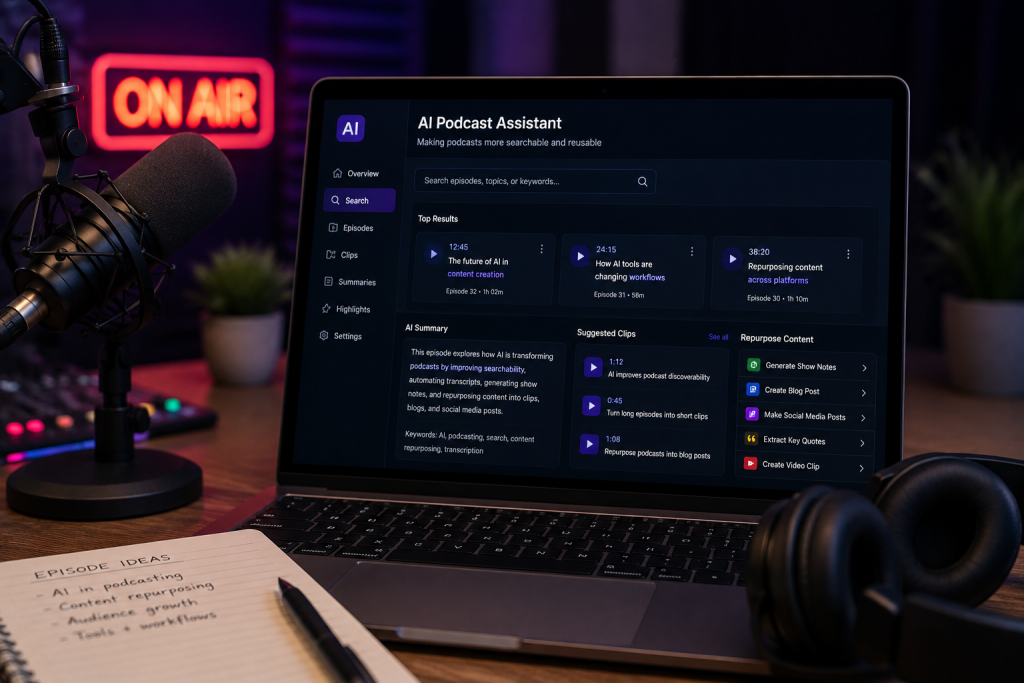
Podcasts are a powerful way to share expertise, tell stories, and build an audience. Yet audio has a practical limitation: it is difficult to scan, search, quote, and reuse.
A listener may remember that a guest explained an important idea halfway through an episode, but finding the exact moment can require replaying large sections. Search engines also have limited ability to understand spoken content unless it is supported by text. Valuable information can therefore remain hidden inside audio files.
Artificial intelligence is changing that. Speech recognition and natural language processing are turning episodes into searchable assets that can support transcripts, summaries, clips, articles, social posts, and structured knowledge.
Why Podcasts Have Traditionally Been Difficult to Search
Search technology is designed mainly around text. A web page can be indexed through its title, headings, keywords, and written content. An audio file does not naturally reveal what was said at each moment.
Episode titles and show notes help, but they rarely capture every topic discussed. A one-hour interview may cover questions, examples, names, and recommendations that never appear in the description. This makes it harder for listeners to locate a specific insight and gives search engines less information to index.
As a podcast library grows, older episodes become harder to rediscover. AI-powered transcription addresses this problem by adding a searchable text layer to spoken content.
AI Transcription Creates a Searchable Foundation
The first step is converting speech into text. Modern AI transcription systems can process recorded conversations, identify spoken words, separate speakers, and add timestamps.
A searchable transcript lets users look for names, phrases, topics, or questions without replaying the full episode. Someone researching customer retention, for example, could search for “churn,” “renewal,” or “onboarding” and jump directly to the relevant section.
Creators can use an AI transcription platform such as UniScribe to turn podcast recordings into text that supports searchable archives, summaries, notes, and other reusable content.
Accuracy still depends on microphone quality, background noise, accents, terminology, and overlapping speech. Human review may be needed when quotations or specialized vocabulary must be exact. Even so, AI removes much of the manual work involved in producing a useful first draft.
Searchable Transcripts Improve the Listener Experience
A transcript is more than an accessibility feature. It can also function as a navigation tool.
With speaker labels and timestamps, visitors can scan a discussion before listening to the full episode. They can identify relevant sections, confirm a quotation, or return to a specific idea later.
Searchable transcripts are useful for long interviews, educational podcasts, technical discussions, news analysis, and professional shows. They also support people who are deaf or hard of hearing. In offices, classrooms, or noisy environments, text provides another way to access the material.
AI Helps Search Engines Understand Podcast Content
Publishing a transcript on a podcast website gives search engines more context than a short episode description. The written version can reveal the full range of topics discussed, including detailed questions listeners may search for.
An episode titled “Building a Better Sales Team,” for example, might also cover hiring, onboarding, compensation, coaching, and performance reviews. Without a transcript, those subtopics may remain invisible. With organized text, each section has a better chance of appearing for a relevant query.
A transcript should be structured for readers rather than uploaded as one large block. Clear headings, speaker names, timestamps, short paragraphs, corrected terminology, and key takeaways make the page easier to navigate. This also helps search systems understand how the topics relate.
AI Summaries Make Long Episodes Easier to Explore
Not every visitor has time to read a complete transcript. AI summarization can condense a long conversation into an overview, key insights, or a chapter-by-chapter outline.
A strong summary helps readers decide whether an episode is relevant before listening. Teams may create an overview for the episode page, takeaways for a newsletter, and timestamped chapter notes.
AI-generated summaries still require review. Automated systems can miss nuance, overemphasize a minor point, or simplify a statement too aggressively. Editorial oversight keeps the summary accurate and faithful to the speakers.
Podcasts Can Become Reusable Content Libraries
Once a podcast exists as text, it becomes much easier to repurpose. A single episode can provide source material for multiple channels without requiring a creator to begin from a blank page.
A detailed interview might become a blog article, email newsletter, social posts, FAQ page, quote graphics, short clips, or internal training notes. This gives each recording a longer useful life and helps teams reach people who prefer formats other than audio.
Effective repurposing does not mean copying the transcript word for word. Spoken conversations often include repetition, incomplete sentences, and informal transitions. Editors must select the strongest ideas and adapt them to each format.
AI can identify recurring themes, memorable quotes, clear explanations, and sections with educational value. Human editors can then provide context, improve readability, and ensure the finished content reflects the speaker’s intent.
Semantic Search Goes Beyond Exact Keywords
Traditional transcript search looks for exact words. AI-powered semantic search can identify passages that are conceptually related, even when they use different languages.
A listener searching for “reducing employee turnover,” for example, might be directed to a section about “improving staff retention.” The wording is different, but the meaning is similar.
As a podcast archive expands, users can search an entire catalog by topic, question, guest, or concept. A business or educational podcast can gradually become a searchable knowledge base containing years of expert discussions.
AI Speeds Up Editing and Clip Selection
Transcripts also improve production workflows. Text-based editing lets producers review a recording by reading it instead of repeatedly moving through an audio waveform.
With timestamps linked to the recording, editors can locate filler, remove irrelevant sections, and identify strong clips more quickly. AI can suggest topic changes, important questions, highlights, or engaging moments.
Teams producing short-form content can begin with a smaller set of AI-suggested sections instead of manually reviewing an entire episode. Human judgment remains essential because tone, pacing, and context often determine whether a clip works outside the full conversation.
Responsible Use Requires Human Oversight
AI can make podcasts more accessible and reusable, but it is not infallible. Before publishing AI-generated material, creators should verify names, dates, statistics, technical terms, speaker attribution, and quotations.
Privacy also matters. A transcript makes spoken comments easier to discover and share than they were in audio form. Guests should understand how recordings may be transcribed, summarized, indexed, and republished. Sensitive information should be reviewed before any transcript becomes public.
Conclusion
AI is helping podcasts evolve from isolated audio files into structured, searchable content resources. Transcription makes spoken ideas visible. Summaries make long episodes easier to understand. Semantic search helps listeners discover relevant moments, while repurposing tools extend the value of every recording.
The real benefit is not automation for its own sake. It is the ability to make valuable conversations easier to find, revisit, learn from, and share.
For creators, publishers, educators, and businesses, one conversation can support a searchable archive and many future materials. Podcasts are becoming less like content that disappears into a feed and more like living knowledge libraries.

Andrea Bell is a blogger by choice. She loves to discover the world around her. She likes to share her discoveries, experiences and express herself through her blogs. You can find her on Twitter:@IM_AndreaBell