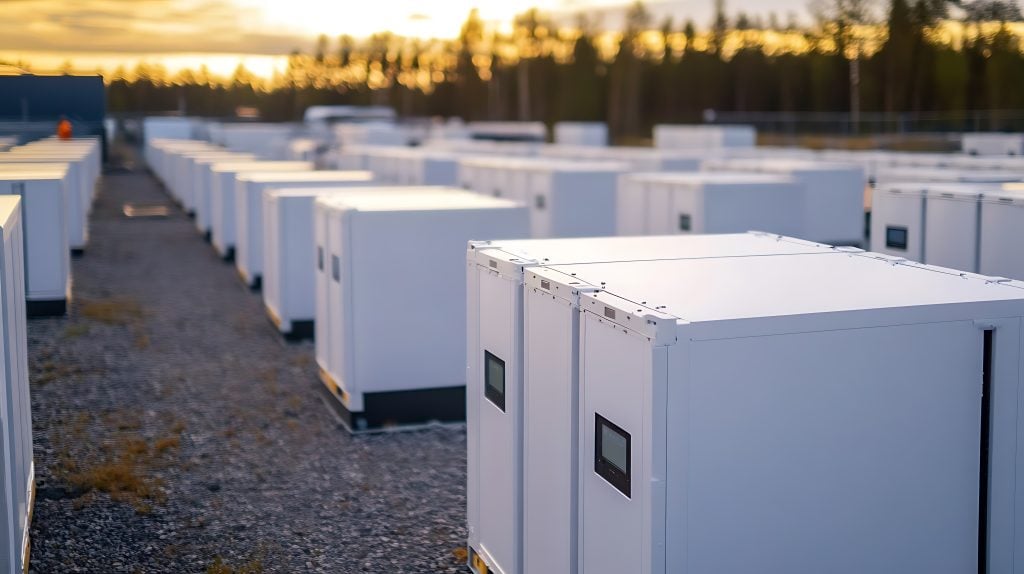
As the global energy transition accelerates, standalone energy storage installations are growing exponentially/rapidly. However, the industry is still facing two systemic challenges: long delivery times and heavy on-site construction workloads.
HyperStrong offers HyperBlock M with a creative modular energy storage system design to solve these problems. This fundamentally changes how energy storage systems are deployed, shifting from the traditional on-site construction approach toward a more efficient model based on factory prefabrication and streamlined on-site assembly.
Key Bottlenecks of Traditional Delivery Models
Before examining the value of modular solutions, it is crucial to understand the four key constraints in traditional energy storage delivery models.
1. Logistics Constraints
Traditional systems typically rely on 20-foot or larger containers as basic units. components necessitate specialized transport equipment and often require extensive permission for oversized cargo.
In addition, during multi-modal transportation—across road, rail, and sea—frequent lifting transfers increase the risk of handling damage to critical battery energy storage system components.
2. Construction Constraints
On-site construction depends heavily on large cranes and requires highly professional technicians to weld between battery racks and install power cables.
Outdoor work is also highly susceptible to disruption from diverse weather conditions, such as rain, snow, and extreme heat, making project timelines difficult to predict and manage effectively.
3. Commissioning Constraints
In traditional setups, subsystems like the BMS, PCS, fire protection, and thermal management are often sourced from different suppliers. This fragmentation model usually results in poor system integration, and battery energy storage system manufacturers rarely standardize interfaces across product lines. On-site integration frequently encounters issues such as interface mismatches and protocol incompatibilities.
Troubleshooting is also inefficient, typically requiring sequential, node-by-node diagnostics, while repetitive point-to-point testing significantly increases commissioning time and labor effort.
4. Expansion Constraints
When a project needs capacity expansion, traditional approaches often require repeating the entire deployment process—from equipment transport and on-site installation to wiring and commissioning.
This lack of scalability prevents any meaningful reduction in marginal costs, making seamless expansion difficult without disrupting the existing system.
How HyperBlock M Reshapes the Delivery Path
HyperBlock M redefines battery energy storage system design across four key dimensions. It keeps the complexity at the factory and delivers a simplified, streamlined deployment experience at the project site.
1. Full-Dimension Pre-Integration
At the factory, the battery, BMS, liquid cooling thermal management, fire protection, and power distribution systems are fully assembled and wired into a unified module. Each module undergoes a comprehensive grid-connected simulation testing before shipment, including insulation verification, communication validation, and charge-discharge cycling.
This ensures plug-and-play operation upon delivery. On-site installation and commissioning can be reduced to less than 20% of the workload by moving system integration to the factory compared to traditional methods.
2. Standardized Interface Design
All internal DC-side connections use factory-grade standard crimping to completely replace manual on-site wiring.
AC-side and DC-side external interfaces, along with communication protocols, are fully standardized. On-site integration becomes a straightforward interconnection of standardized module interfaces without custom engineering requirements.
More importantly, standardized interfaces allow plug-and-play replacement for future expansion or system upgrades without re-adaptation.
3. 10-Foot Standardized Unit
The standardized 10-foot unit, compatible with conventional trucks and eliminating the need for oversized transport permits, significantly lowers shipping barriers.
Both weight and dimensions have been reduced, allowing a standard forklift or small crane to handle on-site placement, reducing the need for large lifting equipment.
When energy storage projects require capacity expansion, the operators can simply add more 10-foot units and connect them in parallel through standardized interfaces, without modifications to the existing system.
4. Full-Process Factory Certification
HyperBlock M has completed key certifications at the factory level, including IEC 62933 (energy storage system safety), IEC 62619 (battery safety), and CE. Therefore, on-site inspections require only factory certification documents to proceed quickly, significantly reducing the time required for approval and certification before grid connection.
Values of Modular Energy Storage System Designs
The design improvements of modular energy storage system designs translate into measurable business value.
1. Higher Project IRR
HyperBlock M shortens delivery time compared to traditional approaches, enabling the project to start capturing value from peak-valley arbitrage in the spot market, frequency regulation services, or capacity lease fees earlier.
2. Lower EPC Costs
The modular approach turns the need for highly skilled on-site technicians into standard unit assembly work. For battery energy storage system manufacturers, this means less reliance on field service teams and more predictable labor costs.
Moreover, the system also cuts rework expenses resulting from on-site quality issues. Improved schedule control lowers the risk of delay penalties and capital holding costs.
3. Environmental Friendly
Common issues such as excess cable materials, packaging waste disposal costs, and material losses from rework are largely reduced through factory-based pre-production.
A battery energy storage system design that prioritizes modularity enables each module to have a precise bill of materials. On-site installation only needs standard interface connections between modules, minimizing on-site work and virtually eliminating construction waste.
Conclusion
The energy storage industry is shifting from a focus on simple capacity expansion toward competition based on efficiency and system performance.
The modular design of HyperBlock M shifts time, cost, and technical complexity from the project site to the factory, transforming battery energy storage system components from custom-fabricated parts into standardized, interchangeable building blocks.
This revolution does more than address traditional challenges in logistics, construction, commissioning, and expansion. It also enhances the liquidity and replicability of energy storage assets, offering a scalable and practical pathway for high-quality and large-scale industry growth.

Caroline is doing her graduation in IT from the University of South California but keens to work as a freelance blogger. She loves to write on the latest information about IoT, technology, and business. She has innovative ideas and shares her experience with her readers.