Towing a trailer involves much more than having enough engine power and a strong hitch. Drivers also need to manage visibility, braking, trailer weight, maneuvering, and changing road conditions. Modern GMC trucks use a combination of mechanical systems, electronic controls, cameras, sensors, and digital tools to make these tasks easier to manage. For drivers researching a Best GMC dealership in Florida, understanding how towing technology works can make it easier to compare different GMC trucks and available equipment.
GMC’s trailering technology is designed to support drivers before, during, and after a towing trip. Depending on the truck and equipment, features can include an integrated trailer brake controller, Tow/Haul mode, trailer profiles, camera views, trailer tire monitoring, and route-planning tools. The exact features vary by model, trim, model year, and equipment.
How a GMC Truck Prepares for Towing
Towing technology begins before the truck starts moving. A properly equipped GMC truck can use digital systems to collect information about the trailer and organize important towing settings.
The available In-Vehicle Trailering App allows drivers to create trailer profiles containing information such as trailer dimensions, mileage, hitch type, and trailer type. Depending on the vehicle, drivers can also access pre-departure checklists, trailer-light testing, maintenance reminders, and trailer tire-pressure monitoring.
This information gives the truck a better understanding of the trailer being used. Certain trailering assistance features can also work more effectively after the trailer dimensions have been entered into a profile.
The Role of the Trailer Brake Controller
A trailer’s brakes need to work together with the tow vehicle’s braking system. An integrated trailer brake controller helps manage the amount of braking force sent to compatible trailer brakes.
On equipped GMC trucks, the Integrated Trailer Brake Control system allows the driver to adjust trailer brake output, commonly referred to as Trailer Gain. The system can also display related information through the Driver Information Center.
This technology helps the driver adjust braking characteristics based on the trailer and load. However, the correct setting depends on the specific trailer and conditions, so drivers should follow the vehicle and trailer manufacturer’s instructions.
What Tow/Haul Mode Actually Does
A truck does not always need to operate the same way when it is pulling a heavy trailer. Tow/Haul mode changes aspects of the vehicle’s operation to better suit the additional load.
Depending on the GMC model, Tow/Haul mode can adjust transmission shift behavior to help provide appropriate power and control while towing. GMC has also offered systems that can retain certain Tow/Haul settings for a period after the truck is switched off, depending on the model.
This can be useful when a driver makes brief stops during a towing trip and then continues traveling with the trailer attached.
Camera Systems Improve Trailer Visibility
One of the biggest challenges when towing is seeing around and behind a trailer. A large trailer can block much of the driver’s rearward view, making lane changes, turns, parking, and reversing more difficult.
GMC’s available camera technology can provide multiple views depending on the truck’s equipment. These can include rear, front, side, hitch, overhead, and specialized trailer views.
Some systems can display a side view of the truck and trailer when the turn signal is activated. This can help the driver monitor the trailer while turning or changing lanes, although GMC still recommends checking mirrors and looking over the shoulder before changing lanes.
How Hitch Guidance Helps With Connecting a Trailer
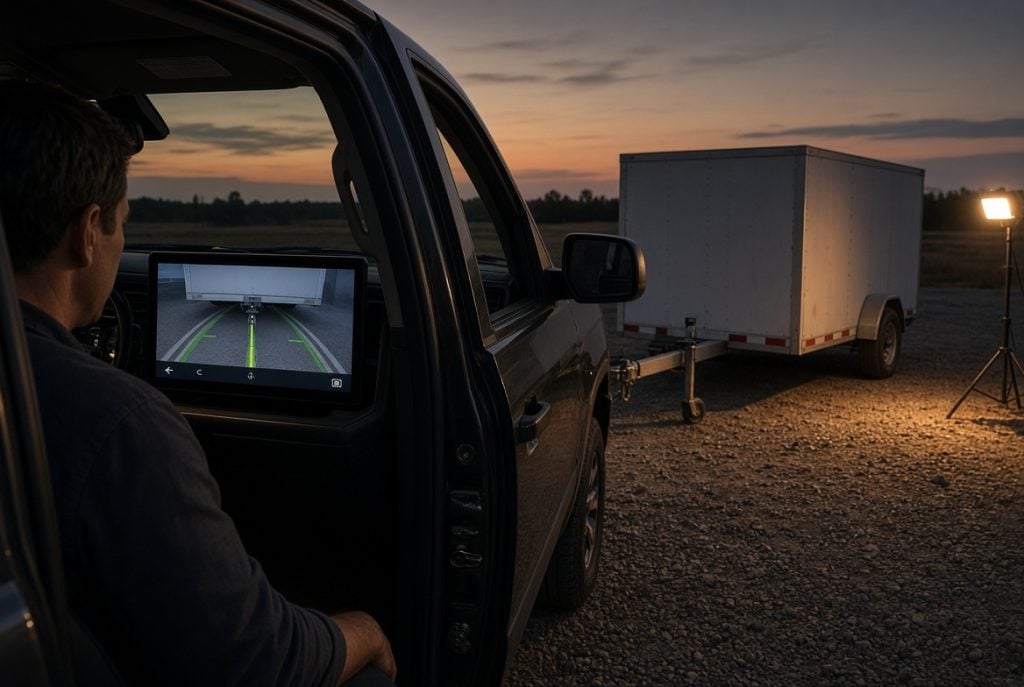
Connecting a trailer accurately to the hitch can be one of the most frustrating parts of towing. Hitch Guidance and Hitch View are designed to help drivers line up the truck with the trailer.
Camera guidelines can show the projected path of the truck and provide visual assistance while reversing toward the trailer. GMC’s camera system can also provide Hitch Guidance guidelines within compatible rear-camera views.
This does not automatically connect the trailer, but it can make the alignment process easier by giving the driver a clearer view of the hitch and surrounding area.
Trailer Profiles Connect Technology With the Trailer
A trailer profile allows a compatible GMC truck to remember information about a particular trailer. This is useful for owners who regularly use more than one trailer.
For example, a driver might have a utility trailer for work and a larger recreational trailer for vacations. Creating separate profiles can help organize the relevant information for each one.
GMC’s available Trailering App can store multiple trailer profiles, with features varying according to the vehicle and equipment. Trailer profiles can also support functions such as maintenance reminders, trailer-light tests, accessory cameras, and tire-pressure monitoring when equipped.
Trailer Tire Monitoring Adds Another Layer of Information
Tire condition is particularly important when towing because a trailer may carry substantial weight over long distances. Some GMC trailering systems can monitor compatible trailer tire pressure through the vehicle’s infotainment system.
The available Trailering App can display trailer tire-pressure information when the truck and trailer are equipped with the appropriate technology.
Instead of requiring the driver to rely only on periodic manual checks, an integrated monitoring system can provide information through the vehicle. Drivers should still inspect trailer tires before every trip and maintain them according to the trailer manufacturer’s recommendations.
Blind-Spot Technology Can Account for Trailer Length
A trailer can extend significantly beyond the truck’s normal blind zones. GMC offers Trailer Side Blind Zone Alert on certain vehicles, which can extend blind-zone monitoring to cover trailer lengths.
When equipped and properly configured, the system can provide visual alerts through the side mirrors when another moving vehicle is detected within an extended side blind zone.
This can be particularly useful on multilane highways. The system is an assistance feature, however, and does not eliminate the need for mirror checks and direct observation.
Transparent Trailer View Uses Multiple Cameras
Some GMC trucks offer one of the more distinctive trailering technologies: Transparent Trailer View. The system uses camera information to create a view that can make a compatible trailer appear visually transparent on the truck’s display.
GMC explains that its available Transparent Trailer View can combine a camera mounted on the truck with an accessory camera mounted at the rear of the trailer. The resulting view is designed to improve visibility behind the trailer.
This technology can be useful when monitoring traffic or surroundings behind a trailer, although compatibility depends on the truck, trailer, camera equipment, and model year.
Digital Trailering Tools Help With Pre-Trip Checks
Towing involves several details that need to be checked before departure. Trailer connections, lights, tires, hitch equipment, and other components all need attention.
The GMC Trailering App can provide a pre-departure checklist and a trailer-light test on compatible vehicles. It can also support maintenance reminders and other towing-related information.
These tools can help organize the preparation process. They do not replace a physical inspection, but they can provide an additional digital reminder system for drivers.
Route Planning Can Consider the Trailer
A route that works well for a passenger car may not always be appropriate for a truck pulling a large trailer. Height restrictions, narrow roads, steep grades, and other conditions can become more important when towing.
GMC offers in-vehicle systems and apps designed to help drivers plan routes that accommodate their trailers on compatible vehicles.
This demonstrates how towing technology is moving beyond the truck’s mechanical components. Modern systems can connect information about the trailer with navigation and other vehicle functions.
Technology Works Alongside Mechanical Towing Capability
Although digital technology is becoming increasingly important, it does not replace the fundamentals of towing. Engine output, transmission performance, cooling systems, suspension, brakes, axle configuration, hitch equipment, payload capacity, and maximum trailer weight all remain essential.
GMC emphasizes that towing capacity varies according to factors such as body style, bed length, drivetrain, and installed equipment.
Therefore, drivers should always confirm the truck’s specific towing and payload ratings in the owner’s manual and towing documentation. Technology can make towing easier to manage, but it cannot increase a truck’s rated capacity beyond its specifications.
Why Towing Technology Matters in Everyday Use
The value of GMC’s towing technology comes from bringing several functions together. Instead of treating cameras, trailer brakes, navigation, tire monitoring, and trailer information as separate systems, modern trucks can integrate many of them through the infotainment display.
This can give the driver a central location for important towing information. The result is a more organized approach to tasks such as hitching, checking the trailer, monitoring surroundings, and managing the vehicle while traveling.
The exact experience depends on the GMC truck, model year, trim, and installed options, so buyers should review the equipment list for the specific vehicle they are considering.
Conclusion
Towing technology in a GMC truck works by combining mechanical capability with electronic controls, cameras, sensors, and digital information. Systems such as Integrated Trailer Brake Control help manage trailer braking, while Tow/Haul mode adjusts vehicle behavior for towing conditions. Trailer profiles, tire monitoring, camera views, blind-spot alerts, and route-planning tools add further assistance.
These technologies can make towing more organized and convenient, but they work best when combined with proper preparation and responsible driving. Understanding how each system works—and confirming which features are included on a particular GMC truck—can help drivers use their vehicle’s towing capabilities more effectively.

“A brand for a company is like a reputation for a person. You earn reputation by trying to do hard things well.” – Jeff Bezos.