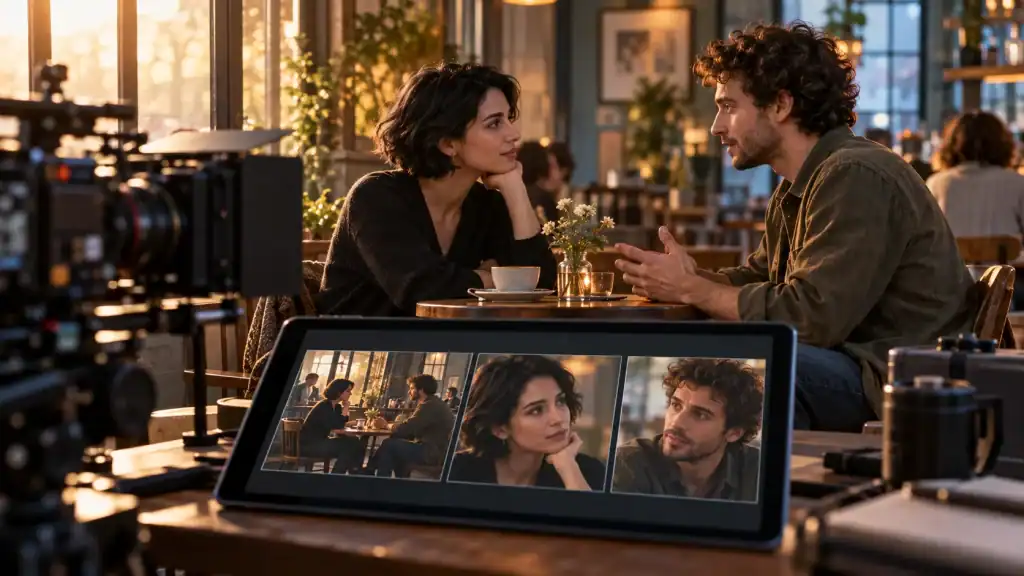
A short dialogue scene can fail even when both characters look convincing. One actor may move their mouth during the other’s line, the listener may stare blankly, or a cut may reverse where everyone is standing. A reliable Kling 4.0 scene plan assigns each beat before anyone begins generating footage.
Write a Scene With Distinct Jobs for Each Character
Assign the story objective
Begin with the dramatic objective. Character A wants an answer; Character B is hesitant to give it. Decide where each person stands, what each holds and who controls the movement. Build a small line-and-action sheet so dialogue, gesture and reaction belong to a named performer rather than an ambiguous “they.”
Direct the silent listener
The speaker should be specified for every line. The listener needs direction too: looking away, hesitating or reacting to a particular word. Those quiet moments can make the difference between an exchange and two disconnected talking-head shots.
Two-Character Dialogue Prompt Template
Use this structure for one beat at a time, naming both characters even when only one speaks.
[Character A] Appearance / position: [name, features, clothing, screen position, prop].
[Character B] Appearance / position: [name, features, clothing, screen position, prop].
[Environment] Scene layout: [location, lighting, positions of people, furniture and doorway].
[Dialogue Beat] Named speaker: [character name, exact line, gesture and approximate timing].
[Listener Reaction] Silent character: [name, gaze, expression or gesture; lips remain still].
[Camera] Position / movement: [shot size, camera side and one movement, or a static shot].
[Continuity] Keep fixed: [clothing, prop and hand, screen direction, eyeline and relevant object states].
Untested Scene Example: The Missing Key
Original fictional scene, proposed only; not a tested generation. Location: a softly lit apartment kitchen at night. Mara stands beside the sink holding an unopened envelope. Eli sits at the table, hands visible.
Mara: “You said you left the key here.” [Mara speaks; she lifts the envelope slightly. Eli remains silent and looks at it.]
Eli: “I did. Before the lights went out.” [Eli speaks; his left hand rests on the table. Mara listens without moving her lips.]
Mara: “Then why is the door open?” [Mara turns toward the hallway. Eli follows her gaze before answering.]
Eli: “I don’t know.” [Eli speaks softly. Mara stays silent and lowers the envelope.]
Performance and shot-planning example for this untested scene (approximate editorial durations; keep all cameras on the same side):
- Beat 1 — Mara speaks and raises the envelope; Eli listens, lips still. Plan: about 5 seconds; static medium two-shot; Mara holds the unopened envelope in her right hand.
- Beat 2 — Eli answers with his left hand on the table; Mara holds her gaze. Plan: about 5 seconds; static over-Mara’s-shoulder view of Eli; his left hand stays on the table and the envelope remains in Mara’s right hand.
- Beat 3 — Mara asks about the door and turns; Eli follows her gaze. Plan: about 4 seconds; medium two-shot from the established camera side, hallway on frame right; retain the envelope and Eli’s seated position.
- Beat 4 — Eli answers quietly; Mara lowers the envelope without speaking. Plan: about 3 seconds; static medium two-shot favoring Eli; the envelope remains in Mara’s right hand.
Generate these as short, reviewable beats before attempting a longer continuous scene. Keep both characters’ clothing, marks and props in the shot log.
Example Prompt for Testing
Untested planning example for Beat 1 above. These appearance and clothing details are proposed reference choices. No controlled quality benchmark was performed for this article.
Character A: Mara, with shoulder-length dark hair and a gray cardigan, stands on screen left beside the sink, holding the unopened envelope in her right hand.
Character B: Eli, with short dark hair and a blue sweater, sits on screen right at the table. Both hands are visible; his left hand rests on the tabletop.
Environment: A softly lit apartment kitchen at night, with the sink on the left, table on the right and open hallway doorway at frame right.
Dialogue beat: In an approximately 5-second shot, Mara says, “You said you left the key here.” She lifts the envelope slightly. Mara is the only speaker.
Listener reaction: Eli stays silent with his lips still, looking at the envelope as Mara lifts it.
Camera: Static medium two-shot from the established camera side, with both faces visible. Keep this beat in one shot.
Continuity: Keep their clothing and screen positions unchanged, Eli seated, the doorway open and the envelope in Mara’s right hand. Preserve Eli’s eyeline toward the envelope.
Establish Screen Direction Before Choosing Cuts
Draw a simple floor plan: Mara near the sink, Eli at the table, doorway on frame right. Choose a camera side and keep the characters’ screen positions stable. An over-the-shoulder shot of Eli should not magically move Mara across the kitchen. If a perspective switch is intentional, use an establishing shot or visible camera movement to make the geography understandable.
For continuity, note the envelope’s hand, whether Eli is seated, the door’s state and each character’s eye line. Regenerate only the affected beat when an object changes position rather than discarding every successful shot.
Review Dialogue and Listening Separately
Play the scene once with audio to check whether each line belongs to the correct speaker and whether mouth movement follows the words. Then mute the clip and inspect reactions: does the listener remain silent and responsive, or do both characters appear to speak? Confirm that a character’s face does not morph during a reverse angle and that the gesture occurs at the intended line.
If the listener mouths a line, first check speaker labels and line timing; then revise only the listener’s silence instruction for that beat. If the envelope jumps hands, compare the last accepted frame with the next shot’s reference, then revise only the prop-placement instruction. A new generation is a troubleshooting option, not a guaranteed fix.
Common Failures and First Checks
| Problem | First thing to check |
| Both characters speaking | Named speaker and silent-listener instructions |
| Prop changes hands | Continuity: prop and holding hand |
| Identity drift | Character reference for the affected shot |
| Wrong eyeline | Blocking and camera position |
| Unexpected camera cut | Simplify the camera instruction |
If producing alternate-language performances, do not assume a translated track will preserve timing. Rework line length and pauses, check pronunciation with a fluent reviewer, and inspect mouth synchronization anew. Keep the same character references and scene blocking while treating each language version as its own performance.
Distinguish Announced Capabilities From Your Actual Results
Kling AI’s official release notes describe audiovisual improvements, voice-only audio references, multilingual support and 3–30-second generation in the published full-model specifications. Controls depend on the selected mode, account and platform.
Plan the complete sequence around its dialogue beats and voice references. Produce one short exchange, review speaker attribution and reactions, and only then scale up to the rest of the film.