
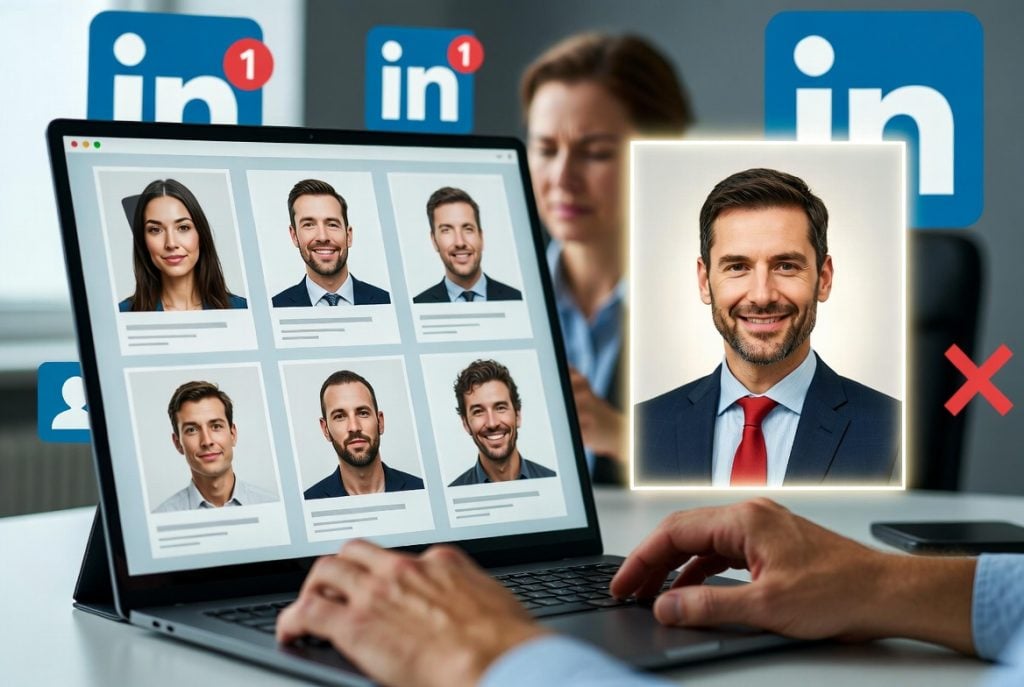
I do not open profiles to appreciate photography. I open them between stand-ups, with twenty tabs already open, and I decide in about three seconds whether a person looks real enough to trust into a screening call. That decision is brutal and mostly unconscious. A LinkedIn headshot that looked impressive as a full-frame JPEG often dies inside LinkedIn’s circular crop — forehead clipped, shoulder story gone, eyes pushed to the edge of a tiny avatar next to a job title.
I hire for a mid-size product org. Candidates blame algorithms when messages go quiet. Sometimes the quieter truth is visual: the photo that survived their desktop gallery did not survive the UI they are actually judged inside. In my testing across a busy hiring week, I started asking finalists how they picked the image. Most answered with outfit opinions. Almost none answered with crop tests. That gap is where ProfessionalHeadshot became useful as evidence, not as a pep talk — and where I stopped wasting interview slots on people whose avatar already felt like a different human.

What Three Seconds Of Hiring Attention Actually Sees
On a laptop, LinkedIn shows a small circle. On a phone, the circle is crueler. Busy backgrounds turn into noise. Off-center faces lose an ear. Soft outdoor bokeh that felt “human” in a full rectangle becomes a muddy ring. I am not grading fashion. I am checking whether the face matches the person who will join a Zoom with fluorescent office light and a slightly tired expression.
Candidates still optimize for the large preview. They pick the frame where the blazer looks expensive. Then the crop removes the blazer’s structure and leaves a forehead and a smile that no longer matches the resume’s seniority claim. One applicant’s outdoor portrait looked fine on a 27-inch monitor until I opened the same file as a phone avatar; the trees behind her head turned into speckles that fought the eyes. The mismatch is subtle. It is also sticky. After enough profiles, hiring managers learn to distrust photos that feel like a different species from the video interview.
Old Advice That Still Creates Soft Failures
Friends say “just use a DSLR portrait.” Friends also say “smile more.” Neither instruction tests the circle. A studio frame can be perfect on a website banner and wrong as an avatar. Stop arguing AI versus human photographer long enough to define acceptance criteria: if you never view the image at avatar size, you are approving the wrong artifact.
Crop-First Acceptance Beats Outfit Taste Debates
I now ask candidates — and internal transfers updating their profiles — to run a boring protocol before they publish. It takes less time than rewriting an About section, and it prevents the soft fail where a profile looks fine until someone opens it on a phone in a rideshare. The rework cost of a bad avatar is not only aesthetic: my team burned an afternoon last quarter re-screening a finalist because the photo and the Zoom person refused to reconcile, and everyone privately wondered if we had the wrong calendar invite.
| Check | How to run it | Fail signal I care about |
| Circle crop | Mask the frame to a circle at avatar size | Eyes clipped, chin floating, ears gone |
| Phone glance | View on a locked phone from arm’s length | Background noise louder than the face |
| Video match | Hold beside a recent webcam still | Face geometry feels like a cousin |
If a frame fails the circle, I do not want a debate about cinematic color. I want another frame. That is the hiring-side rule. The candidate-side tool only matters if it can produce enough framing options to survive that rule.

Why Neutral Backgrounds Win Tiny Avatars
LinkedIn-focused guidance on the headshot type page pushes clean, neutral backgrounds — white, light gray, soft gradient — because clutter collapses inside a circle. Outdoor complexity that looks lively in a portfolio becomes speckles around the jaw. When I scroll a pipeline of applicants, the quiet backgrounds let me read faces faster. Call it interface literacy if you want a label; I call it fewer false alarms in a crowded ATS queue.
Where Framing Tools Change The Failure Mode
ProfessionalHeadshot’s flow is still the public three-step path: upload 5–20 selfies, choose industry and styles, wait through generation, download a large set. Hiring managers should ignore the outfit menu until framing survives. Basic packaging calls out LinkedIn-optimized framing, and the broader system returns multiple pose angles per look — frontal plus three-quarter options — so you can pick a crop that keeps both eyes inside the circle.
I am not asking every candidate to buy a plan. I am asking them to stop treating one full-frame favorite as sacred. When someone does use the platform, the useful behavior is to generate a batch, then judge on avatar size before downloading a folder they will fall in love with for the wrong reason. Delivery in the fifteen-to-thirty-minute band is fast enough that a crop fail does not have to wreck a whole weekend.
Profile View Claims Versus Actual Crop Reality
The LinkedIn headshots page repeats a strong industry claim about professional photos earning far more profile views and connection requests. As a hiring manager I cannot audit LinkedIn’s research desk from my ATS. What I can audit is whether a candidate’s face is legible at a glance. If the photo fails crop, no view-multiplier story helps them in my queue. Use the claim as motivation to update a blurry selfie. Do not use it as a substitute for the circle test.
Why A Multi-Look Batch Helps Screening Surfaces
A batch matters because hiring is multi-surface. The same person needs a circle for LinkedIn, a rectangle for a conference bio, and sometimes a tighter crop for an internal directory. One studio pose rarely covers all three without awkward resizing. An AI professional headshot set with several looks gives candidates options to pass each surface without inventing a new personality every time. From my side of the table, consistency across surfaces reduces the “who is this?” friction before the first call. When I opened one designer’s three surfaces next to the original webcam still, two crops passed and one outdoor look had to be discarded — that single discard saved us from a confused hiring panel.
Limits Hiring Managers Should Still Name Aloud
AI polish will not fix a resume that cannot clear the role bar. It will not excuse a face that was trained on filtered selfies that no longer match the human on camera. Team pages and regulated industries may still require a human shoot for policy. Treat the tool as a way to survive UI crops and channel variety — not as a substitute for being qualified.

Use This Crop Test Or Skip The Purchase
Use a crop-first workflow if your profile is judged in circles and you keep picking full-frame favorites that look fine until the avatar collapses. Skip the purchase if your company forbids AI portraits, or if you only need one highly directed campaign image that must match an existing printed set. ProfessionalHeadshot is one path to enough framed options that the circle stops being a surprise. My screening queue does not reward surprise. It rewards a face I can recognize when the call connects.
If you update nothing else this month, update the test: circle, phone glance, webcam match. Outfit debates can wait until the face survives the UI that hiring managers actually live inside. I would rather see a plain, crop-safe face than a gorgeous full-frame that collapses into an unreadable ring beside a job title — and I will keep saying that in debriefs until candidates stop optimizing for the wrong screen.