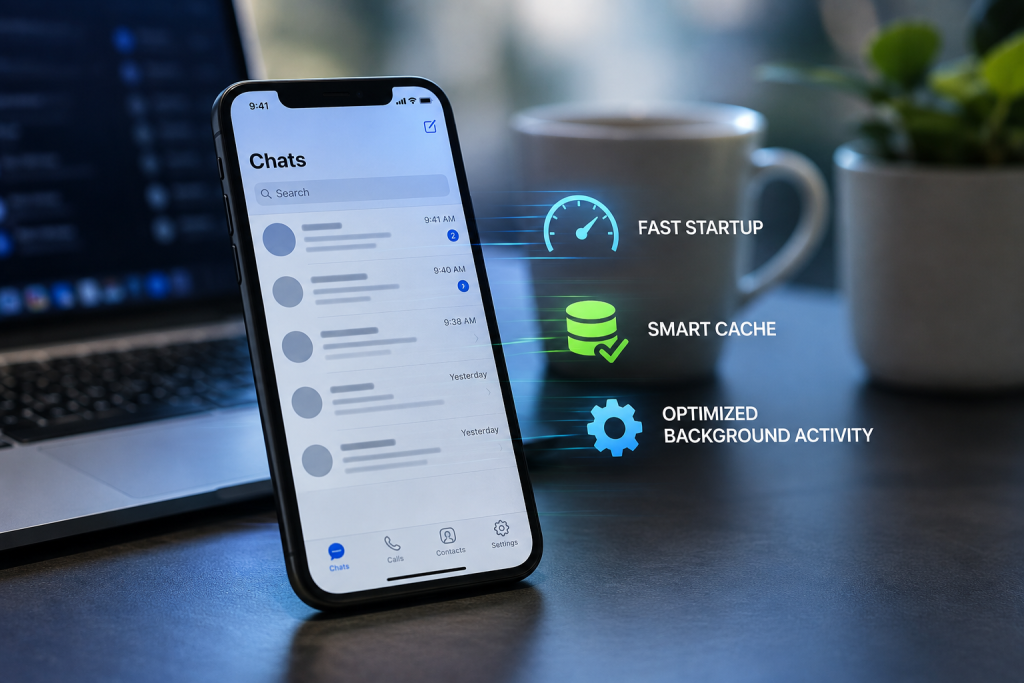
People often describe a messaging app as “fast” or “slow” without being able to explain exactly what creates that impression.
In practice, messaging app performance has several layers. Startup speed matters, but so do the time required to show a usable conversation list, the responsiveness of the interface, the way cached content is handled, and the amount of work that continues in the background.
An app may launch quickly but take several seconds to load recent conversations. Another may open more slowly but feel extremely responsive once it is running. A third may feel fast during a fresh installation but become less responsive after months of accumulated media and local data.
What users experience as “speed” is therefore a combination of perceived responsiveness and actual task latency: startup behavior, local caching, memory management, background activity, network delay, and interface prioritization all contribute.
Separating those signals makes it easier to tell whether a slowdown comes from the messaging client itself, the local device, the account’s accumulated data, or the network connection.
Speed Is Partly About Perception
Software performance is not only about how long a task technically takes.
It is also about how quickly the user receives feedback.
Imagine tapping a conversation and waiting one second before anything changes. That delay feels noticeable.
Now imagine the same conversation opening immediately while older messages continue loading in the background. The total loading time might be similar, but the second experience feels much faster.
This is one reason interface design has such a strong effect on perceived performance.
Apps can feel responsive when they:
- display immediate visual feedback;
- prioritize recently used content;
- load information progressively;
- keep common interface elements ready;
- avoid freezing the entire screen during background work.
From a user’s perspective, responsiveness often matters more than raw processing time.
The fastest-feeling apps are not necessarily completing every task instantly. They are usually better at deciding what must appear first and what can safely continue in the background.
Startup Time Creates the First Impression
The first few seconds after opening an app strongly influence how users judge its performance.
If a messaging app opens immediately and displays recent conversations, users usually consider it lightweight.
If it sits on a blank screen, shows a loading animation, or becomes temporarily unresponsive, it can feel heavy even if the rest of the experience is smooth.
Startup involves more work than simply opening a window.
A messaging application may need to:
- load account information;
- read local message data;
- initialize interface components;
- reconnect to servers;
- check notification status;
- prepare contact information;
- verify updates;
- restore recent sessions.
The app developer has to decide which of those tasks must happen before the interface becomes usable and which can continue afterward.
That decision has a major effect on perceived speed.
An app that waits for every process to finish before showing the interface can feel slower than one that displays essential information first and completes secondary work in the background.
Cold Starts and Warm Starts Are Different
Users may also notice that an app opens faster the second time.
That is because not every startup is identical.
A cold start happens when the application has been fully closed and must initialize its interface, local data, and connections again.
A warm start occurs when some processes, files, or recently used data remain available, allowing the app to return to a usable state more quickly.
Warm starts are therefore usually faster, but they should not be confused with full-launch performance.
This can create confusion when users compare application speed. Someone may report that an app opens instantly because they rarely close it completely, while another user experiences a slower startup after rebooting the device.
Neither observation is necessarily wrong.
They are simply describing different conditions.
For everyday use, both experiences matter. A good messaging application should recover efficiently from a full launch while also remaining responsive during repeated use.
Measure Speed With Repeatable Tests
A quick impression is useful, but a repeatable test produces a fairer comparison between messaging clients.
On the same device, account, and network, measure a few everyday actions:
- cold launch to a usable conversation list;
- warm reopen after the app has already been used;
- opening a recent cached chat versus a first-time media-heavy chat;
- scrolling or searching while synchronization is active;
- opening or sending a small attachment;
- idle CPU, memory, disk, and network activity after several minutes.
Run the same action more than once. A single slow launch can be caused by an update, antivirus scan, or reconnect; repeated behavior is a much stronger performance signal.
Cache Is One of the Main Reasons Apps Feel Fast
Caching is one of the main reasons modern messaging software can feel responsive.
Instead of downloading or rebuilding the same information every time, an application stores selected data locally so frequently used content can be displayed with less repeated work.
In a messaging app, cached content may include:
- profile photos;
- recent message previews;
- thumbnails;
- stickers;
- images;
- recently viewed files;
- interface resources.
When users reopen a conversation, some of this information can appear immediately because the app already has a local copy.
For example, a user testing the Potato app can open the same media-heavy conversation twice and compare the results. The second pass may display profile images, thumbnails, and recent messages more quickly because those assets are already local.
Caching reduces repeated work, but the benefit is easiest to see when the same content is accessed more than once.
It can also make an app feel more responsive on an inconsistent connection because previously accessed interface elements, thumbnails, and recent content may already be available locally.
However, caching creates its own tradeoffs.
Too Much Cached Data Can Become a Problem
Cache improves performance only when storage and retention remain manageable.
An active messaging account can accumulate a substantial amount of local data over time, especially when large groups and automatic media downloads are involved.
That data may include images, videos, voice messages, documents, thumbnails, search indexes, and temporary files. A large cache is not automatically a performance problem, but it becomes more relevant when the device is already short on free space or the app spends noticeable time maintaining local data.
The practical issue is storage pressure rather than cache size alone.
A device with plenty of free space may show no noticeable effect, while a nearly full drive leaves less room for temporary files, updates, databases, and other operating-system work.
Useful warning signs include:
- app storage growing faster than expected;
- repeated cleanup or indexing activity;
- media-heavy conversations becoming slower to open;
- backups or local sync taking longer;
- the operating system repeatedly warning about low free space.
This does not mean users should clear all cached content on a fixed schedule.
Doing that too aggressively can make the next session feel slower because frequently accessed content has to be fetched or rebuilt again.
A better approach is selective maintenance.
Review automatic downloads and app storage when local media becomes unusually large, while keeping useful cache available for routine conversations.
Background Activity Is the Invisible Side of Performance
An app does not stop working just because the main window is hidden.
Messaging software often remains active in the background because users expect immediate notifications and synchronized conversations.
Background work may include:
- checking for new messages;
- maintaining connections;
- downloading previews;
- updating contact information;
- processing notifications;
- preparing media;
- synchronizing account data.
These activities are usually necessary.
The issue is how efficiently they are managed.
If an app sits idle but continues to show sustained CPU, disk, or network activity, users may notice higher battery drain, louder cooling fans, or slower performance in other applications.
Short bursts of background work are normal. Persistent activity after synchronization has settled is the more useful signal to investigate.
On desktop systems, Task Manager can provide a quick check of whether an apparently idle messaging client is still using unusual amounts of CPU, memory, disk, or network bandwidth.
Notifications Have Their Own Performance Cost
Notifications seem simple, but they involve several layers of activity.
The app must receive or check for an event, process the information, decide whether the user should be alerted, and then display the notification.
When many active chats are involved, that work can happen repeatedly throughout the day.
For most modern devices, the computing cost of notifications is small.
However, extremely active groups can trigger repeated network, notification, and preview activity throughout the day.
Users who belong to many busy channels may improve both focus and background efficiency by muting conversations that do not require immediate attention.
The larger benefit is usually reduced interruption rather than a dramatic reduction in CPU use.
A Mature Account Can Behave Differently from a Fresh Install
A fresh installation and a mature account are not always comparable performance tests.
Over time, the local environment becomes more complex.
A mature account may contain:
- thousands of conversation records;
- years of shared files;
- many cached images;
- downloaded videos;
- large groups;
- extensive search history.
The application may therefore be working with a much larger local data set than it handled during the first week.
Well-designed software should manage that growth efficiently, but retention settings and user behavior still influence the workload.
Someone who automatically downloads every video and retains years of attachments creates a different local environment from someone who mostly exchanges text.
For a realistic comparison, test the app with the kind of account and conversation history it will actually need to handle.
A clean installation alone can make performance look better than a representative long-term workload.
Network Speed and App Speed Are Easy to Confuse
One of the most common mistakes is blaming the application when the network is actually the bottleneck.
Messaging apps depend on internet connectivity for many important tasks.
If a photo takes several seconds to appear or a large file downloads slowly, the cause may be:
- poor Wi-Fi;
- mobile network congestion;
- high latency;
- server distance;
- unstable connectivity.
These network delays are different from local interface-performance problems.
A useful diagnostic is to separate actions that depend on the internet from actions that should already be local.
If scrolling, opening menus, switching between previously loaded conversations, or navigating settings is delayed, the bottleneck is more likely to be local.
If the interface remains responsive but new messages, images, or files take a long time to arrive, the connection or remote service is more likely to be involved.
This distinction matters because replacing an app will not solve a weak internet connection.
File Previews Can Make an App Feel More Responsive
Users rarely want to open every file just to understand what it contains.
That is why messaging apps generate previews.
A document may show a filename and icon. An image may appear as a thumbnail. A link may display a title and preview image.
These features improve usability, but they also require processing.
The app may need to download metadata, generate thumbnails, or store preview information.
Efficient applications perform these tasks without interrupting the main interface.
Poorly managed previews can produce the opposite effect, especially in conversations filled with media.
Users may notice stuttering while scrolling or delays when opening media-heavy chats.
Again, the performance question is not simply whether the feature exists, but how much work it requires during normal use.
Memory Management Matters During Long Sessions
Some users keep messaging apps open for the entire day.
That creates a different performance challenge from startup speed.
An app may behave perfectly when first launched but consume more memory as conversations, previews, search results, and files are opened during a long session.
This can happen as users open:
- more conversations;
- media previews;
- large files;
- search results;
- contact lists.
Some growth is normal because applications keep useful data in memory to avoid repeating work.
The warning sign is not a single high memory number; it is sustained growth combined with worsening responsiveness or increasing pressure on other applications.
Users can sometimes detect this pattern when the client becomes sluggish after many hours but returns to normal after being restarted.
An occasional restart may clear temporary resources, but a repeatable pattern is more informative than the restart itself and can indicate inefficient session management.
Updates Can Affect Performance in Both Directions
Software updates are often associated with new features, but they can also affect speed.
An update may improve:
- startup behavior;
- memory usage;
- interface responsiveness;
- network handling;
- cache management.
At the same time, new capabilities can increase resource requirements or change caching and startup behavior.
Performance can therefore change even when the device itself remains identical.
Version-aware testing matters. Users evaluating the Potato messaging app or any other current communication client should record the build being tested, because a result from an older release may not describe the software people use today.
For fair comparisons, record the software version or build along with the test conditions instead of relying on performance reports from several years ago.
Modern messaging clients evolve continuously, so version-aware testing is more useful than treating app performance as a permanent characteristic.
What Users Can Actually Do to Keep Messaging Apps Responsive
Users cannot control every part of software performance, but they can manage several factors that commonly affect everyday responsiveness.
Keep Enough Free Storage
A nearly full drive can make many applications less predictable, especially when temporary files, updates, and local databases all need working space.
Leaving reasonable free space gives the operating system and applications more room to manage those tasks.
Review Media Downloads
Large automatic downloads can quickly increase local storage use.
Users who participate in active groups should check whether every photo and video really needs to be saved automatically.
Limit Unnecessary Startup Apps
If several programs launch at the same time, the device may feel slow immediately after login.
Only essential applications need to start automatically.
Keep Software Current
Updates can include bug fixes, compatibility changes, and performance improvements.
Use a current, supported build when comparing performance so the result reflects the software people are actually expected to run.
Restart Apps That Have Been Running for Long Periods
If an application becomes sluggish after many hours of continuous use, restarting it can release temporary resources and reset the session.
Check the Network Before Blaming the App
A quick comparison with another online service can help determine whether delays are caused by the messaging software or the connection.
Fast Software Is Usually Well-Prioritized Software
The fastest-feeling applications are not always the ones doing the least work.
They are often the ones that prioritize work intelligently and keep the user-visible path short even while secondary work continues.
They display important content quickly.
They defer secondary tasks.
They use cache without allowing it to grow uncontrollably.
They perform background synchronization without dominating device resources.
They manage memory efficiently during long sessions.
They also give users immediate feedback so the interface rarely feels frozen.
These decisions influence the experience more than any single benchmark number.
Final Thoughts
Messaging app performance is a combination of technical speed and human perception.
Startup time shapes the first impression. Cache reduces repeated work. Background activity keeps conversations synchronized but should remain quiet when the app is idle. Memory behavior changes during long sessions, and network delay can easily be mistaken for local slowness.
That is why “fast” is not one benchmark number.
It is the experience created when a client becomes usable quickly, responds immediately to common actions, manages local data efficiently, and keeps secondary work from interrupting the user.
For everyday communication, repeatable responsiveness usually matters more than a single synthetic performance result.
A messaging app feels fast when routine actions stay predictable and the software rarely gets in the way.

Ashley Rosa is a freelance writer and blogger. As writing is her passion that why she loves to write articles related to the latest trends in technology and sometimes on health-tech as well. She is crazy about chocolates. You can find her at twitter: @ashrosa2.