Face swapping used to be something you did after the moment had already happened.
You picked a photo, uploaded a video, waited for the software to process it, and then looked at the finished result. Sometimes it looked surprisingly convincing. Sometimes it was funny for all the wrong reasons. Either way, the experience was mostly about creating a file you could save, edit, or share.
Real-time AI changes that relationship.
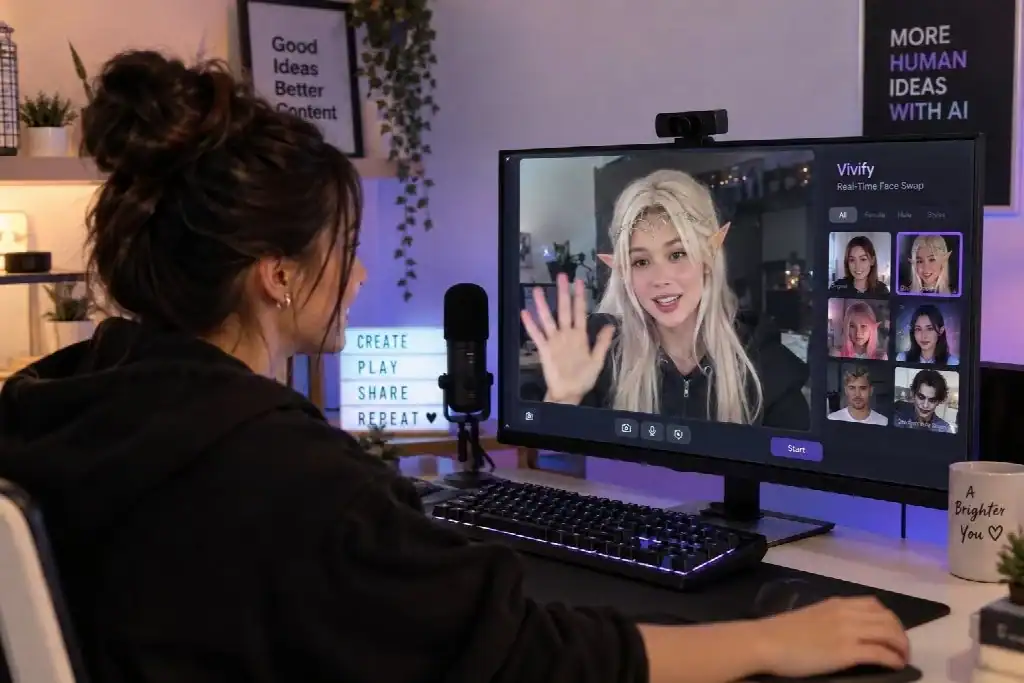
Instead of asking, “What would I look like with this face?” and waiting for an answer, a webcam can now show the transformation while you move, smile, turn your head, or react to what is happening on screen.
That makes real-time face swap feel less like traditional editing and more like an interactive digital experience.
And that difference matters more than it might seem.
From Editing a Result to Experiencing It Live
Most familiar face-swap tools are built around photos or prerecorded video.
That works well when the final image is what matters. A meme, short video, character edit, or social post does not need to react to the person creating it. The software can take its time processing the source material before delivering a result.
A live webcam is different.
The input never really stops.
Every movement creates new visual information. A person looks left, laughs, leans toward the camera, changes expression, or moves into different lighting, and the system has to keep up.
The goal is no longer just to create one convincing frame.
It is to keep the transformation working while something is happening.
That shift turns face swapping into something much closer to the filters, virtual characters, and live effects people already associate with streaming and social apps.
Why the Webcam Makes AI Feel Different
A lot of generative AI is built around waiting.
Write a prompt. Generate an image. Wait for a video. Listen to a finished song. Review the result.
There is nothing wrong with that workflow, but it creates a clear separation between the person and the AI.
You ask. The AI produces.
Live AI shortens that distance.
When a webcam transformation follows your movements, the model becomes part of a feedback loop. Move your head and the output moves with you. Change your expression and the transformed face responds immediately.
For AI enthusiasts, that immediate response is part of the appeal.
There does not always need to be a serious productivity reason to use a new technology. Trying on another face, testing a fictional look, or simply seeing how well a model handles an exaggerated expression can be interesting on its own.
It turns AI from something you request into something you can play with.
Why It Fits Creator and Streaming Culture
That interactive quality also makes real-time face swapping interesting for creators.
There is a big difference between recording a normal video and changing the face afterward versus performing while already seeing the transformed result.
The second option changes how someone can react and perform.
A creator can adjust facial expressions based on what appears on screen. A streamer can remain in character while talking to viewers. Someone making a short comedy clip can experiment with several appearances without running every recording through a separate editing process.
It starts to feel less like applying an effect in post-production and more like wearing a digital costume.
That idea fits naturally into the broader creator ecosystem, where virtual avatars, VTubers, filters, digital characters, and AI-generated visuals have already blurred the line between the person behind the camera and the character viewers see.
From Face Swap to Character Transformation
The idea is also expanding beyond simply replacing one human face with another.
Newer AI experiences increasingly move toward broader character transformation. Instead of changing one realistic face into another, a system can apply stylized, fictional, fantasy, game-inspired, or character-based appearances while still preserving the user’s live movement and expressions.
Platforms such as Vivify are already moving in this direction, where the experience is no longer limited to swapping one realistic face for another.
Traditional face swapping is mostly about identity replacement.
Character transformation is broader. The goal is not necessarily to look like another real person. It can be to look like a fictional persona, a game character, a fantasy identity, or a stylized version of yourself.
Once that happens, the technology starts to overlap with digital cosplay, avatar culture, and AI-assisted performance.
The experience becomes less about “swapping a face” and more about stepping into another visual identity.
Why This Is Different From a Full Virtual Avatar
Real-time character transformation also sits in an interesting middle ground between ordinary video and a full virtual avatar.
A complete avatar can replace almost everything about a person’s appearance. That can work well for creators building an entirely fictional identity, but it usually creates a different visual style and often requires more setup.
Face and character transformation keep more of the original video intact.
The person’s body, clothing, environment, camera angle, and movement can remain real. The AI changes one of the most noticeable parts of the image without rebuilding the entire scene.
That makes the experience feel transformative without completely separating the output from the original webcam feed.
For many casual users and creators, that balance is part of the appeal.
Browser-Based Tools Lower the Barrier
This kind of experience becomes much more approachable when it works directly in a browser.
Vivify is built around a webcam-first workflow rather than requiring users to install an AI environment, download models, or configure local inference software.
That matters because the people most likely to experiment with live AI are not necessarily the same people who want to spend hours troubleshooting drivers or setting up technical dependencies.
A browser turns the experience into something much closer to using any other web app:
allow camera access, choose an appearance, and see what happens.
That low-friction approach matters especially for entertainment technology. If something is supposed to be fun to experiment with, a complicated setup can ruin the experience before it even begins.
There is also more than one way to build around the same idea. Vivify focuses on a browser-first experience, while tools such as LiveFaceSwap AI extend the category into desktop and virtual-camera workflows.
That difference in product design matters because some users want a quick web experience, while others want live AI video to plug into the rest of their streaming or calling setup.
Real-Time Does Not Mean Perfect
The technology still has limitations.
Lighting matters. Fast head movement can be harder to track than a mostly frontal face. Network conditions can affect cloud-based processing, and different AI models may make different trade-offs between speed, stability, and visual quality.
A carefully processed photo or prerecorded video will often have advantages over something that has to update continuously on a live camera.
But perfection is not really the point.
A live system is solving a different problem.
The value comes from immediacy: being able to move, react, experiment, and see the transformation respond with you.
That is something a polished offline render cannot fully reproduce.
There Is Also a Responsibility Problem
The easier face-changing technology becomes to use, the more important consent becomes.
There is an obvious difference between changing your own appearance for a stream, joke, character experiment, or private AI demo and using another person’s identity in a way intended to deceive people.
Real-time tools make experimentation easier, but that same immediacy also means platforms need clear boundaries around impersonation, fraud, explicit content, and non-consensual use.
The technology is most interesting when it expands creative possibilities without pretending those risks do not exist.
The Webcam Is Becoming More Than a Camera
Webcams were originally simple input devices.
They captured whatever was in front of them and sent it somewhere else.
AI is starting to turn them into something more flexible.
Backgrounds can disappear. Eye contact can be corrected. Images can be enhanced. Avatars can replace people entirely. Faces can change in real time. Characters can be layered onto live human performance.
Tools like Vivify show how quickly this category is moving from simple face replacement toward broader live character transformation.
Real-time face swapping is one part of that transition, but the bigger idea is that the webcam itself is becoming an interactive AI surface.
The interesting question is no longer only what AI can generate after we give it a file.
It is what AI can do while we are still there, moving in front of the camera.
For creators, streamers, AI enthusiasts, and people who simply enjoy experimenting with new technology, that may be where some of the most entertaining uses of AI are heading next.

Sandra Larson is a writer with the personal blog at ElizabethanAuthor and an academic coach for students. Her main sphere of professional interest is the connection between AI and modern study techniques. Sandra believes that digital tools are a way to a better future in the education system.