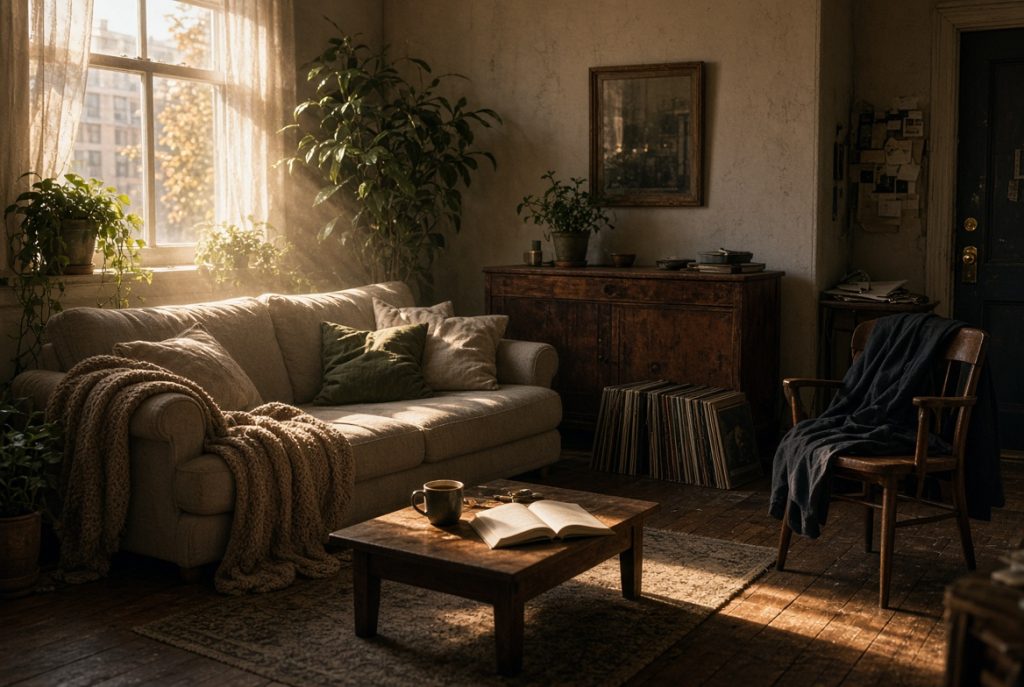
An empty workshop can look ready for a furniture catalogue or as though someone stepped out a moment ago. The difference might be a stool pulled away from the bench, a half-repaired model boat, and a curtain moving beside an open window. None of those details needs a character explaining what happened.
For digital artists and creators exploring short AI videos, this is a useful alternative to another spectacular skyline. Give the setting traces of activity. Then let one small movement suggest that the place continues to exist beyond the frame.
The challenge is restraint. Filling a room with random objects produces clutter, not necessarily a story. A convincing fictional setting needs details that belong together and a reason for the viewer to notice them.
Decide what happened five minutes ago
Before describing furniture, write one sentence about the room’s recent past. In this invented example, someone was repairing a model boat and left the window open while taking a break. That gives the scene a condition rather than just a style.
A stool away from the bench fits. A small tool beside the unfinished boat fits. Three steaming cups, scattered luggage, a flickering control panel, and a wall of mysterious symbols would introduce several competing explanations. They might suit a different story, but they make this one harder to read.
For Seedance 2.5 video creation, that recent-past sentence can become the organising idea behind a text-led or reference-guided draft. The goal is to explore how the workshop feels in motion without expecting the tool to infer a complete backstory from a few props.
There is no need to show the person who left. Their absence is part of the idea. Keeping the cast out of the frame also lets the setting carry the entire visual experiment.
Choose traces of use, not a pile of decorations
Think about three kinds of clues. A trace of routine suggests what usually happens here. An interruption suggests what stopped. A response to the environment gives the video something to show over time.
- Routine: a worn patch on the workbench beneath the model boat.
- Interruption: the stool sits slightly back, and the repair is unfinished.
- Environment: a lightweight curtain shifts beside the open window.
These clues work together because they support the same ordinary explanation. They do not require invented newspaper headlines, readable personal letters, or a screen full of fake messages. Those additions would ask the viewer to read information that the scene can communicate through objects instead.
Keep the clues large enough to matter at the intended viewing size. A tiny scratch might be useful in a close view but irrelevant in a room-wide shot. If the unfinished repair is central to the idea, give the boat a clear position and an unobstructed outline.
Not every viewer will invent the same backstory. That is fine. The goal is a plausible impression of recent activity, not a puzzle with one mandatory answer.
Let the room move without turning it into an event
The curtain provides enough motion for this scene. The boat does not need to launch itself, the tools do not need to rearrange, and the camera does not need to circle the bench. Those events would change the subject from an interrupted afternoon to a magical workshop.
A suggested prompt could say:
An original miniature-boat workshop in soft afternoon light. An unfinished wooden model boat rests clearly on a worn workbench, with one small tool beside it. A stool has been pulled back. Near an open window, a light curtain moves gently in the breeze. The room is empty and otherwise still. Fixed medium-wide view, no lettering.
This is a writing example, not a tested output. Its specificity lies in the relationship between the objects and the limited action. Adding “epic,” “dramatic,” or “hyper-detailed” would not explain the interrupted repair any better.
Start with an illustration when the room already exists
An artist may already have drawn the workshop for an original comic, short story, or personal project. In that case, describing the entire space again could be less useful than starting from the illustration. Its composition already establishes where the boat, bench, and window belong.
With the Seedance image workflow, the illustration can supply that visual starting point while the prompt describes the curtain’s movement. Inspect the resulting clip rather than assuming the drawing will remain unchanged. A bent hull or a tool that appears and disappears may distract more than the added motion contributes.
Use original artwork or material cleared for external AI processing and the intended public use, and check the platform’s upload rules separately. An original workshop is a better basis for this exercise than recreating a recognisable room from a film or borrowing a franchise’s distinctive props.
Ask what the setting suggests before explaining it
Show the clip to someone without the backstory. Ask what seems to happen in this room and whether it feels recently occupied. If they notice only an attractive curtain, the workshop’s meaningful details may need a clearer composition. If they describe a disaster, the scattered objects may be telling a stronger story than intended.
That conversation is creative feedback, not an audience-performance measurement. Use it to locate a mismatch between the intended impression and the visible scene.
If a fictional environment could be mistaken for a real place or documented event, make its illustrative role clear. Here, the model-boat workshop is simply an imagined place with an unfinished task.
Start there: a room, a recent activity, and one detail that moves. The setting does not need a speech or a spectacular transformation. Sometimes a pulled-back stool tells you more than another tower on the horizon.

Sandra Larson is a writer with the personal blog at ElizabethanAuthor and an academic coach for students. Her main sphere of professional interest is the connection between AI and modern study techniques. Sandra believes that digital tools are a way to a better future in the education system.