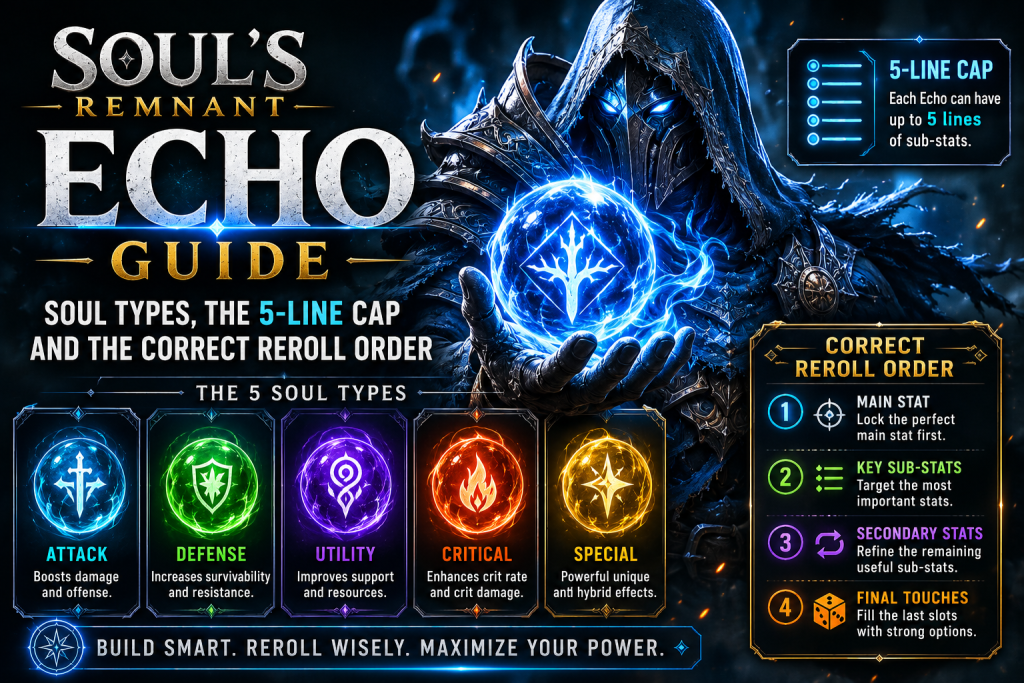
Any player who has spent some time gearing up in Soul’s Remnant, they all must have come across Souls and Echoes. These are the pieces of the game’s stat customization system that decide if our gear is average or good for our build. Echoes are the bonus stat lines that are on the top of an item’s base stats in the game, and every eligible piece of equipment can have five Echoes. Every time we use a Soul, it costs one Soul’s Remnant Soul Crystal, and if the lines for the item are not locked, we can reroll it as many times as we want. This guide will help us understand what Echoes are, how the 5-line cap works, types of Soul in the game, and the correct reroll order most experienced players use.
Echo Lines and How They Are Generated
Echoes are part of the stat customization system and are added to a piece of equipment on top of that item’s base stats. They are filled in the equipment slots to improve the stats so that we can challenge harder dungeons and trials. Echo lines are generated every time we pick up rolls, and they are between 0 and 5. What stat we get depends on the type of item; for example, a hat will have different stats than a backpack or weapon. We will never have two lines with the same stats on one item. Some items like potions can’t roll echoes at all.
We should know about some Echoe Lines by name because they are hard to understand. Item drop increases the rate at which monsters, chests, and rewards give souls and gear. The odds of having more lines on anything we loot or craft are increased by Echoes Find. Once the game finishes calculating damage, the Bonus Damage adds a big amount of damage once per skill cast, which means it increases in value if cooldowns are fast enough. Damage Balance increases the lower part of the damage range instead of the upper limit; this improves the average DPS by making their weak hits less weak. This line is considered best for DPS. And finally, the Armor Pen is an Echo Line that reduces the enemy defense but still benefits the DPS.

The Fifth Line
The fifth Echo line is visually different from the other Echo Lines, and it is not just cosmetic; we can understand this when we get a piece with all five lines filled. Some Echo effects like extra skill points or an extra buff slot on Auras, for example, can only appear in the fifth slot. This makes the fifth line very important. So, getting a full five-lined gear is more important even after having four strong lines already.
The Five-Line Cap and Why Item Level Matters
The main part of the whole system is that the maximum possible value of any Echo Line is capped by the level of the item it is used on. This one factor completely changes our thinking about rerolling.
A perfect roll with maximum value but on a low-level item is considered weaker than a roll with average stats but on a high-level endgame item, because the upper limit increases with the item level. This concept is supported by the visual stat; the item name color starts from weak and gets stronger. The item name starts from gray through green, blue, purple, and then red. The overall Echo strength increases from gray to red. Similarly, the Echo Line quality orb starts from the lowest roll to the highest roll, running from gray, green, blue, gold, to ruby.
The main point is not to hoard the Souls while waiting for the item to reach max level; the difference between the current item and the one at a few levels higher is very small, so stacking souls in advance is not necessary, but some players often buy Soul’s Remnant Soul Crystals in advance to prepare for better rerolls and get good stats that sit well with their item. Keeping two Echo lines on all the equipment should be our priority, because having strong gear early in the game helps to level up faster.

Soul Types
Souls are dropped by monsters, but low-level enemies rarely drop souls, while stronger monsters drop a different range of souls. There are different types of souls, each having different applications:
- Energetic Soul is obtained fastest. Using it on an item with less than two echo lines adds a new line until it reaches two lines, and after that it rerolls the first two lines particularly.
- Similarly, Ambitious Soul targets four lines. It’s rare and stronger, filling four lines before rerolling them.
- Transcendent Soul fills all five lines and then rerolls them with every use.
- Turbulent Soul randomizes the value of one random line; it is used when a line has a poor roll on a right stat.
- Primordial Soul, on the other hand, randomizes the selection of a stat for a chosen line, used when the stat itself is wrong.
- Chaotic Soul randomizes either one main stat or one echo line.
- Transitive Soul is the most different one. It destroys an item completely to move its echoes to a second item of the same category. The quality of the line is maintained, but the value is modified according to the new item’s level, and the gem upgrades made on the destroyed item are lost.

The Reroll Order That Actually Works
Now if we combine all these things, the reroll order that actually works is: Start with Energetic Soul to add two lines to a new piece, since it is the most found soul type in the game. If the item is good enough to invest further, then move to Ambitious Soul to add four lines to it, and then for the fifth line use the Transcendent Soul. When all the lines are added, switch the tools and use Turbulent Souls to reroll a particular line’s value when the stat is suitable but the numbers are weak, and if we want to change the stat itself, then go for Primordial Soul. After we get a line that fits the requirements, use an Eternal Soul to lock it before rerolling on another soul type. This is the best reroll order that we can use for our Echo Lines.
Conclusion
The Echo System in Soul’s Remnant is rewarding for those players who act patiently instead of only depending on luck. The better the item level, the higher the ceiling is on every line. If we work through each Soul type in order, it will give us the best reroll on all five lines.

Jennifer Woods is a farmer of words in the field of creativity. She is an experienced independent content writer with a demonstrated history of working in the writing and editing industry. She is a multi-niche content chef who loves cooking new things.