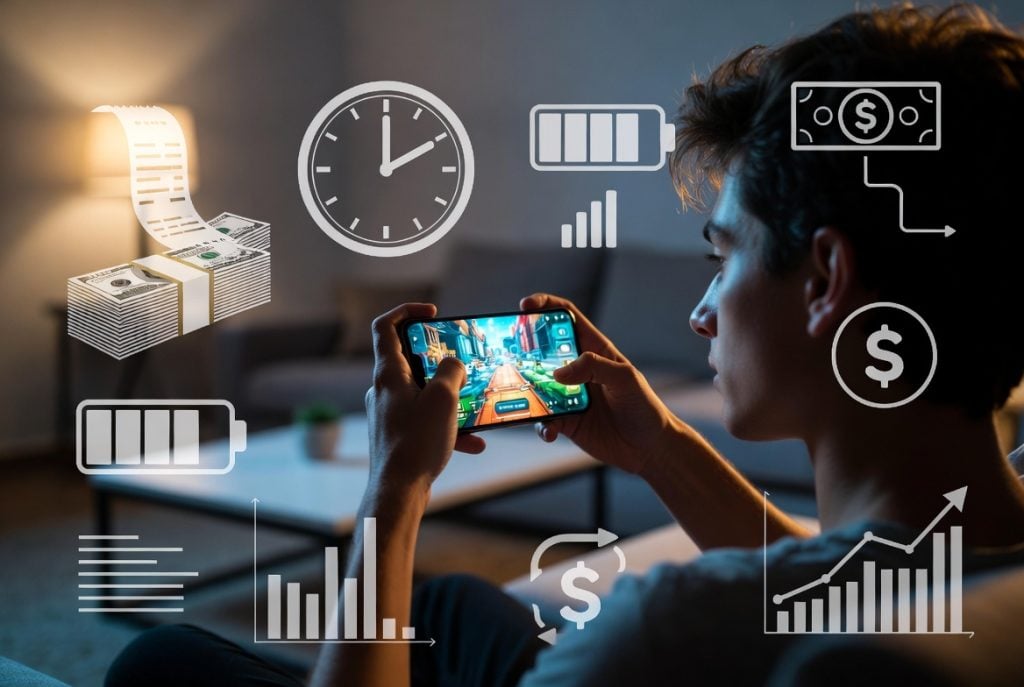
There is a running joke in gaming communities that free-to-play games are neither free nor a game after the first month. The joke lands because it is mostly true. Mobile gaming is now a $133 billion industry in 2026, making up more than half of all global gaming revenue, and the average mobile gamer spends around $94.53 per year on in-game purchases, subscriptions, and associated costs. That number surprises most players because they never sat down and added it up. The design of most free-to-play games depends on exactly that.
This is what mobile gaming actually costs in 2026 and where the money goes without most players realising it.
The Three Billing Layers Nobody Budgets For
Mobile gaming costs do not arrive in a single invoice. They arrive in three separate streams that each feel manageable individually but combine into a significant monthly number for anyone who plays regularly.
The first stream is data. The second is subscriptions. The third is in-game currency and microtransactions. Most players mentally account for one of these at most. The ones who feel blindsided by their spending are almost always the ones who forgot about the other two.
Data: The Cost That Runs Before You Open a Game
Every session of a graphics-intensive multiplayer title consumes data at a rate most players dramatically underestimate. A competitive session of a game like PUBG Mobile or Call of Duty Mobile uses between 40 and 150 megabytes per hour depending on server region, graphics settings and how many players are in the match simultaneously. That sounds manageable until you add game downloads, mandatory updates that regularly run into gigabytes, and the background data games pull while running idle on your device.
Over 3.3 billion people worldwide are expected to be active mobile gamers in 2026. That scale has pushed mobile game file sizes steadily upward as developers add higher-resolution assets, more content updates, and more frequent live events. A game you downloaded at 2GB six months ago may now occupy 6GB after updates and may require another gigabyte download before your next session just to apply the latest patch.
For anyone on a limited monthly data plan this is not an abstract concern. It is a recurring bill that gets attributed to the phone plan rather than gaming because the charges arrive from the carrier rather than the game developer. The game is technically free. The data to run it is not.
Subscriptions: The Recurring Charge That Grows Without Permission
Gaming subscription revenue is projected to reach $14.8 billion in 2026, rising from $11.5 billion in 2024. That growth is not coming from new subscribers alone. It is coming from existing subscribers whose costs quietly increased through exchange rate movement, tier upgrades, and the accumulation of multiple subscriptions that each seemed reasonable when added individually.
There are now 120 million subscribers across gaming services globally, reflecting an audience comfortable with recurring digital spend. Services including Xbox Game Pass Ultimate, PlayStation Plus, Apple Arcade and Google Play Pass all operate on monthly or annual billing cycles that auto-renew without explicit confirmation from the subscriber. Most players sign up during a promotional period, miss the point where standard pricing kicks in and continue paying the full rate indefinitely because the subscription is never urgent enough to cancel immediately.
The Millennial demographic accounts for 46% of all gaming subscriptions, driven by a desire for convenience and a library-first mentality. The convenience is real but so is the passive accumulation. A player holding two or three active gaming subscriptions alongside a music service and a video streaming platform may be spending more on recurring digital access than on any individual in-game purchase, and doing so without ever consciously deciding to allocate that much of their budget to subscriptions.
In-Game Currency: Where the Real Spending Happens
This is the layer that drives the majority of mobile gaming revenue and the one designed most deliberately to obscure what you are actually spending. In-app purchases drive 62% of all mobile gaming revenue. The mechanism that makes this possible is the conversion of real money into fictional currency before purchase.
You do not spend five dollars on a character skin. You spend 500 gems that you bought for five dollars. The extra step disconnects the purchase from its real-world cost in a way that consistently increases average spending per session. Only a minority of players regularly make in-game purchases, with roughly 5 to 10% of players accounting for most spending in free-to-play games. But within that group the spending can become significant quickly in competitive titles where in-game advantages are tied directly to purchased upgrades.
93% of Gen Alpha and 91% of Gen Z have spent money on in-game purchases during the past six months. For younger players in particular the normalisation of small regular in-game purchases means the behaviour becomes habitual before the cumulative cost becomes visible. A battle pass here, a loot box there, a limited-time skin that expires in 48 hour each decision feels isolated and each cost feels small until you look at the month in aggregate.
Gift Cards as a Spending Control Tool
One of the more practical approaches players have developed for managing in-game spending is using gift cards rather than linked payment cards for their gaming purchases. The logic is straightforward. A linked card enables impulse purchases at any moment with frictionless one-tap checkout. A gift card balance creates a natural limit that requires a conscious decision to replenish.
Players who fund their Google Play or App Store spending through gift cards report better awareness of their gaming budget because each top-up is a deliberate decision rather than a passive charge. The same principle applies to selling unwanted gift cards: a player who receives a gift card for a platform they do not use can sell a $100 Google Play Gift Card through a gift card exchange platform and redirect that value toward something they will actually use, whether that is credit on a different platform or cash for another purpose entirely.
The gift card ecosystem around gaming has matured considerably. Exchange platforms now handle the most popular gaming storefronts and process transactions quickly, which makes the option of converting an unused gift card to usable value a genuinely practical tool rather than a last resort.
What a Month of Mobile Gaming Actually Costs in 2026
The average mobile gamer spends around $94.53 per year on in-game purchases, subscriptions and associated costs in 2026. That figure represents a global average across casual and heavy players alike. For someone who plays daily, holds one or two subscriptions and participates in seasonal content events, the real number sits considerably higher.
In MMORPG titles, average spending among paying players can exceed $200 annually due to subscriptions and digital items. Competitive players in live-service games with regular content drops and battle pass cycles frequently exceed that figure in a single quarter rather than across a full year.
The point is not that mobile gaming is too expensive. It is that most players have no clear picture of what they are spending because the costs arrive through multiple channels in amounts designed to feel small individually. Data bills appear on phone statements. Subscription charges appear on bank statements. In-game purchases disappear into fictional currency before they register as real money.
Playing Smarter Without Spending Less
Understanding the three-layer cost structure of mobile gaming does not require you to spend less. It requires you to spend intentionally rather than passively. The difference is knowing what your gaming actually costs each month before you check your bank statement rather than after.
The subscription monetization model saw a 22% increase in adoption year over year in 2026. As more games build subscription components into their core progression systems the passive billing problem will only grow. Players who audit their active subscriptions quarterly, set monthly budgets for in-game currency and use gift cards to create natural spending limits are consistently the ones who enjoy mobile gaming most sustainably over time.
For a broader look at how the gaming industry is evolving its monetisation strategies in 2026, Geek Vibes Nation’s coverage of how blockchain technology is transforming online gaming is worth reading alongside this for context on where game economies are heading next.
FAQs
How much does the average mobile gamer spend in 2026?
The average mobile gamer spends around $94.53 per year on in-game purchases, ads and subscriptions in 2026. Players in competitive live-service games with active subscription plans spend considerably more, with heavy players in MMORPG titles frequently exceeding $200 annually.
What percentage of mobile gaming revenue comes from in-app purchases?
In-app purchases drive 62% of all mobile gaming revenue in 2026, while ads contribute 26% and subscriptions make up 12%. Microtransactions, including battle passes, loot boxes, in-game currency and cosmetic items represent the dominant monetization model across both casual and competitive mobile titles.
Why do mobile games use virtual currency instead of real money for purchases?
Converting real money into fictional currency before purchase disconnects the transaction from its real-world cost in a way that consistently increases average spending per session. Players spend gems, coins or diamonds rather than dollars, which reduces the psychological resistance to each individual purchase even when the cumulative spend is significant.
Are gaming subscriptions worth it for mobile players?
Gaming subscription revenue is projected at $14.8 billion in 2026, which reflects strong uptake, but individual value depends entirely on how much content within the subscription you actively use. A subscription that gives access to games you would have purchased individually pays for itself quickly. A subscription held out of habit or convenience that you rarely use is simply a recurring cost with no corresponding benefit.
How can gift cards help manage mobile gaming spending?
Using gift cards to fund gaming purchases rather than a linked payment card creates a natural spending limit because you must consciously replenish the balance rather than enabling frictionless one-tap purchases at any moment. Players who receive gift cards for platforms they do not use can sell them through exchange platforms and redirect that value toward platforms they actually use or toward other expenses entirely.

Heather Neves is working as a freelance content writer. She likes blogging on topics related to parenting, golf, and fitness, gaming . She graduated with honors from Columbia University with a dual degree in Accountancy and Creative Writing.