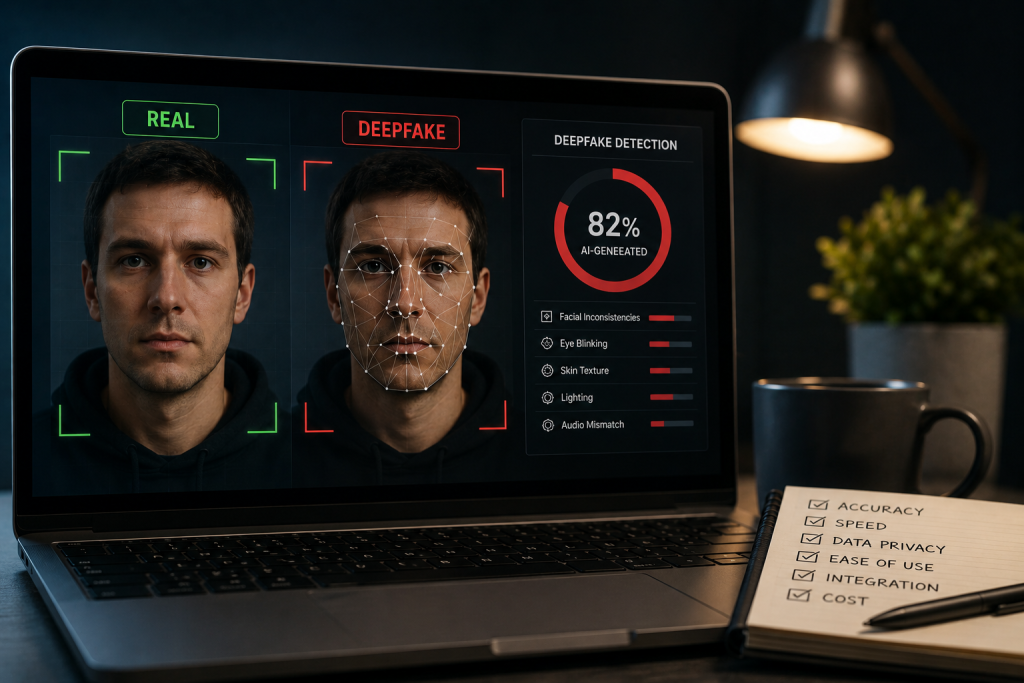
According to Gartner, 62% of organizations reported a deepfake incident in the prior 12 months, with 41% hit by a deepfake plus social engineering on an audio call. That September 2025 figure means detection is no longer a research project. It is a purchase most security teams now have to justify and get right.
The core question for a buyer is simple: which product actually catches synthetic media in the conditions you operate in, without drowning your team in false alarms? The answer comes down to five criteria you can test before you sign. Accuracy, latency, media coverage, integration and evasion resistance separate a tool that helps from one that adds noise.
Accuracy and false positives
Start with the false-positive rate, not the headline accuracy number. A detector that flags 99% of deepfakes sounds great until you learn it also flags 5% of legitimate customers, because at contact-center scale that 5% becomes thousands of blocked real people every day. Accuracy claims measured on clean lab datasets rarely survive contact with real audio recorded over cellular networks, VoIP or noisy call floors.
The stakes make precision worth paying for. Pindrop projected $44.5 billion in contact-center fraud exposure for 2025, so a detector that misses even a small share of attacks leaves real money on the table. Ask every vendor for their true-positive and false-positive rates on your own audio, not on a benchmark. Insist on a pilot with your traffic before you trust any percentage.
Real-time versus post-hoc detection
Decide up front whether you need a verdict during the call or after it. Real-time detection scores audio within the first few seconds so an agent or IVR can challenge a caller mid-session. Post-hoc detection analyzes recordings later, which is useful for forensics and fraud tracing but does nothing to stop a transfer that already cleared.
The two serve different jobs. If your loss happens live, as it did when the engineering firm Arup lost $25 million on a single deepfake video call in January 2024, only real-time scoring changes the outcome. If your goal is investigating patterns and building cases, batch analysis is enough. Many teams need both, and few products do both well, so name your priority before the demo starts.
Audio, video and cross-modal coverage
Match the tool’s coverage to your actual attack surface. A contact center faces audio deepfakes over the phone. A KYC or onboarding flow faces video and document manipulation. A conferencing tool faces both at once, since the Arup attack combined synthetic video and synthetic voice in the same meeting. Buying an audio-only detector for a video threat, or the reverse, leaves an open door.
Cross-modal attacks are the reason coverage matters. When Gartner found that 41% of organizations were hit by a deepfake combined with social engineering on an audio call, it confirmed that attackers mix channels inside one operation. A detector that only inspects one media type sees half the attack. Map your real workflows and buy for the channels fraudsters actually use against you.
Integration and workflow fit
A detector only helps if it fits where decisions get made. Check how the product delivers a verdict: an API that returns a score in milliseconds, a plugin for your contact-center platform or a dashboard your analysts already use. A tool that forces agents to switch screens mid-call, or that cannot feed its score into your existing fraud rules, will be ignored no matter how accurate it is.
This is where evaluating the best deepfake tool means looking past the model and at the plumbing. Ask about supported telephony and video stacks, average API response time under load, data-residency options and how the score plugs into your case-management or authentication flow. The best model with poor integration loses to a good model that lands cleanly inside your existing process.
Evasion resistance and update cadence
Treat evasion resistance as the criterion that decides long-term value. Generative models improve constantly, so a detector trained on last year’s deepfakes degrades against this year’s. Ask how often the vendor retrains, how they source fresh synthetic samples and how the tool handles adversarial tricks like added background noise, compression or slowed playback designed to fool classifiers.
The threat curve is steep. Reporting tied to Pindrop noted a 680% year-over-year rise in deepfake activity in 2024, so any detector that is not updated on a fast cycle falls behind within months. Push vendors on their update frequency, their process for handling novel generation techniques and whether their pricing includes model refreshes or charges extra for them. A static detector is a depreciating asset.
Frequently asked questions
Is a higher accuracy score always better?
No. A high accuracy number means little without the matching false-positive rate. A detector that catches nearly every deepfake but also blocks legitimate customers creates its own losses through abandoned transactions and support costs. Evaluate precision and recall together on your own traffic, and weigh the cost of a missed attack against the cost of a wrongly blocked real user.
Do I need real-time detection or is post-call analysis enough?
It depends on where your loss occurs. If fraud completes during a live call or session, you need real-time scoring to intervene before money moves. If you mainly need to investigate incidents and build cases, post-hoc analysis works. Given that the Arup attack cost $25 million in a single live meeting, most high-value workflows benefit from real-time capability.
How do I test a detector before buying?
Run a pilot on your own audio and video, not the vendor’s benchmark. Feed it a mix of genuine traffic and known synthetic samples, then measure true positives, false positives and latency under production load. Any vendor confident in their product will support a proof of concept with your data. Treat reluctance to pilot as a warning sign.
Will a detector I buy today still work next year?
Only if it is updated frequently. Deepfake generation improved sharply, with a 680% year-over-year rise in activity during 2024, so detectors lose ground fast without retraining. Confirm the vendor’s update cadence and whether refreshes are included in your contract. A tool without a clear update commitment will lose accuracy within months.

Caroline is doing her graduation in IT from the University of South California but keens to work as a freelance blogger. She loves to write on the latest information about IoT, technology, and business. She has innovative ideas and shares her experience with her readers.